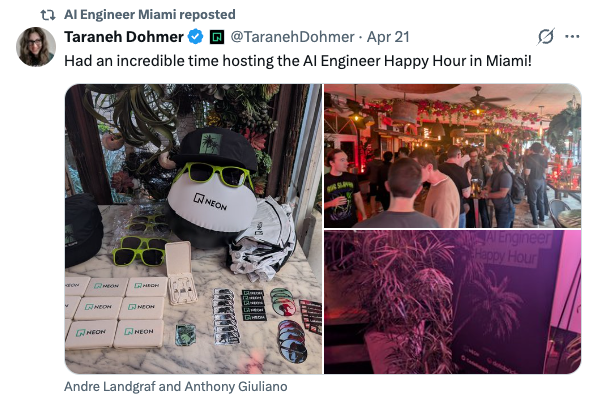
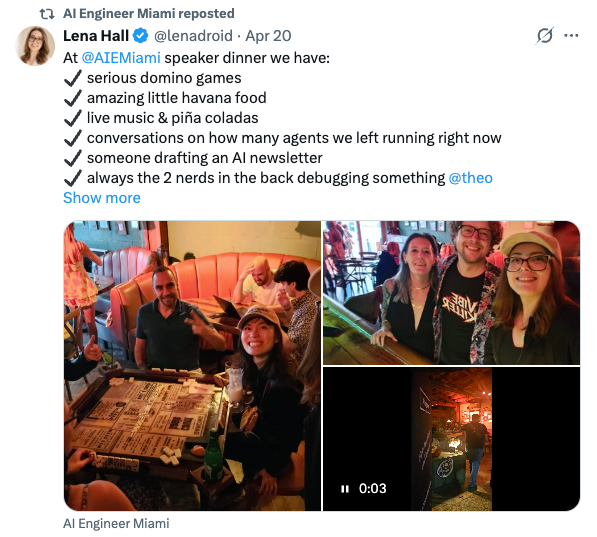
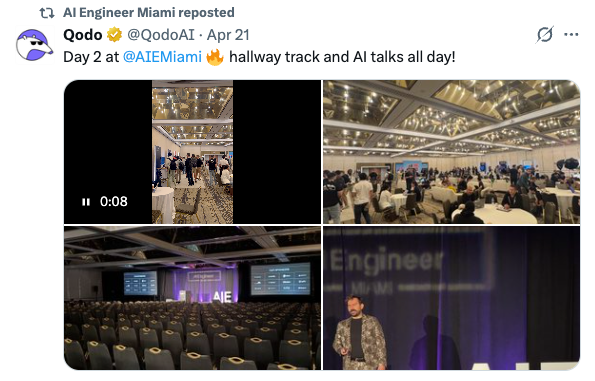
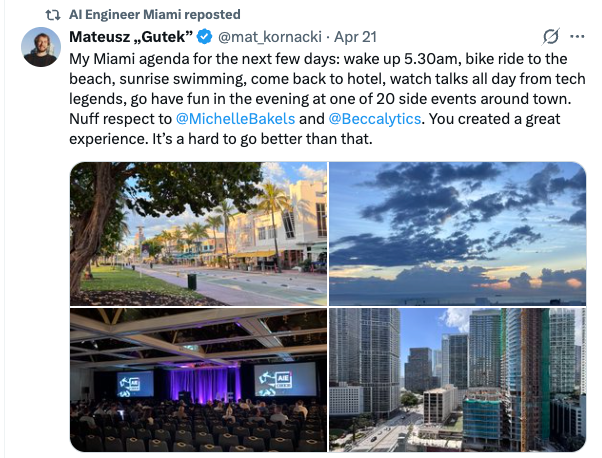
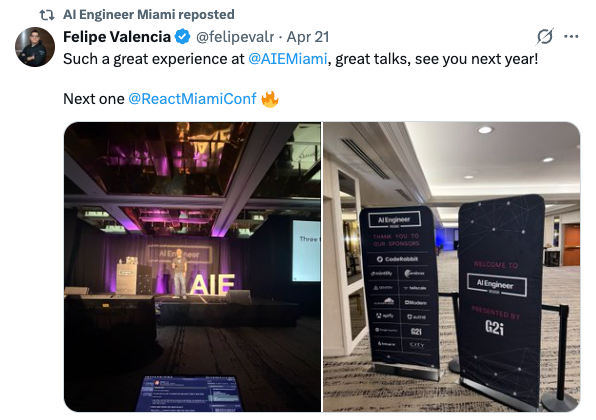
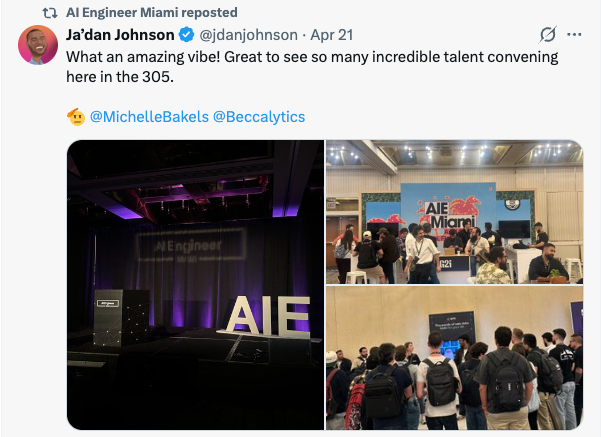
Join 500+ AI engineers, CTOs, and VPs of AI in Miami to connect, learn, and build the future of AI engineering.
Part of Frontier Tech Week. Organized by the creators of React Miami.
DOWNTOWN MIAMI
APRIL 20 - 21, 2026
Bringing the global AI engineering movement to South Florida for the first time
A technical conference & expo gathering 500+ engineers, VPs of AI, founders, and CEOs building the future of AI
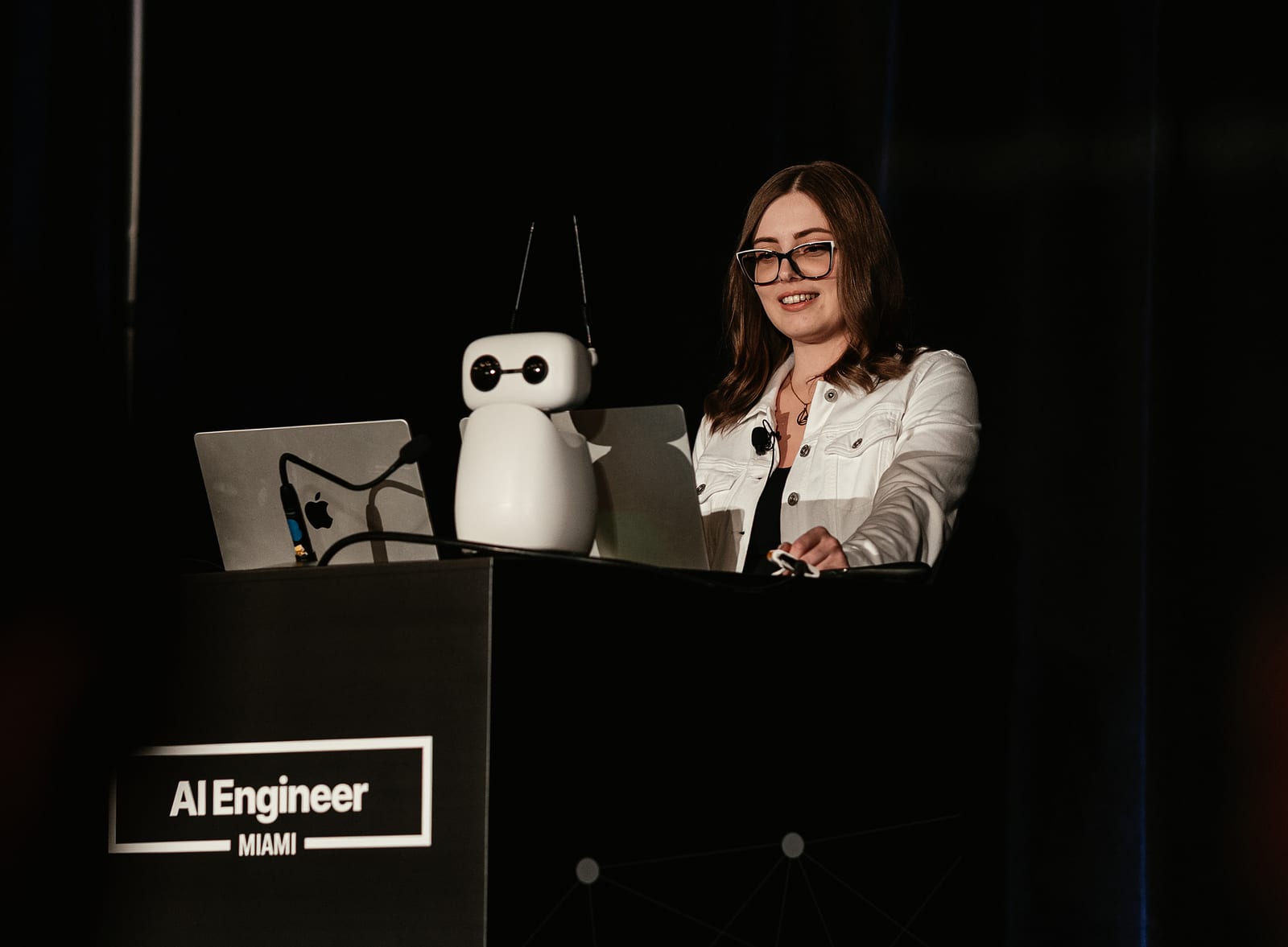
No theoretical promissory hoopla. Just engineers and founders on the cutting edge of AI Engineering, sharing their knowledge.
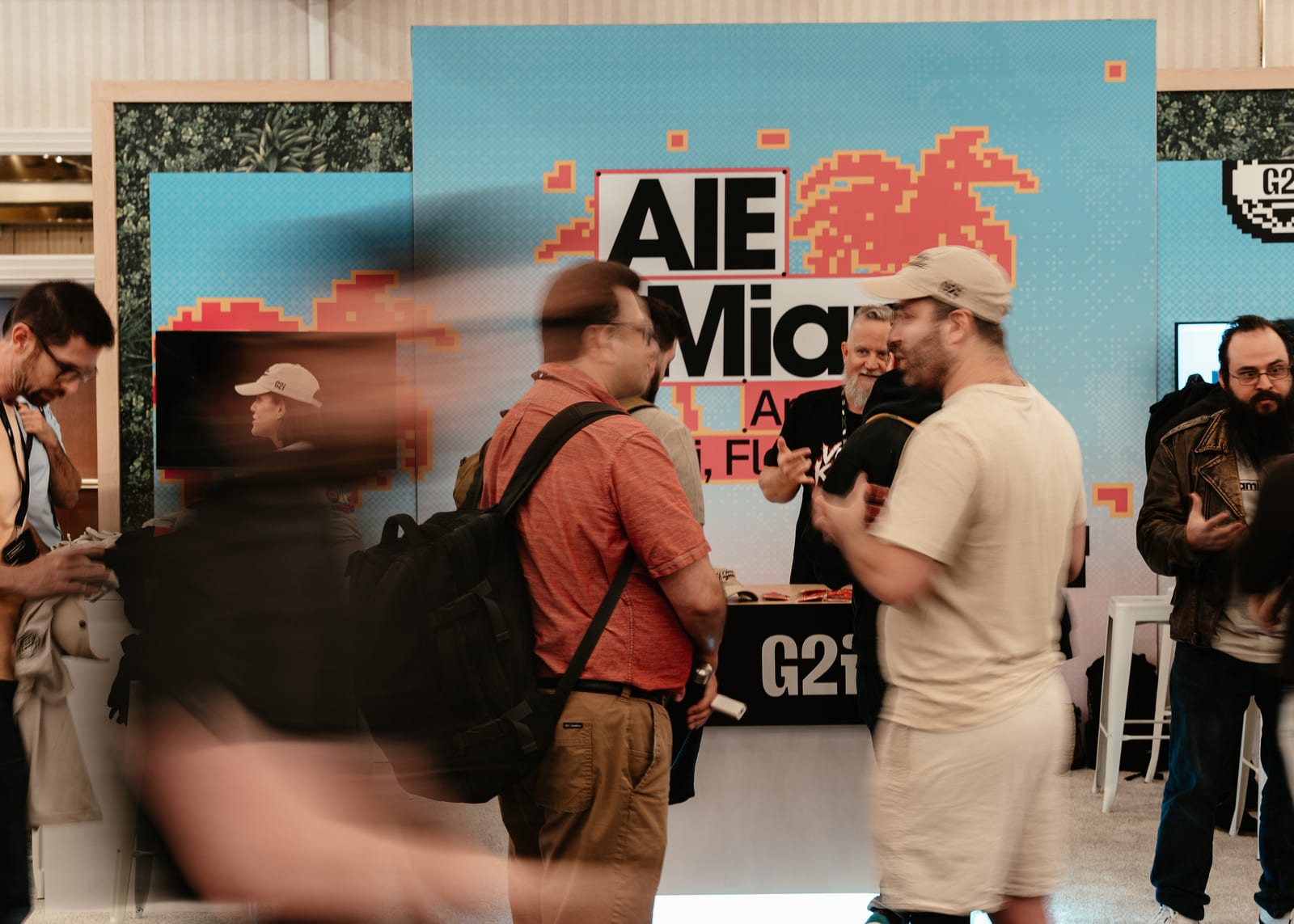
AI Engineering moves fast. Meet the engineers & founders behind the companies who are innovating at the edge of what's possible.
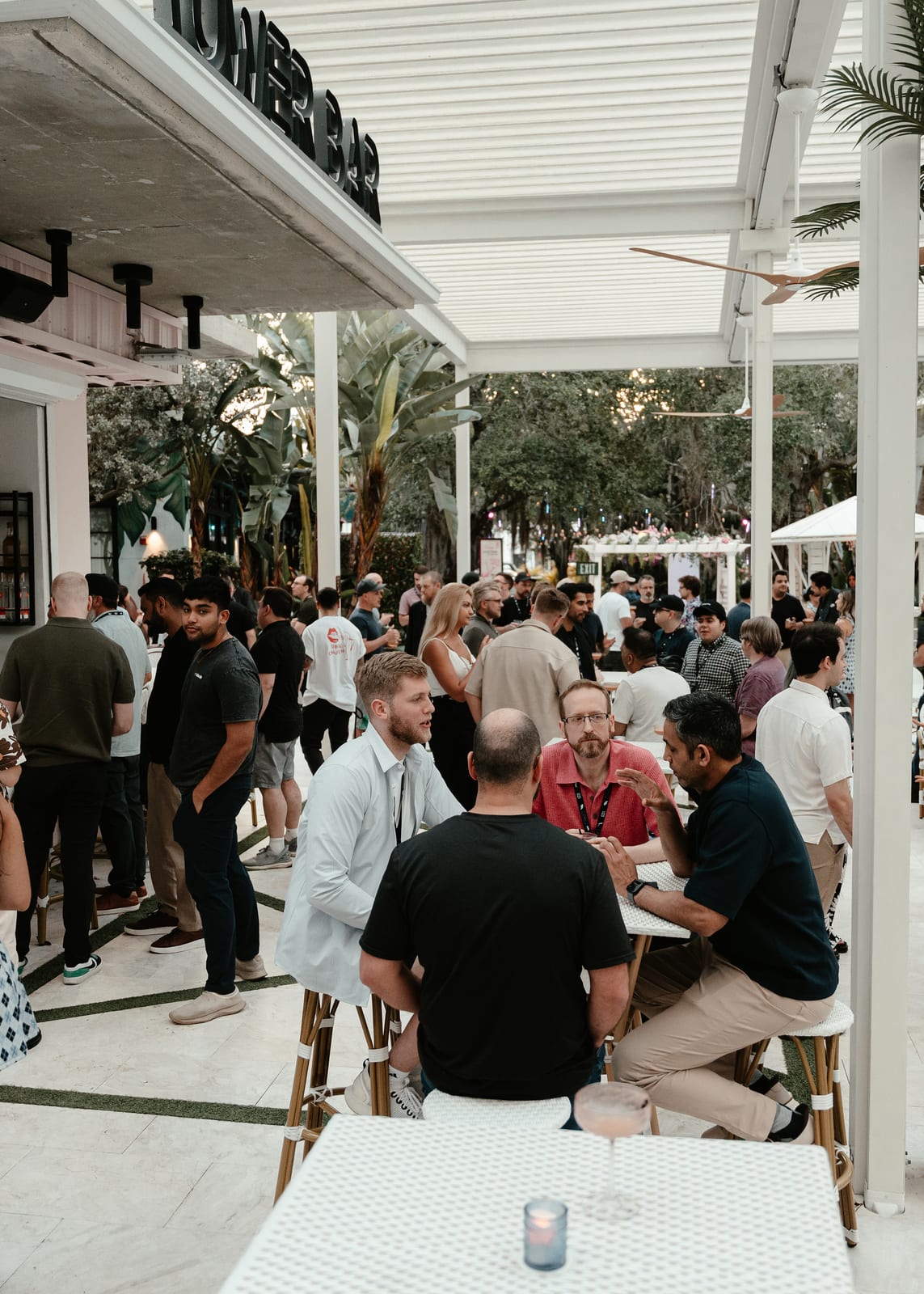
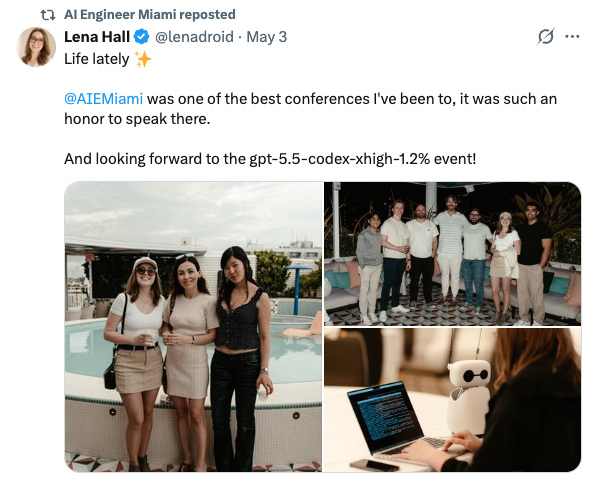
Connect with 500+ AI engineers, founders, and industry leaders. Build meaningful relationships that extend beyond the conference.
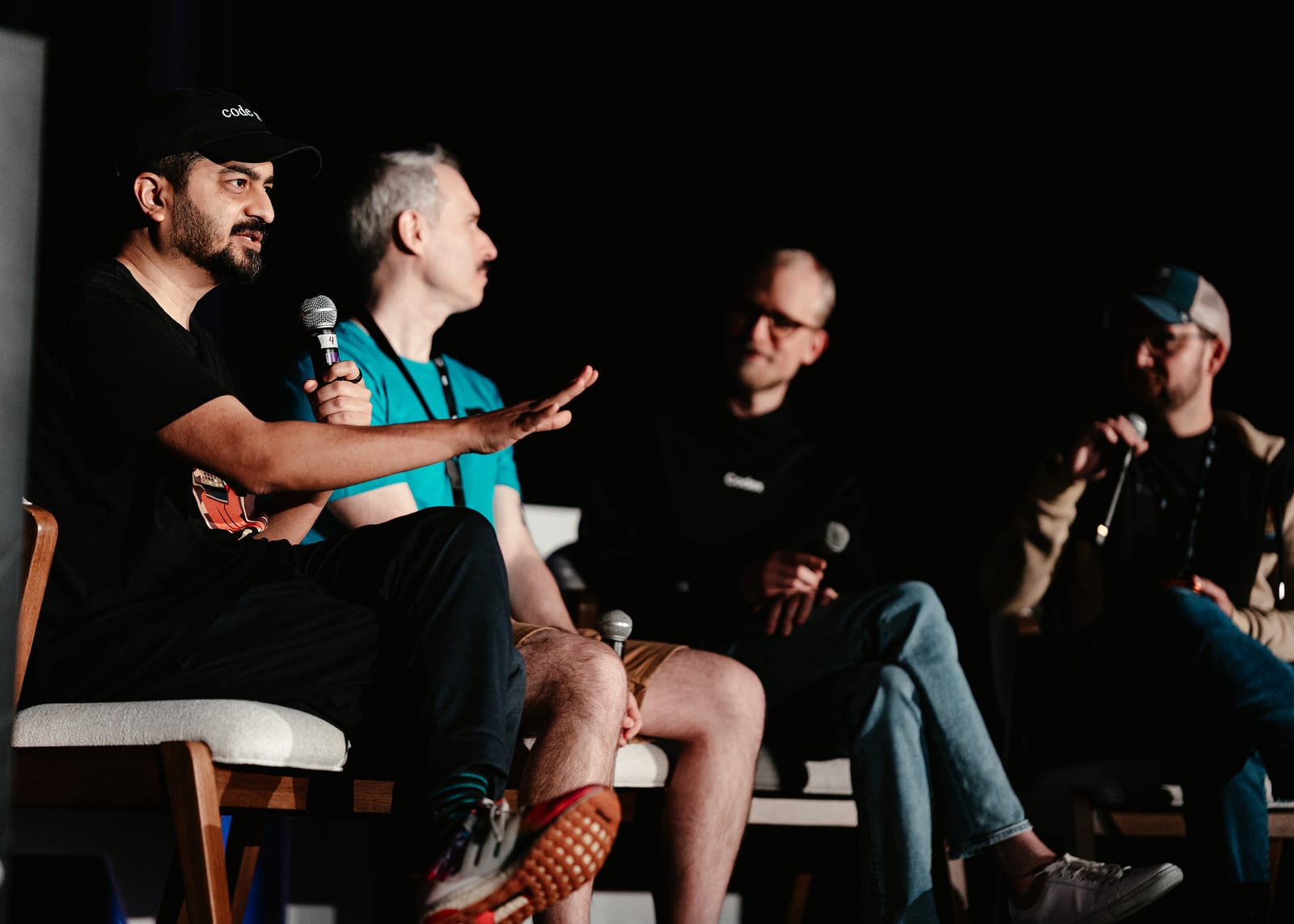
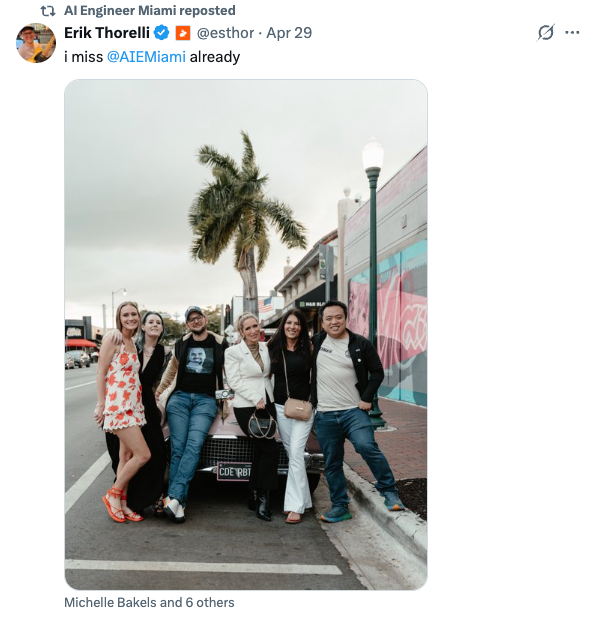
The hallway track is buzzing with AI Engineers & founders. Every conversation you have is ensure to educate & inspire.
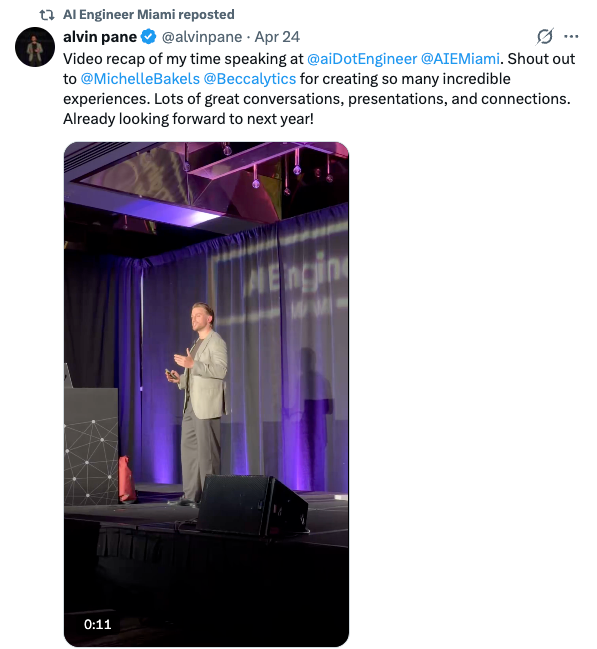
World-class speakers from leading AI companies sharing insights on the future of AI Engineering.

OpenCode • Co-Founder

Kent C. Dodds Tech LLC • Software Engineer and Educator

Google DeepMind • Product Manager Google AI Studio
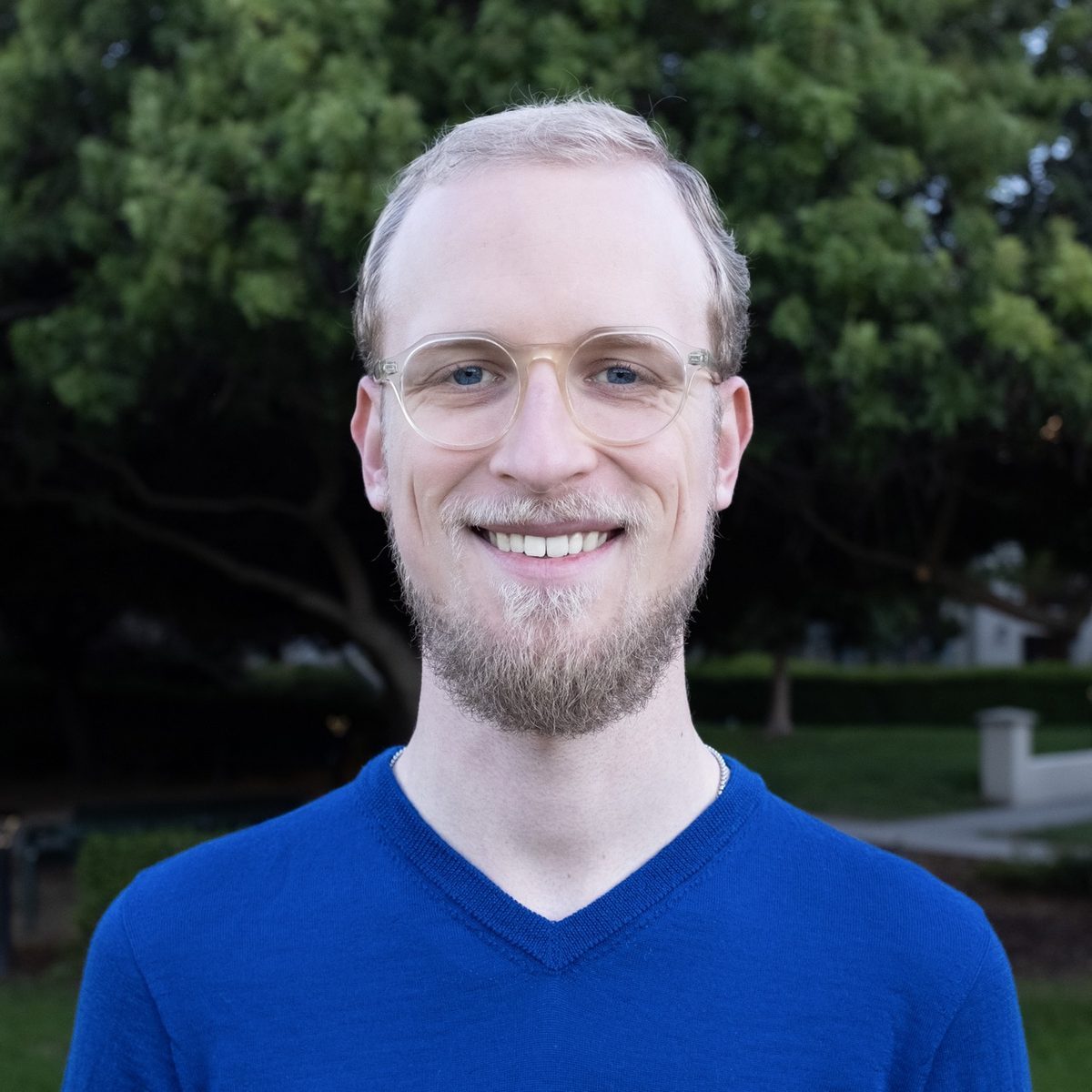
OpenAI • ChatGPT Apps

Cloudflare • VP of Product

Baseten • Head of Developer Relations

HumanLayer • CEO and Co-Founder

Agentuity • Founder

G2i • Engineering Manager

OutRival • Engineering Lead

Pinterest • Sr. Software Engineer

Mux • Sr. Community Engineering Lead

Cerebras • Head of DevX

Latent Patterns • Founder

Together AI • Director of Developer Experience

Arize AI • AI Engineer / Head of Devrel

CallStack • Senior AI System Engineer

Akamai • Senior Director of Developer Relations

Qodo • AI Principal Developer Advocate

OpenRouter • Founding Engineer

Modem • Founder

Google DeepMind • GenMedia Developer Advocate

CodeRabbit • Head of DX

Neo4j • Senior Developer Advocate

Morph LLM • Founder

Cursor • Software Engineer

G2i • CEO and Founder

OpenCode • Head of Business

T3 • Theo's Manager
8:00 AM
9:00 AM
9:10 AM
9:15 AM
9:40 AM
No Vibes Allowed is the second most-watched talk of the 2025 AI engineer code summit, and in the top five most-watched AI Engineer talks of all time. From it, you know I'm a big fan of Research / Plan / Implement. For the last 6 months, we've been working with large orgs (hundreds or thousands of engineers) to adopt advanced context engineering techniques for coding agents. We learned a ton of things we got wrong, and are here to share some lessons trying to scale these techniques to large teams working on a broad variety of complex codebases with hundreds of repos spanning platform, product, DevOps, and more. We'll talk about the shortcomings of previous approaches, and how we're now breaking down research and planning into more discrete steps, using control flow instead of prompting for managing workflows, and unique perspectives on "what is PR slop, where does it come from, and how to combat it", and a whole lot more.
10:05 AM
As coding agents become part of the development workflow, great developer experience is no longer just about features, speed, or abstraction—it is about taste. What should feel seamless, what should stay explicit, and how do you build tools at the right level of abstraction so that agents can use them well immediately? This panel will explore what good taste in developer experience looks like in the age of agents: the judgment to create developer experiences that are intuitive, legible, and trustworthy for humans and agents alike.
10:30 AM
11:00 AM
Many engineers have already adopted terminal-based coding agents. This talk is about the next step: moving those workflows off your laptop and onto remote machines. I’ll show why I like running coding agents over SSH: remote machines stay up 24/7, don’t compete with local resources, make persistent sessions easier, and create a better environment for long-running or multi-agent work. We’ll cover remote machine choices, tmux workflows, CLI agent options, terminal-friendly browsing and screenshot tools, TUI development, editors, and review workflows. If you already use coding agents in the terminal, this talk is about how to make that setup more durable, scalable, and agent-native.
11:25 AM
Static benchmarks tell only part of the story. At OpenRouter, we observe a different reality—one shaped by billions of real-world requests, rapidly evolving models, and agents operating in production. In this talk, we’ll explore how the shift toward agent-driven workflows is redefining how we evaluate model performance. We’ll look at data from across the stack to understand trends like exploding token usage, longer context windows, and the rise of tool-calling systems. Along the way, we’ll highlight what actually matters in practice: reliability, cost, and the ability for models to take meaningful actions. Beyond benchmarks, you’ll see how real-world usage reveals the true capabilities—and limitations—of modern AI systems.
11:50 AM
AI is a force multiplier that turns weak standards into architectural chaos. As code review becomes the ultimate bottleneck, engineering teams must bridge the gap between human intuition and machine output. This talk introduces a holistic framework for designing quality-driven systems around AI coding. We'll explore how to codify development best practices into machine-readable guardrails. We'll walk through how to leverage context engineering at scale to ensure your AI code tools respect your system’s design, preserving long-term maintainability without sacrificing the speed of the AI era. Attendees will learn how to embed code quality into the SDLC from AI-generated output. They will leave with a practical methodology for encoding best practices into their workflow, where developers already operate (CLI, IDE, and Git).
12:15 PM
1:40 PM
The cost of software development has fallen to $10.42 an hour—less than minimum wage. A burger flipper at Macca's earns more. What does it mean to be a software developer when everyone in the world can develop software? Tools like Cursor have commoditised the knowledge and skill of software development, enabling non-developers to build and ship. In this talk, Geoffrey Huntley shares a cold, stark view of how AI is reshaping the unit economics of business. Drawing on a year of game theory around Ralph Loops, and conversations with venture capitalists in Australia, South Korea and San Francisco, he explores the K-shaped divergence: model-first companies operating as lean apex predators versus incumbents struggling through people transformation.
2:05 PM
Four-bit quantization has a bad reputation for destroying model quality. While it’s true that post-training quantization in 4-bit integer formats makes models noticeably worse, new microscaling data formats like MXFP4 and NVFP4 deliver on the promise of fast low-precision inference without meaningful quality loss. This talk introduces these data formats along with a shift from quantization as a binary decision to quantization as a granular process with model-level considerations (quantization across weights, activations, KV cache, attention) and layer-level considerations (quantization of input, output, and hidden layers) to help you preserve quality while accessing improved performance and cost characteristics from low-precision inference.
2:30 PM
Unlock the product potential of Google’s latest generative media models in this focused deep dive. Move beyond the hype and discover how to extract tangible user value from cutting-edge models like Veo, Nano Banana, and Lyria.
2:55 PM
Most AI agents never make it past the experiment phase, especially when they touch sensitive data and regulated workflows. At Pinterest, we built Agent Snowy, a LangGraph‑based agent that automates routine Snowflake data warehouse operational requests end‑to‑end, designed to cut median resolution time from hours down to minutes for supported flows. The agent takes requests from Slack and Jira ticket intake through to generating auditable SQL and GitHub PRs, all without direct write access to production. This talk will walk through how we wired LLMs, the Model Context Protocol (MCP), and existing CI/CD pipelines together, and the concrete guardrails we put in place to keep the system secure and compliant. Attendees will leave with a practical blueprint for turning their own routine operational tickets into safe, auditable agent workflows—without handing the keys to production over to an LLM.
3:20 PM
3:50 PM
Most AI assistants are still just chats with tool access. This talk shows a different approach: using MCP as a personal runtime. I'll walk through how Kody uses `search`, `execute`, and `open_generated_ui` to discover capabilities, run sandboxed workflows, manage and use memory, keep secrets out of prompts, and turn generated interfaces into reusable software. The goal isn't a better model. It's making AI assistants portable, secure, and actually useful across MCP hosts. In this talk, you'll learn that with the right primitives, you can create a highly capable assistant without paying an extra cent for inference.
4:15 PM
Here's some napkin math: 100 million US knowledge workers, 15% concurrency, one agent each. That's 15 million simultaneous sessions. Now give each person three agents. Now do the rest of the world. Containers can't touch this. So let's talk about things agents actually need: a way to get their own compute instantly without dragging along an entire OS, and the ability to just write code when tool-calling gets awkward (which is often). Dynamic Workers give you an isolated execution environments that materialize in milliseconds and vanish when they're done. We'll talk all the details how it works, what it looks like in practice, and what's next.
4:40 PM
BAML, Vercel's AI SDK, the Pi Agent SDK, and the Opencode SDK. Which one should you build with?
Venue

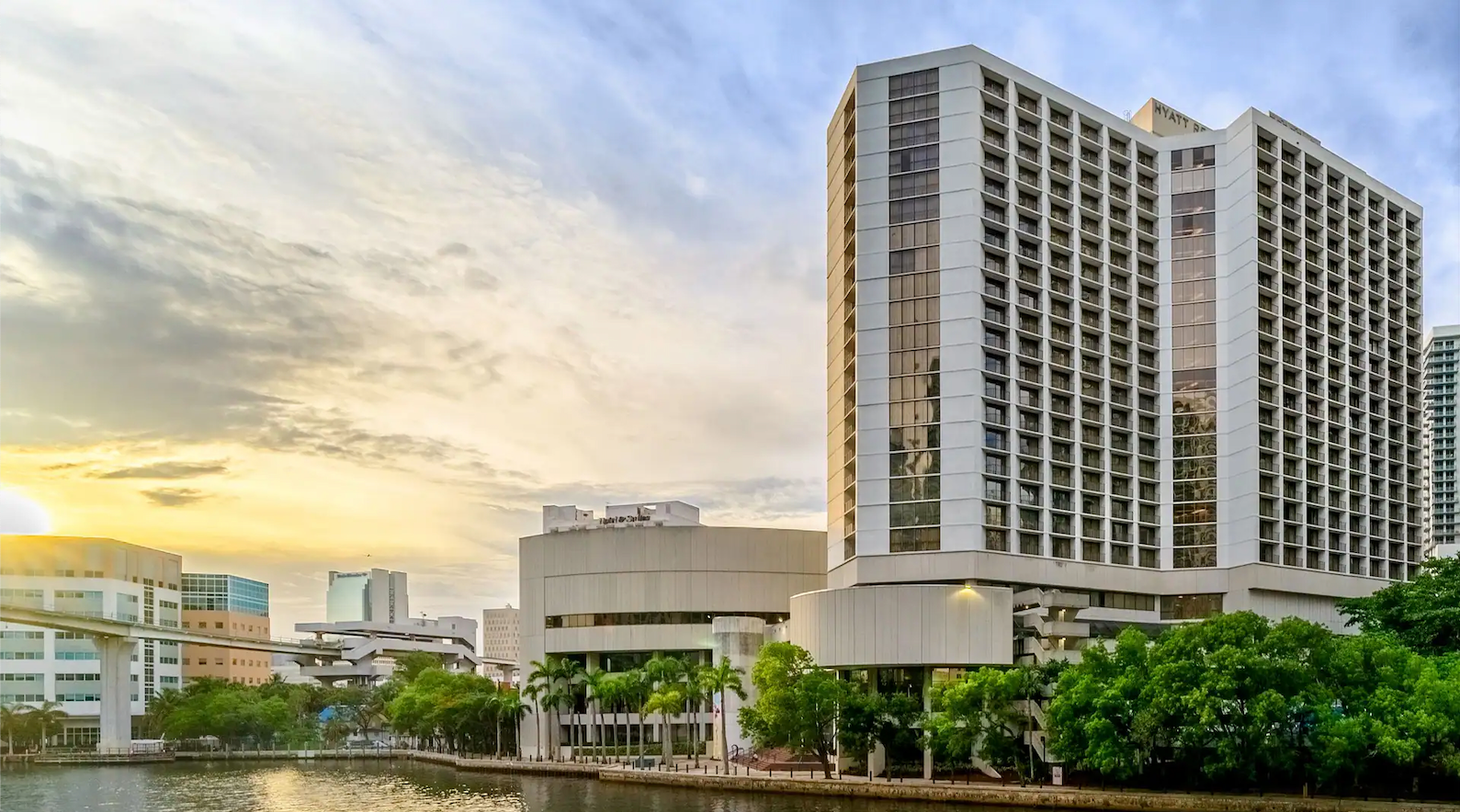
Hyatt Regency Miami is a waterfront urban retreat at the center of downtown, offering panoramic river and skyline views alongside modern rooms and thoughtful amenities. Connected to the city's Metromover and moments from Brickell, Wynwood, and the beaches, it places guests at the crossroads of business, culture, and leisure. As Miami emerges as a global hub for technology and AI innovation, the hotel serves as a meeting point for the AI engineering community in our most dynamic district.
Available Now
Join 500+ AI engineers, CTOs, and VPs of AI in Miami to connect, learn, and build the future of AI engineering.
Date
Apr 20-21
2026
Location
Downtown
Miami, FL
Attendees
500+
AI Engineers
Format
Talks
Expo & Networking