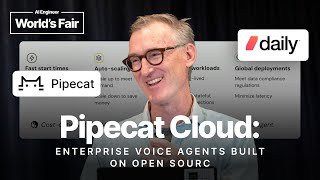
The New Primitives: Building AI-Native Software
Kwindla Kramer · Kwindla Hultman Kramer
AI Engineer World's Fair 2026 · 21:14

Realtime audio, video, and voice AI infrastructure
Daily builds infrastructure for developers to add realtime audio, video, and AI conversations to applications. Its Video SDKs support web, mobile, desktop, and server applications, with recording, live streaming, and transcription capabilities. Pipecat, its open-source framework, lets engineers build voice and multimodal agents using interchangeable models, data stores, and network transports. Pipecat Cloud provides managed deployment and scaling for these agents, supporting uses such as patient intake, scheduling reminders, and automated interviews; the same agent code can also be self-hosted.
Daily was co-founded by Doug Brunton, Nina Kuruvilla, and Kwindla Hultman Kramer, its CEO. Its WebRTC SDKs share a Rust core, allowing updates across platforms through a common implementation. Pipecat grew out of Daily’s internal tooling for conversational AI. Another engineering contribution, Smart Turn, detects when someone has finished speaking directly from raw audio, helping voice agents time their responses. Daily makes the model’s weights, datasets, and training code public.
Pipecat Cloud became generally available in 2026 after a nine-month beta in which Daily reported more than 1,000 teams building and scaling voice agents. Daily’s historical financing includes a $40 million Series B led by Renegade Partners in 2021, bringing funding across three rounds over the preceding 18 months to $60 million.
Kwindla Kramer · Kwindla Hultman Kramer
AI Engineer World's Fair 2026 · 21:14
Mark Backman · Aleix Conchillo Flaqué
AI Engineer World's Fair 2025 · 1:09:41
Kwindla Kramer · Shrestha Basu Mallick
AI Engineer World's Fair 2025 · 21:43
AI Engineer World's Fair 2025 · 26:46
AI Engineer World's Fair 2025 · 18:46
Sean DuBois · Kwindla Hultman Kramer
AI Engineer World's Fair 2025 · 16:30
AI Engineer World's Fair 2024 · 20:38
Affiliations reflect their AIE appearances, not necessarily current employment.