Compression at the Edge
Chris Alexiuk · Daniel Han · Asma Beevi · Merve Noyan · Parth Sareen
AI Engineer World's Fair 2026 · 46:01

AI development platform and open-source tooling
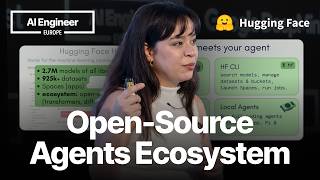
Hugging Face builds tools and infrastructure for researchers, developers and enterprises to share and use machine learning. The Hugging Face Hub hosts models and datasets, while Spaces lets developers publish interactive AI applications. Inference Providers offers model access through a unified API; Inference Endpoints provides managed deployment. Paid team and enterprise services add access controls, security and support. Its 2025 acquisition of Pollen Robotics extended its LeRobot software work into hardware, including Reachy 2 robots for research, education and embodied AI experiments.
Founded in 2016 by CEO Clément Delangue, Julien Chaumond and Thomas Wolf, the company began with a consumer chatbot before pivoting to open-source machine learning infrastructure in 2019. Its Transformers library brings pretrained models and model architectures together under a unified API, helping developers reuse implementations across tasks. Another engineering contribution, Safetensors, stores model weights as numerical data rather than executable Python pickle content and supports memory-mapped loading.
In its summer 2026 analysis, the company reported 2.96 million public model repositories, one million datasets and 1.44 million Spaces. Its reported annualized revenue run rate reached $150 million in August 2026. A 2023 financing raised $235 million at a $4.5 billion post-money valuation. On August 26, 2026, Nvidia reportedly agreed to acquire Hugging Face for $12.9 billion; neither company had confirmed the agreement in that report.
Chris Alexiuk · Daniel Han · Asma Beevi · Merve Noyan · Parth Sareen
AI Engineer World's Fair 2026 · 46:01
AI Engineer World's Fair 2026 · 20:37
AI Engineer World's Fair 2026 · 21:39
AI Engineer World's Fair 2026 · 19:13
AI Engineer World's Fair 2026 · 17:28
AI Engineer Europe 2026 · 21:16
AI Engineer Europe 2026 · 19:11
Affiliations reflect their AIE appearances, not necessarily current employment.