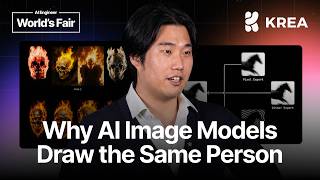
Infra behind Krea 2 - How to train and serve at scale
AI Engineer World's Fair 2026 · 16:55

AI creative tools and image foundation models
Krea builds AI tools for creating and editing images, video and 3D assets. Its workspace brings together more than 50 models, custom model training and enhancement tools for creative teams in advertising, architecture, fashion and film. Krea Nodes lets users connect generation, enhancement and style transfer into reusable workflows, while enterprise controls manage model access and spending. Krea also acquired Wand and released Krea iPad, combining native brushes with real-time AI.
Founded in 2022 by CEO Victor Perez and CTO Diego Rodriguez, Krea grew from their work on interfaces for artistic interaction with AI. Its own Krea 2 foundation-model family focuses on creative exploration. A prompt expander turns sparse descriptions into richer visual directions; a style-reference system lets users control and mix reference-image aesthetics while limiting the transfer of their subject matter. Krea released open weights for its Raw and Turbo variants in 2026.
Krea reported over 20 million users in April 2025. In April 2025, the company reported $83 million in cumulative funding. That financing included a $47 million Series B led by Bain Capital Ventures, at an approximately $500 million reported post-money valuation.
AI Engineer World's Fair 2026 · 16:55
AI Engineer World's Fair 2026 · 21:46
AI Engineer World's Fair 2025 · 16:28
Diego Rodriguez · Eugene Cheah · Jonas Bauer · Shijia Liao · David Vorick · Alex Atallah
AI Engineer World's Fair 2025 · 22:16
Affiliations reflect their AIE appearances, not necessarily current employment.