
Application monitoring and AI debugging
Sentry
Sentry builds application monitoring software that helps developers diagnose failures and improve code performance. Its platform connects errors, logs, session replays, traces, profiles and metrics, letting teams investigate slow requests and failed interactions with the surrounding application context. Seer, its AI debugging agent and code reviewer, uses production telemetry and code history to explain failures, generate patches and identify potential regressions before changes ship. Integrations with GitHub, Slack, Jira and Linear bring that context into developers’ existing workflows.
Founded by David Cramer and Chris Jennings, Sentry grew from an open-source project for handling application errors. Milin Desai joined as CEO in 2020 and continues to lead the company. Its engineering includes Snuba, a service built on ClickHouse that ingests data from Kafka and provides a query optimizer and data model for searching and aggregating telemetry. Originally replacing a combination of Postgres and Redis for error analysis, Snuba now supports much of Sentry’s time-series functionality.
In 2026, Sentry reported use by 200,000 organizations across 146 countries. Its 2022 $90 million Series E brought total funding to $217 million at a valuation above $3 billion. Sentry acquired code coverage provider Codecov in 2022; Harness acquired Codecov from Sentry in June 2026, moving that business to a separate owner.
5 talks
Newest first

The Great Loops Debate — Dex Horthy, Geoff Huntley, Ian Livingstone, Greg Pstrucha, moderated by Allie Howe
◆Allie Howe · Dex Horthy · Geoffrey Huntley · Ian Livingstone · Greg Pstrucha
AI Engineer World's Fair 2026 · 1:00:16
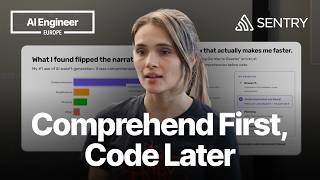
Comprehend First, Code Later: The AI Skill I Rely On Daily
AI Engineer Europe 2026 · 17:05


4 speakers at AIE
Affiliations reflect their AIE appearances, not necessarily current employment.

Company sources · checked 2026-08-28
- Application Performance Monitoring & Error Tracking Software | Sentry
- About Sentry | Sentry
- Application Monitoring, Dev Tips & Engineering | Sentry Blog
- Harness Acquires Codecov from Sentry to Strengthen Software Delivery Governance in the AI Era
- Report: Sentry Business Breakdown & Founding Story | Contrary Research
- Snuba documentation — Features
- Sentry Raises $90 Million in Series E Funding to Expand and Drive Adoption of Developer-first Application Monitoring