Harish Gaggar develops shared infrastructure for data work and enterprise AI agents. His work at Intuit Credit Karma spans Kubernetes-based analyst workspaces and agent platforms that provision identity, persistent state, tool access, and operational records together. His distinctive contribution is to make these capabilities part of a reusable platform, so each team does not have to assemble them around every new application.
From data workspaces to agent platforms
Harish’s background spans more than two decades of enterprise infrastructure. In an interview on AI platform engineering, he describes roughly ten years at Credit Karma and responsibilities that developed from provisioning Google Kubernetes Engine clusters toward platforms for building, deploying, and operating agents. That progression extends the platform’s responsibilities beyond compute: agents also need permission to use tools, state that survives individual requests, and records of what they did.
His work with Coder at Credit Karma shows the earlier foundation. Analysts and data scientists needed environments for workloads that exceeded their laptops’ resources, with different languages, dependencies, and hardware requirements. Harish selected Coder, and he and the administration team built reusable Terraform templates and scanned container images. Workspaces ran on Kubernetes, while workload identity gave them access to authorized Google Cloud resources without embedding service-account keys in containers. The team made obtaining an appropriate environment a repeatable provisioning process.
Making agent infrastructure reusable
Harish’s MCP Server Gateway is an open-source reference implementation for connecting agents to internal systems, particularly on restricted networks. It combines a gateway, example Artifactory, GitHub, and Google Drive servers, and a LangGraph agent. Its design calls for per-user OAuth authentication on tool calls and continuous audit logging, making the user’s identity and the record of access part of the route to a tool. His introduction to the gateway presents it as a reference that teams can adapt to their own infrastructure.
The stack also includes persistent conversation checkpoints, per-query tracking, sensitive-input filtering, and context optimization. In Paving the Road to Production, Harish explains how these supporting capabilities fit into an enterprise deployment path: registration leads through local development, container builds, review, security scanning, and Kubernetes deployment. A centralized MCP gateway handles authentication and routing, while traces and metrics expose failures, latency, and access behavior. Within the agent workflow, policy checks and human approval govern sensitive actions.
These mechanisms have distinct limits. Tracking model use, tool calls, costs, and evaluation fields makes execution inspectable; those records alone do not establish answer quality. Similarly, filtering sensitive inputs before they reach models, memory, or traces is a control whose detection and redaction need evaluation, rather than a guarantee against disclosure.
Context budgets must preserve task success
Harish’s context-engineering experiments began with an analytics agent repeatedly sending information it had already used. Asking individual teams to manage that history proved difficult to sustain, so he moved context management into a shared layer beneath agents. The layer selects relevant material, reranks it for the current step, removes duplicates, and compresses what remains.
The experiments exposed a consequential tradeoff: a fixed trimming budget reduced token consumption while worsening Gemini’s task success. Harish argues that context budgets must account for both the task and the model, with answer quality measured alongside token savings. This qualification matters when interpreting large reductions: the production talk demonstrates about a 90% token reduction for one query, but supplies neither a paired answer-quality study nor measured business ROI for that example.
His Task-Aware Budget Forecaster extends the work in two complementary directions: estimating token consumption before execution and trimming messages during the agent loop through a ContextOptimizer. The repository separates its synthetic forecasting benchmark from its production case-study data, preserving the distinction between forecasting experiments and observed context-optimization results.
Outside engineering, Harish serves on the board of the eVidya Scholar Education Foundation, which supports rural education through digital classrooms, learning materials, and educational technology.
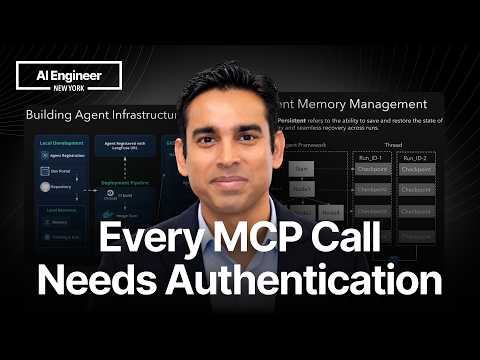
Harish Gaggar walks through an enterprise agent platform at Intuit Credit Karma, from registration and authenticated tool access to checkpoints, evaluation records, sensitive-input filtering and context optimization.
A paved path should create supporting resources as well as code: workload identity, memory storage, tracking tables and secret management need to be ready when the agent deploys.
The demonstrated optimizer reduced one query from 24,000 to 2,400 tokens. That establishes a token reduction for the example, without establishing preserved answer quality or business ROI.

 ▶ Watch ↗