Hrishi Olickel is the co-founder and CEO of Southbridge AI, building agents that reconcile fragmented organizational data while preserving its relationships and context. His work connects practical experience in maritime operations with methods for multi-step retrieval, task-specific evaluation, and agent workflows that can be inspected and resumed after failure.
From security research to maritime software
Hrishi grew up in Kerala and moved to Singapore on a scholarship at fifteen; he considers Singapore home. His early engineering work included signal processing, microcontrollers, and research at Yale-NUS. In 2016, he was one of five authors of the research behind Oyente, a symbolic-execution tool for finding potential vulnerabilities in Ethereum smart contracts. The project examined how seemingly valid programs could become exploitable through the behavior of the distributed system running them.
He subsequently spent five years as co-founder and CTO of Greywing, developing software for ship routing, fuel, flights, and crew operations. When pandemic restrictions stranded seafarers, the team redirected its work toward crew changes. Hrishi left Greywing in 2024.
His 2022 essay on button syndrome examined a problem within Greywing’s own product: every added control served a real need, yet the growing interface made those capabilities harder to discover and use. The team moved toward search and suggestions, partly because unsuccessful searches could reveal needs that ordinary click analytics missed. Hrishi also acknowledged the tradeoff: search could conceal functionality and encourage expectations the software could not meet.
Greywing’s SeaGPT gave him a setting for applying language models to these operational workflows. In his account of its architecture, he advocated smaller, specialized prompts connected through structured interfaces. One component identified the user’s intent, another collected missing information, and others selected or executed actions. This let the team test components separately, replace them without rewriting the whole system, and reserve expensive models for harder work.
Transforming data without losing its meaning
With Minu Choi, Hrishi founded Southbridge in 2025. His founding essay connected the company’s work to years spent cleaning and reconciling shipping and insurance data. Its ambition extends beyond extracting fields from documents: preserve relationships, infer rules implicit in a dataset, and connect information across formats without discarding the context that makes it meaningful.
His just-in-time ontology approach makes that position concrete. A customer means something different to billing, support, and compliance, so a universal schema can erase distinctions needed for a particular decision. Hrishi proposes building the transformation when the question is known, taking account of the source, storage constraints, intended decision, and model assumptions, then preserving the context and evidence for reuse.
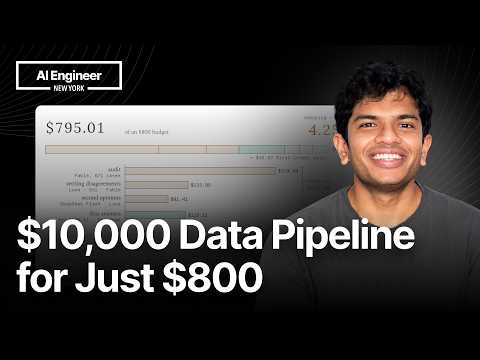
An Ohio campaign-finance entity-resolution project illustrates how he separates models that design a pipeline, models that perform individual jobs, and models that optimize the resulting system. Definitions and held-out cases determine what counts as a correct match; comparing model families can direct review toward disagreements. Agreement alone is insufficient, however. Hrishi describes a pipeline that stripped minus signs from loan amounts, turning a net $784,000 into $5.3 million of debt while multiple models agreed on the wrong result. Shared assumptions can survive cross-model checking.
This gives his optimization argument a practical limit: establish a baseline with small pilots, bound the budget, define how the system should fail, and retain independently checked segments that can be inspected and reverted. Cost and speed improvements need to preserve the evidence behind the answers.
Retrieval, evaluation, and room to recover
Hrishi’s projects explore several ways to make model-driven work easier to examine and improve:
WalkingRAG: His multi-turn retrieval method lets a model use what it has already found to decide where to look next. It extracts partial facts, identifies references or missing information, retrieves again, and retains intermediate results. The initial question therefore need not contain enough information to locate every relevant passage. Those intermediate facts also give users something to inspect and potentially correct before the final answer.
Task-specific evaluation: His writing on evals starts with defining a useful measurement before choosing a platform. For entity extraction, he recommends checking individual extracted entities rather than asking a judge model to assign one broad score to an entire output. Smaller checks make failures easier to locate and reduce the complexity demanded of each judge. He cautions that generic labels such as factuality can disguise a scorer’s lack of context about the actual task.
Antibrittle Agents: In his work on agent reliability, Hrishi challenges the expectation that a successful run must consist entirely of successful steps. Difficult work involves experiments, false starts, and revisions; forcing it into a predetermined sequence can make an agent fragile. He argues for assessing behavior over a longer interval and allowing exploration within defined limits. He also questions indiscriminate parallelism: coordinating agents can consume the time and context it was supposed to save.
Hankweave: Southbridge’s team developed and open-sourced this runtime for long-running agents. Execution budgets, event monitoring, checkpoints, and rollbacks allow an hours-long job to be investigated and resumed after failure. Its deliberately single-threaded execution makes what happened easier to follow, at the cost of concurrent activity. Writing a workflow requires more preparation in exchange for easier maintenance afterward.
Hrishi has also explored a different execution model through Rakis, his experimental browser-based inference network. Participating nodes run local models and compare results through an embedding-based consensus mechanism. He presents it as an educational experiment, with behavior under load still an open question.
The shift from SeaGPT’s specialized prompt components to longer agent loops changes the unit Hrishi asks engineers to assess. A component can be tested in isolation; an exploratory workflow also needs a way to retain useful work, investigate mistakes, and recover without restarting everything. His later work allows more experimentation while making the resulting execution easier to inspect and repair.
Hrishi Olickel explains how decision-specific definitions, checked pipeline segments and bounded experiments let models reduce transformation costs—and why several models can still agree on the same wrong answer.
Build transformations around the decision: source observations, storage limits and intended use determine which distinctions matter.
Definitions can change results without changing models: specifying sufficient household evidence corrected confident negative answers in the Ohio development work.
Cross-model disagreement can focus review, but shared assumptions can produce unanimous errors. Preserve domain-specific checks for categories, dates and sign conventions.

 ▶ Watch ↗