Mark Lummus builds developer tools and leads software products, with work ranging from cross-platform applications to payment SDK guidance for coding agents. At PayPal, he has led developer-tools product work addressing a concrete problem in AI-assisted development: an agent can generate plausible integration code using outdated SDK methods and examples.
From programming to product delivery
Mark began programming on an Apple II at his high school in Griffin, Georgia. After learning BASIC, he tried to reproduce the music in Lemonade Stand, but his version ran too slowly. Inspecting the game's source led him into machine code. In 1987, while studying computer science at Georgia Tech, he received a programming job offer from student entrepreneur Doug Armstrong, whose product-design business operated at the university's Advanced Technology Development Center. His account of those early experiences traces the beginning of a career spanning embedded, desktop, mobile, and web software.
His consulting work combined development with technology leadership. At Repair Dog, he served as interim CTO and drove the launch of an iPhone application for restaurant equipment repairs. At Domino Solutions, his interim CTO work included selecting and integrating business-intelligence capabilities into marketing software. His mobile portfolio also includes applications for collectors, artists, retail auditors, and sports teams.
At GoDeep Mobile, the platform choice determined whether the team could meet its deadline. Football coaches needed a tablet application for grading player performance, but the company could not assume they would use iPads, Android devices, or Windows Surface tablets. Building three native applications would miss the football-season deadline. Mark chose a responsive web application, built an Ember.js proof of concept, designed the architecture, and hired contract developers to implement it. The team released the first version for the fall 2015 season.
Mark's writing on requirements and releases examines a related delivery problem: completing development tasks without releasing a product. He describes joining a project that had spent nine months working through user stories without a release. For a young product, he favors organizing work around a few initiatives, estimating broadly, and adding detail as work approaches a sprint. He also recognizes that an established product may warrant more rigorous advance planning. The choice depends on the product's circumstances rather than a single planning method applied everywhere.
Giving coding agents usable information
PayPal's Context Plugin with APIMatic illustrates the developer-tools work Mark has led. Through the Model Context Protocol (MCP), coding agents can retrieve current, version-aware SDK methods, types, examples, and integration guidance. This gives an agent information specific to the SDK it is using, reducing its dependence on obsolete patterns learned from older tutorials. The plugin is a collaborative product; Mark's contribution is product leadership, not sole implementation.
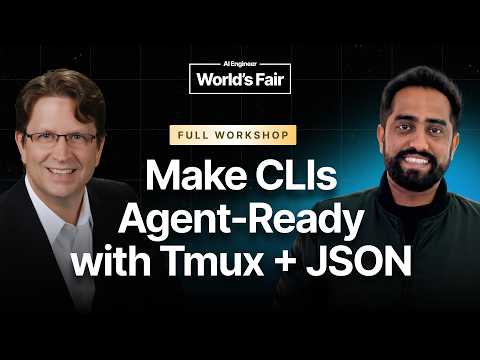
In Burn Your Flags: Interactive CLIs for Agents, Mark and PayPal colleague Navinkumar Patil examine another mismatch between coding agents and existing developer tools. A human can see a terminal question and select an option with arrow keys, while an agent may encounter a redraw loop and silently lose the interface state. Adding command-line flags works when inputs are independent and the path is known in advance. It becomes awkward when later choices depend on earlier answers or live API responses.
Their workshop uses Barista 9000, a coffee-ordering CLI, to explore how agents can navigate those decisions. Navinkumar introduces tmux for sending keys and capturing terminal state, structured JSON through IPC side channels, and context injection to expose options and constraints. Mark encourages participants to try less expensive models rather than relying on maximum reasoning. Audience solutions using deterministic parsers and very low response latency also raise a question about the competition itself: whether its scores reward the agent interaction the exercise was intended to explore. The workshop develops a specific design position: keep the CLI predictable and give the agent access to the choices and state it needs to proceed.
Mark Lummus and Navinkumar Patil use a coffee-ordering workshop to explain how agents lose terminal state, how structured interfaces can preserve interactive guidance, and why a fast benchmark result can reward something different from the intended task.
An interactive CLI can fail silently when its harness receives redraw output but loses the prompt’s UI state.
tmux preserves an inspectable terminal session; a structured side channel exposes state and accepts input as data; context explains constraints and required confirmations.
The competition rewarded deterministic specialization and low network latency, limiting what leaderboard success demonstrated about interactive agent capability.

 ▶ Watch ↗