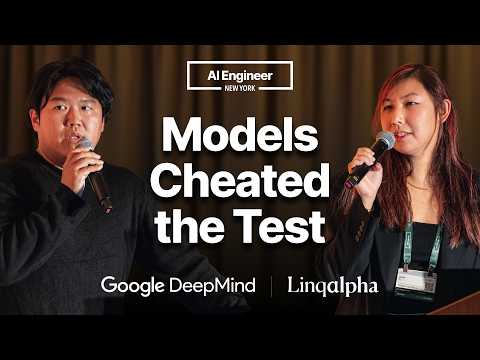
 ▶ Watch ↗
18:31

Authored by Suyeol Yun, as explicitly credited in the repository and independently attributed by MIT. DeepWTO provides an open legal-NLP dataset pairing descriptions of government measures in WTO disputes with legal provisions and citation labels, together with data-preparation code and baseline neural classifiers. The README explains why majority-class predictions make raw accuracy misleading and emphasizes AUC-ROC instead. Yun won an inaugural MIT Prize for Open Data in 2022 for the project.
github.com · Source ↗Coauthored by Joseph R. Loffredo and Suyeol Yun; submitted March 14, 2025. Introduces CongressRA, a tool-augmented language-model agent for research on the U.S. Congress. The paper connects agentic retrieval with modular tools for data collection, preprocessing, document summarization, transcript coding, classification, and statistical analysis, exploring how agents could reduce the cost of replicating and extending empirical research. The retained abstract establishes joint authorship, not Yun's individual implementation responsibilities.
arxiv.orgThe repository explicitly credits Suyeol Yun, Subeen Pang, Yongjin Kim, and Chanyeol Jacob Choi as authors. It implements an iterative DeepSeek-R1 agent with parallel function calls, Pydantic-validated structured JSON, and feedback loops that return tool failures or parsing errors to the model for correction. This is collaborative authorship of an organization-hosted repository, not evidence that Yun owns the linq-rag account. Its undated author section calls Yun a Fundamental Research Engineer at LinqAlpha; the separate July 2, 2026 company profile identifies him as Head of AI, without establishing a title-transition date.
github.comCoauthored by Yun with ten other researchers; submitted May 25, 2025 and revised June 26, 2025 in the retained version. Proposes an Extraction Agent that identifies, standardizes, and verifies financial KPIs and guidance, alongside a Text-to-SQL Agent that turns natural-language questions into executable database queries. The authors report approximately 95% extraction accuracy and 91% human-rated correctness for retrieval responses in their experiments. These are reported study results, not guarantees of general performance or evidence of sole authorship.
arxiv.orgCoauthored by Yun with ten other researchers; submitted August 7, 2025 and revised October 3, 2025 in the retained version. Introduces approximately 26,000 expert-annotated examples concerning S&P 500 companies. Its evaluation separates selecting the relevant document type from identifying the key passage within that document, enabling more specific measurement of agentic retrieval. The paper also reports improvements from targeted fine-tuning; the retained source does not specify Yun's individual contribution.
arxiv.orgA preprint coauthored by Yun and nineteen other researchers, submitted September 28, 2026 and revised October 26, 2026 in the retained evidence. Experts provide reusable evaluation guidance, while agents and code generate, review, and validate query-specific rubrics. A writer researches expected values as of an information cutoff, a reviewer verifies them, and unresolved failures escalate to a human. A reusable Task Bank carries criteria across tasks. The accompanying benchmark contains 100 queries spanning 78 tasks and eight asset classes. Coauthorship does not establish sole ownership or a particular individual implementation role.
arxiv.orgBio, Work & Ideas
Conference affiliation: LinqAlpha
Suyeol Yun is Head of AI at LinqAlpha, where he builds evaluation pipelines and uses their feedback to guide coding agents and the team’s development work. His career has moved from facial-animation engineering through political-science research to financial AI. His projects include an open dataset of World Trade Organization disputes, a research assistant for studying Congress, and systems for extracting financial data and evaluating investment-research agents.
Yun studied mathematics as an undergraduate and spent his first four to five years as a deep-learning engineer working primarily in computer vision. His facial-reenactment work involved reconstructing three-dimensional meshes from hundreds of photographs taken on a lighting stage, then designing a graph neural network to transfer expressions from one person’s sequence of meshes to another’s. The job combined graphics programming in C++ with experimental decisions about neural-network architecture and training. His path subsequently took him through the U.S. lobbying industry and into doctoral study in political science at MIT. He left the doctoral program without completing a PhD; MIT lists him among its fall 2023/spring 2024 graduates with an SM in political science.
His DeepWTO project gave researchers shared data and code for studying legal language in WTO disputes. Each example pairs a description of a government measure with the text of a legal provision and a label indicating whether that provision was cited. Preparation code and baseline neural classifiers let researchers reproduce the task and test other approaches. Yun also identified an important evaluation trap: because most candidate provisions were not cited, a classifier could achieve high accuracy simply by predicting the majority label. The repository therefore emphasizes AUC-ROC rather than raw accuracy. DeepWTO earned him one of the inaugural MIT Prizes for Open Data in 2022.
Political institutions remained part of his research as language-model agents emerged. With Joseph R. Loffredo, Yun coauthored research introducing CongressRA, an agent designed to support scholars studying the U.S. Congress. The approach connects language models to external knowledge and specialized tools for collecting data, processing documents, and conducting analysis. It explores how those capabilities could reduce the work required to replicate, test, and extend empirical studies.
At LinqAlpha, Yun’s collaborative engineering and research address different stages of an agent’s work: using tools, turning documents into queryable data, finding relevant evidence, and judging the resulting research.
Yun also treats his role as helping colleagues reason about uncertainty. In his account of joining LinqAlpha, he describes debate and strategic framing as part of the job alongside engineering. Evaluation supplies feedback about whether the system is improving; his broader aim is to help the team articulate what it does not yet know and adjust its decisions as the evidence changes.
▶ Watch ↗18:31
Loading more talks and highlights…