Machine transcription with reviewed terminology and names. Some recognition errors may remain. Timestamps refer to the original livestream.
3:39:34All right.
3:39:35Happy Thursday.
3:39:37I like how full this room is.
3:39:40It's Wednesday.
3:39:41It's Wednesday?
3:39:43Oh, sorry.
3:39:44I'm clearly ahead of everybody here.
3:39:47Happy Wednesday.
3:39:48My name is Carmen Li.
3:39:49I'm the CEO for Compute Exchange as well as SiliconData.
3:39:53I love the previous session.
3:39:56We talked a lot about the whole ecosystem,
3:40:00the financiers, and the spot market traders, and the hedgers.
3:40:04Namesh Nadeemun, Ph.D.: So, what we're sitting in is really cool. I have a company called Compute Exchange. The world's actually the only neutral marketplaces for GPU procurement.
3:40:14Namesh Nadeemun, Ph.D.: We started in 2024 when there were, I don't know, five new clouds, three hyperscalers.
3:40:21essentially we sort of will foresee interestingly enough the proliferation of the gpu ecosystem
3:40:29so you think about stock market today right when you try to buy and sell stocks you can call brokers
3:40:36obviously you can call a few banks to say hey i want to buy and sell x amount of tesla or actually
3:40:41spacex right and you can do that or you can transact through your app at niz or nasdaq
3:40:49doesn't mean you get the best price at nice your nasdaq just because it's more efficient and you
3:40:55know the liquidity will be there you know the trade will be settled it will be cleared you can
3:40:59get what you're looking for at the prices you're looking for in a very efficient manner right for
3:41:04capital markets and resource allocation is about efficiency so in compute world obviously now we
3:41:12have a huge proliferation which is great we have over 300 new cloud private provider globally we
3:41:18have a lot of token factories, we have a lot of API routers, which is all good for end customers.
3:41:25But at the same time, introduce a very interesting variable is how do we make transaction efficient?
3:41:32Right? Do you want to call 300 salespeople? I mean, it's great to make friends, right? You want
3:41:37to talk to them on a regular basis. They know a lot of things. But at the same time, when you need
3:41:41compute in the next 48 hours on reserve contracts, the easiest way is go to an
3:41:47exchange and then go to the verified compute resources. Just like go to
3:41:52NASDAQ and IZ to buy stocks. So that's one of the things
3:41:55ComputeGinge does extremely well is we have this neutral platform. And by design,
3:42:02we do not own GPUs. Once we start owning GPUs, that would translate to just like
3:42:07Nasdaq-only stocks, translates to
3:42:09I have a conflict of interest
3:42:11with you and with the providers.
3:42:13I could cherry-pick clients,
3:42:16I could hold relationships.
3:42:18Because Compute Exchange
3:42:19does not own anything by
3:42:21design, we work really
3:42:23well with all our providers globally.
3:42:26And
3:42:27one very important thing is
3:42:29we trade
3:42:31every single transaction individually,
3:42:34meaning we want to find
3:42:35you as end-customer the most
3:42:37suited compute resources.
3:42:39And we focus on reserve compute, forward contracts,
3:42:43as well as token packages.
3:42:45give you some high level.
3:42:52today, we have over 100 verified providers
3:42:57over 80,000 GPU in supply.
3:43:00cover all regions, obviously ex-China.
3:43:04our commitment is 24 hours turn around.
3:43:07The difference between us and other so-called brokers
3:43:11is we do verify GPUs.
3:43:13If it's existing reserve capacity,
3:43:17meaning things are actually in a functional stage,
3:43:20we'll verify the UIDs, the inventories,
3:43:22the performances we run,
3:43:24NVIDIA DGX, InferenceX, ML Perf,
3:43:28make sure you get resources you're promised to get.
3:43:31So we're the middle sort of trusted platform.
3:43:34So if it's forward capacity, I'd say you need GPU starting
3:43:38Jan 1st, 2027, we actually look through the purchase orders,
3:43:44all the permits they get, make sure we help you do it at your
3:43:47delicious level.
3:43:49Now on the flip side, right, if you're a new cloud, your concern
3:43:52is there's a zillion clients looking for Pimpu.
3:43:55How do you know who has the ability to pay at a schedule rate?
3:43:59that's what computers comes in we do KYB KYC of the clients obviously you want
3:44:04to make sure your clients is the clients using name who they are so we step in
3:44:09and do that kind of verification just like an exchange that would do and
3:44:13everything we do in the four markets is actually the precursor to physically
3:44:18deliver futures also give you some context why am what I do sorry I probably
3:44:23should say that I start my career as energy option market maker at your
3:44:28double trading in Chicago.
3:44:30So I did that for four or five years.
3:44:31So as an option,
3:44:32energy, market maker,
3:44:33everything is very intuitive.
3:44:34You have WTI,
3:44:36you have Brent.
3:44:37Right?
3:44:37WTI is a physically delivered commodity,
3:44:40contracts.
3:44:41Brent is cash settled.
3:44:42They also have very distinct use cases.
3:44:46You're looking for hedging
3:44:48in the financial sense, right?
3:44:50Your price volatility,
3:44:51your cost volatility,
3:44:52you're going to Brent.
3:44:53You're looking physically procure resources,
3:44:56use WTI.
3:44:58So we're creating the WTI at ComputeChange.
3:45:05So the ways to buy Compute through ComputeChange right now,
3:45:09you can get reserve contracts, you can get forward contracts on both GPU and token.
3:45:13Let me explain.
3:45:15The forward contracts on GPU is very reasonable, right?
3:45:18You want something starting in the future, nothing available right now.
3:45:21So that's something we're doing on a regular basis.
3:45:24Token forward, I think, can be a new-ish concept.
3:45:26basically can think about as a dedicated deployment on-premise deployment,
3:45:32right? Similarly you reserve a bare metal GPU clusters, you reserve a cluster but
3:45:39you have dedicated token deployment on top of that. So you get guaranteed SLA
3:45:44some of that particular models, you get quantization, position, everything's fixed
3:45:50for you for a period of time.
3:45:52So we try to solve the on-demand token API
3:45:55volatility pricing problem here.
3:45:59The third is we have a huge market,
3:46:01open hardware market.
3:46:02It's really interesting.
3:46:04The secondary server transactions started last year
3:46:07when people were just pinning me and
3:46:09hey, Carmen, I have like 20,000 H100 sitting X data center.
3:46:15Can you take it away from me?
3:46:16So I was like, I don't know.
3:46:18I can't store in my home, obviously.
3:46:20So we started having the marketplace for secondary server sales.
3:46:24This has been a very vibrant market for the past, I would say, 12 months.
3:46:29We cover, again, all servers, even B200.
3:46:32You see secondary transaction is happening, sometimes trading above MSRP.
3:46:37It can make sense.
3:46:39Think about COVID times when secondary car is trading above.
3:46:42It's a brand new car price.
3:46:45So we covered the three major layers of compute.
3:46:52So, reserve GPU, obviously, I think the previous speaker covered extremely well with the terms.
3:46:58The minimum we do is one node starting at one month, and then we can go all the way
3:47:02to three, four, five years, right?
3:47:04It all depends on the availability, the providers, but you get a chance to state your preferences.
3:47:11We don't do on demand.
3:47:15and another thing really works really well for compute changes we do provide a flexibility
3:47:20I'd say if you overcome it in terms of quantity or duration you can sell it back to compute
3:47:26change right so that's something we come in to do so you don't have to worry too much if you overbought
3:47:35all right segment life so I will actually do a quick demo later so we have a lot of listings
3:47:40marketplace listings. You can browse and chat with the providers and figure out the best
3:47:45delivery mechanisms. You can also RFQ if you don't see anything you liked. We're actually
3:47:51seeing over a billion RFQs every month. Sounds big, but we all know it's full compute. It's
3:47:59not that huge, right? But still, you see the activities, which I love is we see a big range
3:48:07of RFQ requests.
3:48:08From one node all the way to
3:48:1020,000 nodes. So our clients
3:48:12are all different shapes and forms,
3:48:15different use cases, which is great.
3:48:19Yeah, so you set timing,
3:48:21submit, and we route it.
3:48:22So behind the scene, we have
3:48:24inventory tracking. So with
3:48:26over 100 providers globally, we know
3:48:28who has what, roughly when, right?
3:48:30The forward capacity. And then let's say
3:48:32you submit a request in that, hey, I need
3:48:3430, 300 GPUs, B200,
3:48:38USEs starting
3:48:39first. We say
3:48:41we have three providers. We think
3:48:43they have those. We'll route it to the three.
3:48:45They will respond to you through the platforms
3:48:47and they'll give you
3:48:49rubrics back. Pricing,
3:48:51specs, SLAs, we
3:48:53benchmark them if it's existing
3:48:55servers and then it's your choice.
3:48:57Price is not only an indicator.
3:48:59We believe give you as much transparency
3:49:01as we can and then you will make a decision.
3:49:06So I record in one place.
3:49:08Again, it's rubrics coming back.
3:49:09You will see everything.
3:49:10And we introduce you to each other.
3:49:12We never hold relationships.
3:49:14We'll make sure you know who you're dealing with.
3:49:18So by tomorrow's compute, today's price.
3:49:19So it's a physically procured platform.
3:49:24This is the used refurbished GPUs.
3:49:28So again, we have extremely exciting ecosystem participants
3:49:33in this secondary GPU sales.
3:49:36We cover from 409Ls, 2B200, AMD, everything.
3:49:45Inventory is live, and we do connect with you
3:49:48through all different channels, Slack, email, chat,
3:49:51however you want to do this.
3:49:53We track end-to-end.
3:49:55We actually have scoring for everybody.
3:49:57We score you, our customers.
3:50:00We score our providers. You can't see it quite yet, but you know, we'll be really fun. We're going to have end of year celebration for our providers. We're going to give out the best provider in APAC, best provider in Europe, best provider in the US, most responsive providers. So we're going to have a lot of provider awards coming up. Stay tuned.
3:50:23Verify Network.
3:50:24So everything's verified,
3:50:26which is negotiate, state exchange.
3:50:28So we help in terms of
3:50:30be the middleman. Sometimes things
3:50:32are not very clear. We try to make sure
3:50:34people understand what's the best practices
3:50:36we have seen in the ecosystem.
3:50:41I'm going to quickly
3:50:42show you guys the platform.
3:50:45I think that's more fun.
3:50:54And here.
3:50:57So this is the platform.
3:50:59You can see a bunch of available inventories.
3:51:01By the way, anyone can sign up.
3:51:03It's completely free.
3:51:03There's no downside using us.
3:51:05You don't have to buy.
3:51:06You can browse.
3:51:07You can request for quotes if you're interested in something
3:51:11we don't have.
3:51:12You can start with your vendor type.
3:51:14Again, we're agnostic of GPUs.
3:51:16You can select a model.
3:51:17you can select your deployment type, you can select number of GPUs, you can select your
3:51:23compute interconnect preferences, CPU platforms, storages, everything you need, and then some
3:51:30optional items with systems, software stacks, regions. Obviously, we encourage you to select
3:51:35multiple regions if you open to that. You can add head nodes, tell us your use cases, anything you
3:51:40want, and then submit RFQ.
3:51:43So this has been extremely robust.
3:51:46And then obviously, we want to make sure,
3:51:49if you have any feedback, let us know.
3:51:52So I'm going to pause on the Compute Change side.
3:51:55I think I have some time left, which I'd love to show you
3:51:59some of the numbers we see in terms of term structure.
3:52:04Also, context.
3:52:05I'm CEO for Compute Change.
3:52:07I'm also CEO for another company called SiliconData.
3:52:10I'm a founder CEO for SiliconData,
3:52:12which is the Bloomberg for compute.
3:52:15So we provide indices for CME to settle their futures on,
3:52:20which will be happening in a few weeks.
3:52:21I'm very excited about this.
3:52:24So the ones that are going to start trading at CME
3:52:27will be the H100 NeoCloud on-demand rate,
3:52:30as well as B200 prices.
3:52:34What I want to show you is implied forward curve.
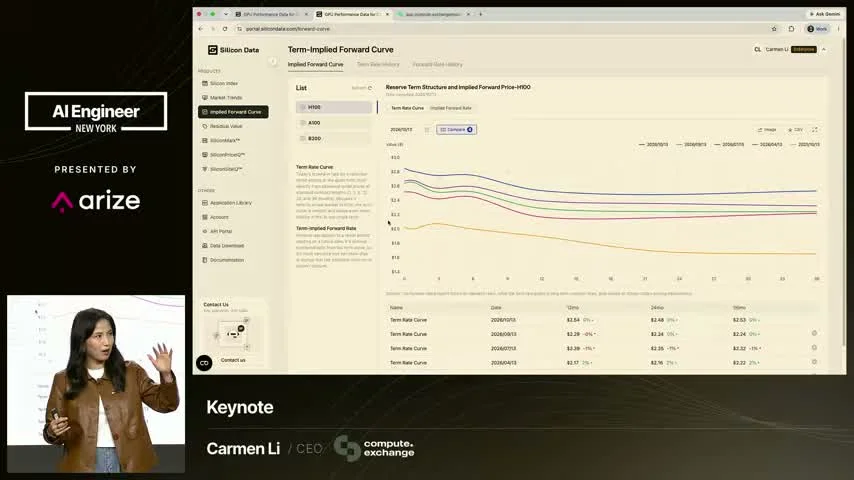
3:52:38so as I said
3:52:39compute change would do a lot of forward capacities
3:52:41so essentially a lot of
3:52:43longer term contracts is going to be very
3:52:45critical you think about
3:52:47even in your cloud or your
3:52:49consumers let me just make it larger
3:52:53so
3:52:53the yellow line was last year
3:52:56right the x
3:52:57horizontal line is the duration
3:53:00and the dollar amount
3:53:01is the y exist so
3:53:03last year was complete downward
3:53:05or sloping curve from the yellow line, right?
3:53:07Meaning the longer term contract you signed,
3:53:09it cheaper, you know, was per chip-up power.
3:53:13And this year, starting early this year,
3:53:15the whole curve shifted up and became contangled.
3:53:18If you see the red line, right?
3:53:20So it translates to people not getting a discount,
3:53:24enough discount for a longer term contract,
3:53:27implies that people assume the price is going to rise down the line.
3:53:31And now you see the price, the whole term,
3:53:33keeps shifting up but got flattened.
3:53:35So meaning people will now either get penalized or get awarded by a non-contract contract.
3:53:43This is reserve contract we observe.
3:53:45And if you look at implied floor rates, this is implied floor rates, right?
3:53:50Because we don't have a future trading.
3:53:52So this is calculated based on our term structure.
3:53:56And we use similar methodology at Treasury Futures Curve.
3:53:59So you can see a market consensus view is the price could go up in the future, next 36 months.
3:54:07Again, market consensus doesn't mean it's right.
3:54:11If you look at B200, again, last year was contangled, and this year the whole curve shifted up.
3:54:17Every single term is more expensive, and it's got flattened.
3:54:22In platform rates, similarly, people think the price is going to go up.
3:54:26I want to point this out, the term structure out, is this shows you that GPU behaves just like every commodity,
3:54:34have a very clear term structure risks, which data futures are excellent at hedging.
3:54:40So we have seen a lot of block trading happening around the term structure.
3:54:44So you think about this, right?
3:54:46If you have servers on your balance sheet, you have financing obligation for the next five, six years,
3:54:52and you have reserve contracts for first three.
3:54:55Then they exposed essentially year four or five or six.
3:54:59So you want to hedge that risk out by entering swaps or block trading.
3:55:06those are things.
3:55:06Or there are trades happening even for the first three years,
3:55:10which you have reserve contracts on.
3:55:12What if the reserve contract defaulted?
3:55:16What's your guarantee from some of the players?
3:55:20So we saw block trading happening around indices.
3:55:23Trade has a floating rate.
3:55:29This chart actually is being used differently by the NVIDIA team.
3:55:38In NVIDIA's latest September investor day deck, they set us with only data provider
3:55:45that actually cited in their deck.
3:55:48is very interesting.
3:55:49SiliconData becomes the appraisal for a few banks when they have GPU servers on their
3:55:54balance sheet.
3:55:56everything you see here
3:55:57is a forward looking view
3:55:59so discount the cash flow
3:56:01so as I said we have a term structure
3:56:03so assume A100s
3:56:06A100s have been around for 6 years
3:56:07if today you sign a 3 year long
3:56:10lease on A100s
3:56:11and you have a rate, if you discount
3:56:13the cash back to time zero
3:56:16you have how much
3:56:17the asset is worth
3:56:19obviously there's a lot of things
3:56:21baked in, utilization rate
3:56:23What is your cost?
3:56:25There's a bunch of assumptions which we're pretty transparent about.
3:56:29We actually calculate the residual value for normalized value, obviously,
3:56:33across all A100, H100, B200 servers globally.
3:56:37And then we'll compare that with the straight line depreciation,
3:56:42which is everybody using the 5 yen depreciation.
3:56:44What's interesting is the A100, right?
3:56:46Even though it is downward sloping, you know,
3:56:49it means things are depreciating,
3:56:50but it's above the accounting depreciation curve, straight line.
3:56:55And H100, obviously, it's going bananas now.
3:56:59The price actually went up.
3:57:01My analogy will be just like secondary cars during COVID time.
3:57:06The price went up, right?
3:57:08And B200, obviously, went above the MSRP by this point.
3:57:12So this gives you some views about what's going on
3:57:15on the residual value side.
3:57:17I think I'm out of time, but feel free to grab me.
3:57:20Carmen, CLI
3:57:22at computechurch.com
3:57:24CLI stick in there.com
3:57:26feel free to get me on Twitter
3:57:27Carmen Lee is my Twitter handle
3:57:29just Carmen L.I.
3:57:31That's it. Thank you.