Machine transcription with reviewed terminology and names. Some recognition errors may remain. Timestamps refer to the original livestream.
1:10:03Hi, everyone. I'm Joseph Kim, and I lead ChatGPT for Financial Services, a new product we launched just one month ago. Many of you have already experienced how tools like Codex have changed the way you build in software engineering. AI has become a much bigger part of the work you do every day.
1:10:21Model intelligence is continuing to improve at an incredible pace.
1:10:25But many people working industries like finance haven't yet experienced that same change in their day-to-day work.
1:10:32I expect that to start changing rapidly over the next few months.
1:10:36And builders like all of you in this room have a big role in making that happen quickly.
1:10:41Taking the intelligence in these models and turning it into products that people can use in their daily work.
1:10:47Today, I will share a little bit about what we learned building ChatGPT for financial services
1:10:51and how we're thinking about what comes next.
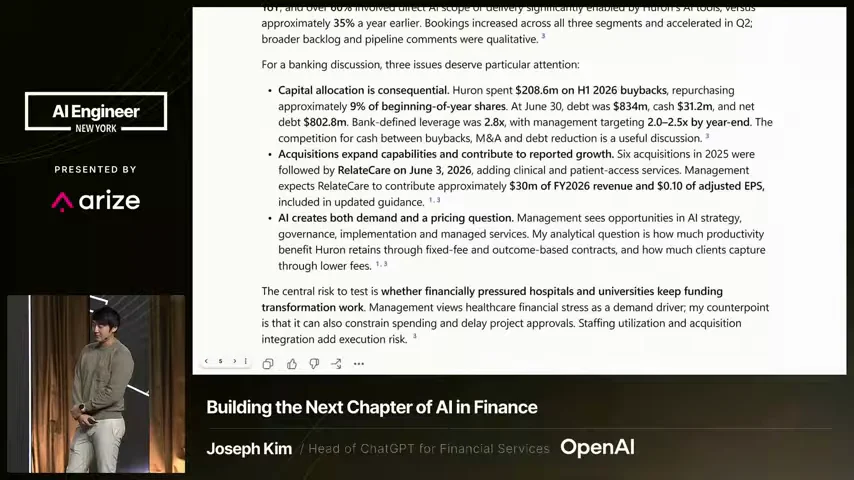
1:10:55I'll start by showing you what we've built, including a quick demo.
1:10:59Then I'll explain why we built it and why we think now is the right time to build.
1:11:03From there, I'll walk you through how we built it with some technical lessons that I hope you can apply to your own products.
1:11:10Finally, we'll take a look at where models are headed and products are going
1:11:13and what that can mean for financial work over the next year.
1:11:17Let's start with what we've built.
1:11:21ChatGPT for Financial Services is a tailored version of ChatGPT work built specifically
1:11:26for financial professionals, starting with investment banking and equity research.
1:11:30It's designed to help people at the large financial institutions get more out of their
1:11:35day-to-day work, similar to how Codex speeds you up in software development.
1:11:39As we built the product with our design partners, Morgan Stanley and Evercore, we focused on
1:11:44three core areas.
1:11:45First, financial data.
1:11:48Financial data is the foundation of financial work,
1:11:50and the work you can do is limited by the quality of your sources.
1:11:54We wanted people to have access to the data they need directly within ChatGPT.
1:11:59Second, an interface built for finance.
1:12:02We wanted the product to feel familiar to financial professionals
1:12:05with ways to inspect source material, explore financial charts,
1:12:09and control the sources behind an analysis.
1:12:12Third, your firm's format.
1:12:15Financial work happens within the context of an organization,
1:12:18and the models and presentations people produce
1:12:20need to follow their forms format and standards.
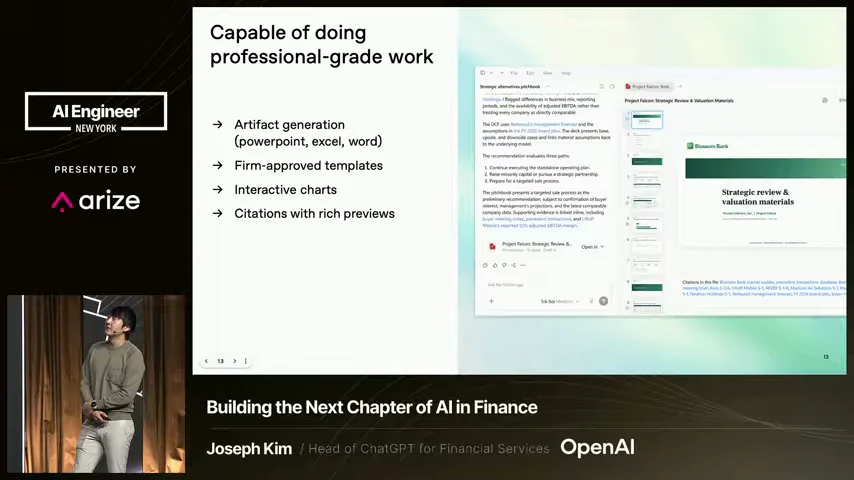
1:12:23We made it easier to create those artifacts using firm-specific templates.
1:12:28But they say a picture is worth a thousand words,
1:12:30so I'll stop talking for a bit and show you the product.
1:14:03Wonderful.
1:14:03Now I'd like to take some time to talk about why we built it.
1:14:08We built ChatGPT for financial services to help close what we call the capability overhang.
1:14:13As you can see here, model capabilities have improved at a tremendous rate over the last few years.
1:14:19In just a few years, we've gone from models solving high school math problems
1:14:22to systems capable of solving millennial-prized math problems.
1:14:25But the value people get from these models in their day-to-day work hasn't kept pace.
1:14:29You read about the breakthroughs in the news, yet for many financial professionals,
1:14:33the way they work hasn't changed nearly as quickly.
1:14:36We call that gap the capability overhang, the distance between what the model is capable of
1:14:40and the value people can actually get from it.
1:14:43Closing that gap takes more than building a capable model.
1:14:46People need the right data and tools and they need an experience that fits the way they
1:14:50work.
1:14:51That's where builders like you come in.
1:14:53I want to show you an example of how much of a difference the right product experience
1:14:56can make.
1:14:58This is a chart that shows how codex usage grew within OpenAI across different job functions.
1:15:04As you can see, engineers started using codex early and that share grew steadily.
1:15:09But look at finance, legal, and recruiting.
1:15:12At the beginning of 2026, almost none of their AI output was generated in Codex.
1:15:17By June, that share was around 90%.
1:15:20If you look carefully, you'll notice a huge inflection point that happened around February, March of this year.
1:15:25I went back to see what happened around this time, assuming that we must have released a new model,
1:15:30but instead I found that we had released the Codex desktop app in February.
1:15:34My takeaway is that the product made it easier for people outside of engineering to put these capabilities to work.
1:15:40That's the opportunity we're pursuing in finance,
1:15:42building an experience that helps financial professionals get much more value from the intelligence already available to them.
1:15:49Now let me talk about how we built it.
1:15:53Let's start with data.
1:15:54In finance, the work you can do is limited by the quality of the information you have access to.
1:15:59So we wanted the product to come with the sources professionals rely on,
1:16:02from financial statements and earning transcripts to market and private company data.
1:16:06We looked at existing MCP connectors for financial data
1:16:09and found that many had issues with latency, errors, or search quality.
1:16:14So we went and licensed a lot of this data directly
1:16:16and built our own hosting and search indices
1:16:18using the same infrastructure as our web index.
1:16:21We still use the MCP protocol to give the model access to the data,
1:16:25but hosting and indexing it ourselves gives us more control over the quality
1:16:29and the reliability of the experience.
1:16:31It also gives us the flexibility to post-train our models to work with these data sets.
1:16:36The analogy I like to use is MCP and skills are like handing an instruction manual to
1:16:41a junior analyst versus post-training where the model is like having a senior analyst
1:16:45who's been working with the data for over two decades and knows all of its quirks like
1:16:49the back of their hand.
1:16:51MCP and skills give the model access to instructions.
1:16:54Post-training can help it develop more familiarity with the data itself.
1:16:58Once we had that data foundation in place, the next step was making it easy to turn that
1:17:02information to professional-grade work.
1:17:05For financial professionals, that work often takes the form of an Excel model, a PowerPoint
1:17:09presentation, or a written analysis that needs to be reviewed and shared with other people.
1:17:14So we focused on helping the model produce those outputs in a way that fits the firm's
1:17:17existing workflows.
1:17:19We built a template system that gives users access to the firm's approved templates when
1:17:24generating spreadsheets and presentations.
1:17:26The goal is to reduce the work someone has to do to get an output ready for their team
1:17:30or clients.
1:17:32We also added things like interactive financial charts so users can explore stock prices and
1:17:36financial metrics directly within ChatGPT as they work through an analysis.
1:17:41And we built citation viewers that let people inspect the source passages and tables behind
1:17:46an answer.
1:17:47In finance, you need to be able to check where a number came from and understand the context
1:17:51around it.
1:17:52We wanted that review to be a natural part of the experience.
1:17:55These are the kind of product details that help turn a model's capabilities into work
1:17:58that someone can use.
1:18:01The part I think that is most relevant for people in the room is how we built it.
1:18:05Much of the functionality you just saw was built using the same ChatGPT plugin platform
1:18:09that's available to you as developers.
1:18:12For financial data, we used MCP tools and connectors to give the model access to the
1:18:16information it needs.
1:18:17We use citation metadata in MCP apps to let users inspect their sources, and MCP apps also power interactive financial charts.
1:18:25We use skills together with shared artifact tools to guide financial workflows and produce Excel models and PowerPoint presentations.
1:18:32And for financial onboarding, we leverage the native plugin onboarding experience.
1:18:37What that means for builders is that you can focus on the expertise that makes your product valuable.
1:18:41If you have unique data, an existing tool, or a deep understanding of a particular workflow,
1:18:47you can use these building blocks to bring that into ChatGPT and create an experience around it.
1:18:52Financial services is just one example, but I do think this opportunity expands far beyond finance.
1:18:58I personally believe that we're going to see multiple $1 billion businesses built simply as ChatGPT plugins.
1:19:04And that opportunity will keep evolving as the models become more capable.
1:19:09Last but not least, I'd like to spend the rest of the talk on what comes next and what
1:19:14that means for the products we should be building today.
1:19:18I'd like to start by talking about model capabilities and expectations for the future.
1:19:23Models are improving so quickly that it can be difficult to get an intuitive sense of
1:19:26what comes next.
1:19:28One useful way to build that intuition is to look backwards.
1:19:32Something remarkable about the last couple of years is how predictable parts of that
1:19:36progress have been. Model improvements have come from three broad, sometimes overlapping drivers.
1:19:41Scaling compute, improving algorithms, and something we call unhobbling, which is about
1:19:47finding ways to get more useful work out of the models. We'll come back to unhobbling on a later
1:19:51slide. In 2002 and 2003, the most visible driver was pre-training, which meant scaling compute by
1:19:58making the models bigger and adding more data.
1:20:00By leveraging scaling laws, researchers were able to predict model performance with high accuracy. For example, before GPT-4 finished training, OpenAI researchers were able to predict its final loss as well as its performance on a coding eval. Improvements on the algorithm side have also been surprisingly steady. One study found that the compute needed to reach a given level of language model performance from scratch fell by roughly half every
1:20:25eight months. Although you can't predict the timing of each individual breakthrough, the
1:20:29cumulative rate of improvement follows a surprisingly steady trend. In 2024 and 2025, reasoning
1:20:36became another major driver of progress. We used reinforcement learning and post-training
1:20:40to teach models to work through problems more effectively, and we gave them more compute
1:20:44to think when answering. That opened up another way to improve performance alongside pre-training.
1:20:50However, for folks that don't know, at OpenAI, we ran into problems with pre-training and
1:20:54and therefore had difficulty scaling the model.
1:20:57In 2026, we've been able to solve many of these issues, and we've successfully trained
1:21:01larger and more capable models, as you've seen through GPD-56 Sol and GPD-6 Astro.
1:21:07Throughout these years, researchers have raised concerns about potential barriers to further
1:21:11scaling.
1:21:12For example, in 2024, many researchers were concerned about a potential data wall where
1:21:17we would run out of human-generated text to train on.
1:21:20But techniques like synthetic data generation,
1:21:23learning from verifiable rewards,
1:21:25as well as algorithmic improvements
1:21:27to learn more from each individual token
1:21:28have essentially solved this problem.
1:21:31We've also solved concerns around things
1:21:33like context window length
1:21:34using things like sparse detention and compaction.
1:21:38Looking ahead to 2027,
1:21:40I strongly believe that the trend lines of the past
1:21:42will continue and that we'll train larger,
1:21:44more efficient, and more capable models.
1:21:46We clearly still have very difficult problems to solve,
1:21:48especially around things like alignment and safety,
1:21:50but like we have in the past, I believe that human ingenuity,
1:21:53increasingly assisted by capable models,
1:21:56will help us make progress on those problems too.
1:21:58So how good will models be at the end of 2027?
1:22:01Let's use math as an example.
1:22:03In 2023, GPT-4 scored 700 out of 800 on SAT high school math.
1:22:09By 2005, an opening eye model reached gold medal status
1:22:12on the International Mathematical Olympiad.
1:22:16And in early 2026, an internal model disproved a long-standing conjecture related to a problem that mathematicians have been working on since 1946.
1:22:25More recently, an internal model proposed a solution to the Navier-Stokes Millennium Prize puzzle problem,
1:22:32and we also shared 719 mathematical research manuscripts across 372 families of results.
1:22:39In just a few years, we've gone from a strong score on a high school math exam
1:22:42to AI systems producing original research at the frontier of mathematics.
1:22:46If we see another year of progress roughly in line with what we've been seeing over the past couple years,
1:22:51I expect that by end of 2027, models will outperform even leading human experts
1:22:55on a growing range of difficult tasks across different fields and specialties.
1:23:00Mathematics gives us an early glimpse of what that could look like.
1:23:04And while the capability curve may look gradual, the change in how we work can feel sudden.
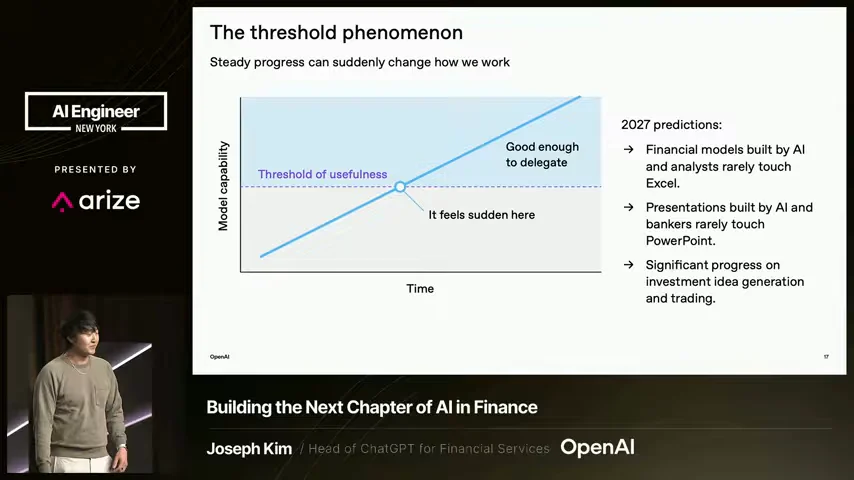
1:23:08I call this the threshold phenomenon.
1:23:11For any given task, there's a threshold of usefulness, the point where a model becomes
1:23:14capable and reliable enough to save you time.
1:23:17That threshold depends on the work you're doing and how much checking or human review
1:23:20it requires.
1:23:22Below that threshold, improvements can be hard to appreciate.
1:23:25The model might produce better answers, make fewer mistakes, or get further through a task.
1:23:29But if checking and fixing its work still takes as long as doing it yourself,
1:23:32your practical assessment hasn't changed.
1:23:34It's still not useful.
1:23:36Meaningful improvements in capability can feel like little progress.
1:23:40Then the model crosses that threshold.
1:23:42Suddenly it produces something you can use.
1:23:44The time you spend reviewing it becomes much smaller than the time it saves you.
1:23:48You start using it regularly,
1:23:50and eventually you become comfortable delegating that task.
1:23:52That transition can feel like an enormous leap,
1:23:54even if the underlying improvement was similar to the previous few improvements.
1:23:58What changes of progress became useful to you.
1:24:01This helps explain why model progress sometimes feels sudden,
1:24:04even when parts of the underlying trend have been steady and predictable.
1:24:07And because difficult tasks have different thresholds,
1:24:10we should expect those moments to arrive at different times across the work that we do.
1:24:13So as you think about the products you're building,
1:24:16I'd encourage you to ask yourself,
1:24:17what model capabilities am I underappreciating today because they aren't quite useful yet?
1:24:22Where might those capabilities be a year from now?
1:24:25Then think about what you would build if those capabilities crossed the threshold of usefulness
1:24:29and became reliable enough to delegate?
1:24:32How would the interface change?
1:24:34What would the users still need to control, review, or approve?
1:24:38Those are product and design questions we can start working on now.
1:24:41We want to have the right experiences ready
1:24:43so that when the models cross that threshold,
1:24:45people can take advantage of the capabilities right away,
1:24:47and so you can stay one step ahead of your competitors.
1:24:51So what does this mean for finance?
1:24:53I think there are two forces that will push more financial work
1:24:56across that threshold of usefulness.
1:24:57I think of them as the rising tide and the waves on top.
1:25:00The rising tide is the underlying improvements to the underlying model.
1:25:05Historically, we haven't dedicated a significant amount of training time or compute specifically to finance.
1:25:10Much of the financial capabilities you see today have come from building larger, more capable models
1:25:15and from transferable skills developed in areas like mathematics, coding, and reasoning.
1:25:20As these general capabilities improved, they lifted performance across many kinds of financial work.
1:25:26The Ways are what happens when we focus directly on finance.
1:25:29My team is leading an effort to invest significantly more in finance-specific post-training.
1:25:33The idea here is to build on those broad capabilities
1:25:36and train the model more directly on the work people do in finance.
1:25:40That can create peaks in performance on particular tasks on top of the rising tide.
1:25:44Over the next three months, we're focused on improving general financial reasoning
1:25:48and the quality of the work these models produce,
1:25:50analyzing financial information, building Excel models,
1:25:53and creating PowerPoint presentations.
1:25:55These are the kinds of tasks that make up a significant percentage of the daily work of a junior analyst,
1:25:59and we want the output to be accurate, well-structured, and increasingly useful in real workflows.
1:26:04Beyond that, we plan to invest more in the kinds of judgment that senior bankers, analysts, and investors bring to more difficult questions.
1:26:11This includes taking in large amounts of information, deciding what matters, and essentially trying to predict the future,
1:26:17forecasting a company's earnings, assessing where commodity prices might go, or evaluating which businesses are attractive investments.
1:26:24Our goal is for models to match the performance of the best human experts
1:26:28on these types of financial tasks sometime in 2027.
1:26:31We expect that progress to come from both forces working together,
1:26:35the underlying model continuing to improve,
1:26:37and our team training it more directly for the work people do in finance.
1:26:41We've talked about how models are becoming more capable
1:26:43and how we can train them to perform better on specific tasks,
1:26:46but I want to come back to one third driver I mentioned earlier unhobbling.
1:26:50We've already seen a few examples.
1:26:53ChatGPT use RLHF to teach models to follow instructions and have conversations with us.
1:26:58Tools allow them to search for information, write and run code, and interact with the software we use.
1:27:03Each of these makes the model more useful in the real world.
1:27:06I think the next form of unhobbling will be proactive and persistent agents.
1:27:11Today, a lot of our interactions with AI still happen when we open a conversation and tell it what to do next.
1:27:15A persistent agent can hold on to a goal, remember the relevant context, and continue working in the background.
1:27:20Once you've given it a direction, it can make progress even when you aren't actively prompting it.
1:27:25The other reason persistence matters is it changes the API or the way people work with the agent.
1:27:30Today, getting the most out of AI agents requires learning a new workflow, learning how to prompt it, and learning how to use the tools.
1:27:36A persistent agent can work in a way that's more familiar.
1:27:39You can give it a project, share context, and ask for an update.
1:27:43It's much more similar to how humans work with other humans, and therefore makes the AI more accessible to people
1:27:48that don't develop those initial skills.
1:27:51Let me close with three bets for finance in 2027.
1:27:54These are just a couple of my expectations
1:27:56for what comes as the models improve.
1:27:59First, people will rely rarely, if ever,
1:28:02on Excel and PowerPoint
1:28:02to make financial models or pitch decks.
1:28:05Second, AI financial analysts
1:28:07will start to feel like human coworkers.
1:28:09They'll remember your preferences and context
1:28:10from the previous days,
1:28:12take ownership of assignments,
1:28:13productively follow up,
1:28:14and keep working when you're focused on something else.
1:28:17Third, models will start to outperform the best human experts on critical financial tasks.
1:28:21That includes things like forecasting earnings and developing investment ideas.
1:28:25I expect models to become better than the best people at making these economically important, forward-looking judgments.
1:28:30Those are my three bets for 2027.
1:28:33And if this is where we expect to be in 2027, I'll leave you with one last question.
1:28:37What should you start building today to be ready for inevitable thresholds that the models will cross tomorrow?
1:28:43Thank you.