Machine transcription with reviewed terminology and names. Some recognition errors may remain. Timestamps refer to the original livestream.
1:55:22My name is Freddy Lecue.
1:55:23I'm part of the Wells Fargo team.
1:55:25I'm leading the Frontier AI modeling organization here.
1:55:29And I'm going to show you the work we've been doing lastly on building our first foundation
1:55:34model, Wells Fargo Foundation model.
1:55:37So I explain why we did that, how we did it, and what we accomplished.
1:55:41in doing so so so first from financial model it doesn't necessarily need to be language based i
1:55:48mean we're all playing with uh claude and chat gpt and others they're all language-based
1:55:55from the show models in financial services uh we also have language of course uh from a
1:56:00structure unstructured representation data but we also have a lot of structure representation
1:56:05a lot of these data is tabular data we have a lot of information from our customers we have
1:56:11information in investment banking, consumer banking, and all of this data is data that we
1:56:17have in Wells Fargo, and all big financial organizations have too. And we want to take
1:56:23benefit of all of this huge amount of data that we have. And it's not like you just take it and
1:56:30put it in a language model and get the best of it. Of course, you can get a lot of benefit out of it,
1:56:37but it's not necessarily the best way to do it.
1:56:40So what we decided to do is to look at the data we have,
1:56:43all the transactions, all the customer transactions
1:56:46that they're doing with their debit card, credit card, digital, check,
1:56:50all of those coming from many different channels
1:56:52and see if we can build a foundational model
1:56:56that we can use and fine-tune for downstream tasks
1:56:59like credit scoring or that you can use it for fraud detection,
1:57:03anti-money laundering, do marketing.
1:57:05So how we can build one backbone that you can use and streamline across downstream tasks.
1:57:12So now you're moving from many models very siloed across different organizations.
1:57:17In really one backbone that every organization can just reuse because you learn the representations of customers' transactions at scale.
1:57:27So that's the intent.
1:57:28And just spoiler alert, you may say, hey, that's tabular data.
1:57:31why do you just don't use XGBoost and the usual suspect?
1:57:35We did that.
1:57:36This is the model we had in production.
1:57:37But the model I'm going to show you is something that beats XGBoost,
1:57:42even from a latency perspective, but also from a fault detection,
1:57:47we get much better reduction of false positive and better detection rate.
1:57:54So it was a really good lesson learned in terms of having better model
1:57:59using foundation model.
1:58:01And to foundation, I mean transformer blocks, and that's what we build.
1:58:06So we have, as I mentioned, billions of transactions on a monthly basis.
1:58:13Our customers are interacting with their debit credit card, and they do checks, and they do different sort of transactions.
1:58:19And the question is really how we can use this information at scale, and not for one and every single downstream task.
1:58:26So I'm going to cover a bit of the data, the representations, the architecture that we use,
1:58:34what the result we get, and the lesson we learned in building this.
1:58:40So left-hand side, language foundational model.
1:58:44They're processing language tokens, and then the goal is to learn the representations that's going to predict the next token.
1:58:51and then you have supervised fine-tuning
1:58:54and then you do LHF, LRVR
1:58:57and all of the great post-training process
1:59:00to get better at the task that you want to, right?
1:59:03And that's for languages, that's great.
1:59:05But what if your data is very much more specialized
1:59:09in terms of representation?
1:59:11So that's where we build this transaction foundation model.
1:59:15So instead of having languages as the base,
1:59:19the base is now transactions.
1:59:21transaction from our customers.
1:59:23And you still try to predict the next thing,
1:59:26and here the next thing is the next transaction,
1:59:28or it's the next token in the transaction,
1:59:30using all of the channels that you have.
1:59:32But that's not the end goal.
1:59:34I mean, similarly to language model,
1:59:36where you try to predict the next token,
1:59:38that's not the end of the story, right?
1:59:40You learn the representation,
1:59:41and then you use that representation,
1:59:43and then you fine-tune it,
1:59:45and you post-tune it for any other task, right?
1:59:48So it could be classification tasks for languages,
1:59:50but in our context for transaction foundation model it could be used for
1:59:54credit line increase could be used for doing fraud detections and flagging
1:59:58bad actors from
2:00:00an anti-money-laundering perspective.
2:00:01And the goal is to learn this relationship between transactions over time and transactions across customers. That's really the intent.
2:00:10So the intent number one is you do pre-train from scratch. I'm saying it again because people are sometimes confused.
2:00:17we pre-train transformer blocks at scale from scratch using our transaction data.
2:00:26So the zero rate that we use from open rates, we just use the architecture,
2:00:30and then we pre-train it from scratch using our GPU cluster,
2:00:34and then we train it for a couple of days and weeks,
2:00:38and then you do the downstream task of post-training.
2:00:42but the goal here and you pre-train it
2:00:45for predicting the next
2:00:47token or the next transactions
2:00:48and you try to do this
2:00:50you try to predict the next pattern
2:00:52of the customer but that's not the intent
2:00:54the intent is to do the downstream
2:00:56task later on and in terms of scale
2:01:00we operate
2:01:01at a large scale
2:01:02so we have billions of transactions
2:01:04a million of accounts
2:01:07hundreds of transactions
2:01:08per client on a monthly
2:01:11basis interacting with their
2:01:12debit card, credit card, or doing check.
2:01:15And the five main dimensions we look at
2:01:18is really who is doing,
2:01:20I mean, who is processing and who is asking
2:01:23and who is providing a service.
2:01:25So, will it the customer or the merchant?
2:01:28The what?
2:01:29So, I mean, what do we buy?
2:01:32What do we transact?
2:01:34And how?
2:01:35So, which channel?
2:01:35Is it credit?
2:01:36Is it debit?
2:01:37Is it digital?
2:01:38When is it happening?
2:01:39And where is it happening?
2:01:40And all of those, they're basically breaking down in hundreds of features.
2:01:44And if you look at the existing model we have in production,
2:01:48there's a lot of people that build those models in similar organizations
2:01:54may understand that.
2:01:56They build a lot of very hard-crafted, uncrafted engineering,
2:02:01feature engineering efforts on that.
2:02:03And that's required a lot and a lot of time.
2:02:05So we step back and look at the raw features we need,
2:02:08not the one that's been pre-built and post-built for doing the downstream tasks,
2:02:14but try to understand which raw features.
2:02:16And we ended up with basically Android features.
2:02:19Even at the end of the day, we had thousands of them,
2:02:22but we tried to find which ones are the raw information unit.
2:02:27And then we led the architecture, the transformer blocks,
2:02:31to figure out the relationship between those core features.
2:02:34and as you can see
2:02:36we do have a bunch of features
2:02:39on those five dimensions
2:02:41and the vocabulary is very unique
2:02:44to the financial services setup
2:02:47and that's the reason why
2:02:49we didn't really use
2:02:51existing pre-trained model
2:02:53because the vocabulary that we use
2:02:56is very specific to the work
2:02:58that you want to do
2:02:59and even if you merge
2:03:02while all digital and checking and saving
2:03:06and all of those sort of transactions,
2:03:10even if you merge all of those,
2:03:12you still end up with a very limited number of features and characteristics.
2:03:15So at that scale, then the question is,
2:03:18well, how you work with that?
2:03:20So we started, everything is tabular data.
2:03:23I mean, there's no secret, it's tabular data.
2:03:25And then the goal is to understand
2:03:26how you're going to capture the vocabulary
2:03:29because you do have numerical values,
2:03:31you have categorical values, you have information like zip code,
2:03:37do you encode each and every zip code in a token?
2:03:39Does it make sense?
2:03:41So there's a lot of efforts you need to push in understanding
2:03:44the vocabulary that you need and the vocabulary that you want also to scale
2:03:49because at the training, if you have too huge vocabulary,
2:03:52it would be kind of messy to train such a model with a vocabulary
2:03:56which is far, far too big.
2:03:57So there's a lot of effort in understanding this value to tokens.
2:04:02So which information do you encode in a token?
2:04:04And then you have the token to ID, the tokenizations,
2:04:07and then the embedding lookup.
2:04:09So then when we have a transaction coming up,
2:04:11you do have the vocabulary.
2:04:13So basically it's a lookup in aligning a transaction
2:04:16and all the characteristics of that transaction
2:04:19to a token and an ID and then an embedding.
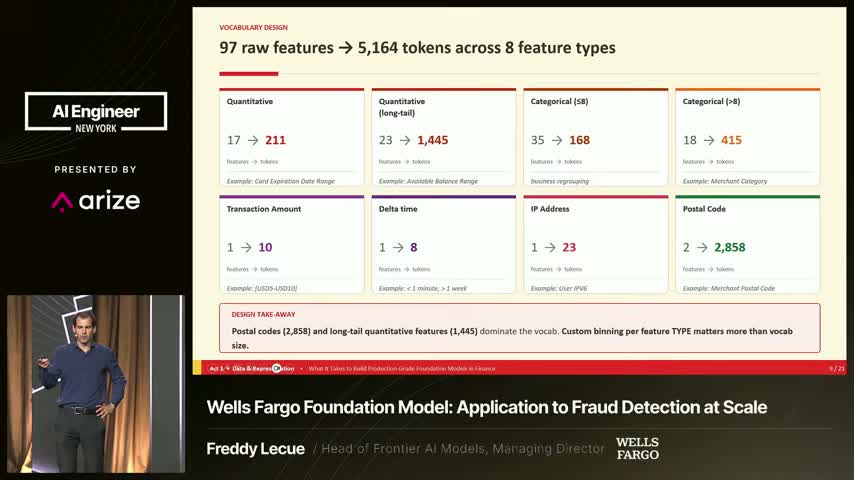
2:04:25So just to give you a number,
2:04:26well some numbers so we have quantitative qualitative categorical of different kind
2:04:32right so categories with only eight types some with much bigger types you have transaction amount
2:04:38which is a big deal you have the delta time between transaction so you have anything related
2:04:44to ip address postal code so just to give you example of variety and heterogeneity of each and
2:04:51every characteristic could be encoded in a binary token
2:04:55or could be encoded in a much larger number of tokens.
2:04:59And even if you look at the zip code,
2:05:01I mean, you have a much larger number of zip code
2:05:03in the US than those 2,800,
2:05:07but you have much better way to structure
2:05:11how you're going to regroup zip code
2:05:15based on distributions, for instance.
2:05:17so architecture
2:05:19so here just
2:05:21so we use the
2:05:23chinchilla
2:05:25mathematics behind
2:05:26to define how we build it
2:05:29initially because we had
2:05:31no clue how it's going to work in the tabular
2:05:33space even though there are
2:05:35existing
2:05:37open ways and open solutions
2:05:39for doing tabular
2:05:41data foundation models
2:05:42so we started from
2:05:45what they learn and adapt it to what we needed to do and that gives you an
2:05:49example of invading dimensions number of decoder blocks we use and all of the
2:05:54recipe from a from an architecture perspective so we have and as you can
2:06:00see we're not trying to build a trillion parameters model we don't try to compete
2:06:05with any of the the leaders in the language models because we working with
2:06:11and focusing on transactions, right?
2:06:14Transactions, foundation models at billion level.
2:06:18And one billion is because that's the model that gave us,
2:06:21that was kind of the smallest and gave us the highest boost.
2:06:25And now we're working on the next versions at 11 billion.
2:06:29But that's good enough to give a lot of ROI
2:06:33from a false positive reduction for downstream tasks
2:06:37like for detections and the detection,
2:06:39unit detection rate.
2:06:41So, and the type of architecture,
2:06:45so the decoder-only architecture,
2:06:47that's basically for predicting the next token
2:06:50or the next transactions.
2:06:51And that's really the pre-training.
2:06:54So here we initially used 20 times the number of parameters
2:06:57to define the number of tokens we might need.
2:06:59We ended up actually 10 times fractured than that.
2:07:02So by doing a few experimentations,
2:07:04we needed much more tokens per parameters.
2:07:08I mean, this is kind of the initial experimentation we did.
2:07:13So I'll pass on this because this is the usual suspect
2:07:16from an objective function,
2:07:19so causal language modeling and mass language modeling
2:07:22type of optimization work.
2:07:27And from an architecture perspective,
2:07:30nothing really fancy here.
2:07:33the most complex part was really the tokenization
2:07:36and then
2:07:37doing the pre-training and then how you do the fine-tuning.
2:07:41So I would say the recipe or the secret sauce
2:07:43is really how you do the tokenization
2:07:45and how you're going to do the post-training.
2:07:48But anything from a training perspective,
2:07:52the question is just
2:07:53how many transactions
2:07:56you're going to put in your context
2:07:58or in your history for doing the training.
2:08:00and evaluation perplexity-based accuracy dashboard
2:08:05on downstream tasks.
2:08:06That's the ULs respect.
2:08:09And so, yeah, so use mixed precision,
2:08:13distributed data parallel,
2:08:15maximize macro batch size,
2:08:18get faster convergence,
2:08:20yeah, using Muran,
2:08:23Rope, usual,
2:08:25and memory efficiency, flash attention,
2:08:27activation chain pointing.
2:08:28I mean, here there's nothing really new.
2:08:30It's just we use the advices from the best
2:08:35and from the one that built even much bigger models.
2:08:39So I'll pass on this one.
2:08:42Time is short.
2:08:42But I wanted to spend some time on the results.
2:08:47So, yeah, so when you build this foundation,
2:08:52That foundation is really, is only a backbone.
2:08:58It's something you can use for downstream tasks.
2:09:01And the downstream task was to do fraud classification.
2:09:04So you have a transaction, and then you try to predict if that transaction is going to be fraudulent.
2:09:09So in the model we have in production, it's an XGBoost model,
2:09:13and it's trained on large amount of transactions, which is fraudulent or non-fraudulent.
2:09:19and the missing pieces
2:09:20was the relationship
2:09:23between whatever transaction
2:09:25you try to predict, try to classify
2:09:28and the relationship with this
2:09:29transaction with all of the past transactions
2:09:32and that information is kind of
2:09:34gone when you use an XGBoost model
2:09:36unless you encode it
2:09:38in a very hard way which is not
2:09:39so easy but if you use
2:09:41transformer architectures you do have
2:09:43these nice attentions
2:09:46from transactions to
2:09:47past transactions
2:09:48And that's basically what helps, and this is what we think, this is what really helps pushing the fraud detection rate much higher.
2:09:56But at the end of the day, the downstream task was to say, here's the
2:10:00sequence of transactions. I have someone just using the debit card. Is that transaction fraudulent with respect of all historical information? And that's exactly what you put in at inference time when you try to do the prediction.
2:10:15so that's the
2:10:19architecture so nothing
2:10:21really fancier you just need to have the
2:10:23good engineering
2:10:24in place to do
2:10:26less than 250
2:10:28milliseconds for doing the processing
2:10:31because the
2:10:32decline needed to happen within that time frame
2:10:35but it's
2:10:36we were
2:10:3810 times slower than done from a latency perspective
2:10:40so it was all good
2:10:42and just in terms of
2:10:44final result we get. So the main
2:10:46metrics and those metrics
2:10:48relate right away to
2:10:53savings for the firm.
2:10:55So it's detection rate
2:10:56and false positive rate. Of course
2:10:58you can detect much higher, but
2:11:00in many cases
2:11:02sometimes you get much more false positive.
2:11:04And in this case, we managed to get
2:11:06more fraudulent
2:11:08activities and we even
2:11:10reduced the false positive.
2:11:12so that was a big win
2:11:13because at the end of the day
2:11:15if you decline a transaction
2:11:18which is not fraudulent
2:11:19then that person is going to call
2:11:21there is an operation cost associated to it
2:11:23you lose the transaction related to
2:11:26that non-fraudulent action
2:11:28so it's a very
2:11:31well
2:11:31something that you don't really want to happen
2:11:34so again
2:11:35that's compared to the state of the art
2:11:38of the XGBoost model
2:11:39using fraud detection
2:11:41So it's basically huge.
2:11:44It's millions of dollars savings.
2:11:47So it's a very big boost.
2:11:50So just to finish up on that slide,
2:11:53so that foundation model has been built on billions of transactions
2:12:00from Wells Fargo customers.
2:12:04That's number one.
2:12:06It's pre-trained from scratch.
2:12:08So we don't free train from any open-rate existing model.
2:12:11We use existing architecture, but the way the zero rate, we pre-training on a couple
2:12:17of days.
2:12:18I mean, we did a couple of weeks initially, but then that's pre-trained.
2:12:21And then when it's pre-trained, it's pretty good in predicting the next transaction.
2:12:26And when you're done with that, then you can use it for many downstream tasks.
2:12:29We did it for fraud detection.
2:12:31Now we're investigating for credit line increase, investigating for anti-money laundering,
2:12:36investigating for marketing.
2:12:37so now the same foundation is used
2:12:39across different organizations
2:12:41even Wells Fargo
2:12:43and yeah
2:12:45thank you for having me and thank you