
AI Agent Monitoring and Observability
Raindrop
Raindrop builds monitoring and debugging software for engineers running AI agents. It captures messages, tool calls, retries and errors, then surfaces silent failures such as hallucinations, loops and broken tools. Teams can investigate issues through its triage agent in Slack or the web and use Experiments to test model, prompt or tool changes against production traffic. Workshop, its free, open-source local debugger, lets developers inspect traces, replay calls and give coding agents access through MCP to generate evaluations from actual failures.
Raindrop’s founders are CEO Zubin Koticha, COO Alexis Gauba and CTO Ben Hylak. Its earlier product, Dawn, focused on analytics for AI products. Today, its Signals behavior classifiers combine code that selects relevant trace context with task-specific models and semantic reasoning. This approach can detect failures spread across tool calls and responses, rather than examining each step in isolation. The system concentrates reasoning in classifier construction and samples production classifications to identify drift and retune.
In August 2026, the company reported that its classification infrastructure evaluated over 20 billion traces per month, with a median classification time of 100 milliseconds. Customers include Vercel, Speak, Clay and Framer. Raindrop announced $15 million in funding in 2025 from Lightspeed and other investors, including Figma Ventures, Vercel Ventures and YC.
3 talks
Newest first
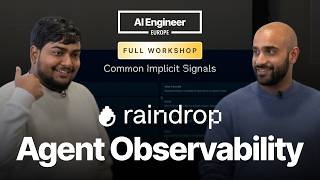
Everything You Need To Know About Agent Observability
Danny Gollapalli · Ben Hylak · Zubin Koticha
AI Engineer Europe 2026 · 50:25

3 speakers at AIE
Affiliations reflect their AIE appearances, not necessarily current employment.


Company sources · checked 2026-08-28
- Raindrop | AI Agent Monitoring & Observability
- Blog – Raindrop AI
- Raindrop: Sentry for AI Agents | Y Combinator
- Raindrop Raises $15M from Lightspeed to Monitor the Agent Era
- Introducing Raindrop Workshop
- Introducing Raindrop 2.0: Self-Healing Agents
- rd-signal-2: Frontier Classification at Production Scale