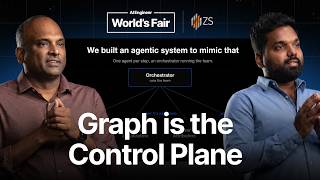
Why We Killed Our Multi-Agent Pipeline — Subbiah Sethuraman and Abhilash Asokan, ZS Associates
Subbiah Sethuraman · Abhilash Asokan
AI Engineer World's Fair 2026 · 15:00

Management consulting and life sciences AI technology
ZS provides management consulting and technology to help companies optimize clinical trials, bring products to market and improve operations. Its ZAIDYN life sciences platform spans commercial, medical, patient, content and clinical workflows. Teams can plan sales incentives, forecast trial enrollment, coordinate patient engagement and create or review content. ZAIDYN connects existing business systems with agents that monitor signals, recommend actions and execute workflows with human review, approval and override. ZAIDYN Medical and ZAIDYN Content, introduced in 2026, extend that approach into medical affairs intelligence and content creation, regulatory review and reuse.
Founded in 1983 by Andy Zoltners and Prabha Sinha, ZS grew from their operations research work into a consulting business. The founders applied a multiple-choice knapsack algorithm to sales-force sizing and developed computer-assisted territory alignment software, establishing an emphasis on quantitative resource allocation. Pratap Khedkar, CEO since 2021, previously led the global pharmaceuticals practice and founded the firm’s advanced data science capability focused on AI.
ZS lists ZAIDYN adoption by 150-plus life sciences organizations across more than 100 countries and use by over 100,000 field personnel, alongside more than $2.5 billion in annual incentive payouts managed through ZAIDYN Field Incentives. These figures appeared on its website in August 2026, without specified measurement dates or an annual payout reporting period. ZS also expanded its implementation business through its 2025 acquisition of Torrent Consulting, adding Salesforce Health Cloud, Life Sciences Cloud and Agentforce capabilities.
Subbiah Sethuraman · Abhilash Asokan
AI Engineer World's Fair 2026 · 15:00
Affiliations reflect their AIE appearances, not necessarily current employment.