Dan Adler leads Sourcegraph as CEO, an appointment announced in December 2025 after years spent helping build its business and data infrastructure. His work centers on codebase ownership: keeping an organization’s software understandable, consistent, and maintainable as coding agents accelerate changes across thousands of repositories.
Building Sourcegraph’s business and infrastructure
Adler’s career spans software, investing, and business operations. Before Sourcegraph, he worked at Bain & Company and Vector Capital and founded Cells Software. His startup pursued spreadsheet-based data labeling; he was shutting it down shortly before joining Sourcegraph in fall 2016.
The experience of searching code and following definitions and references directly in a browser drew him toward Sourcegraph. He joined before its first customer, sold early contracts, delivered demos, supported customers, and built the company’s first dashboards. He also wrote its original data infrastructure and contributed to its production codebase. His responsibilities combined hands-on software work with establishing the business around it.
Adler subsequently served as director of business operations and strategy and VP of business, establishing functions spanning finance, analytics, strategy, and IT. He was CFO before becoming CEO during Sourcegraph’s separation from Amp. Sourcegraph co-founders Quinn Slack and Beyang Liu founded the independent Amp company and remained on Sourcegraph’s board. The separation gave the businesses distinct directions: enterprise code understanding at Sourcegraph and frontier coding agents at Amp.
Understanding the code that already exists
Adler focuses on the people responsible for systems that accumulate decades of business logic, dependencies, and architectural decisions. He argues that AI-generated changes can compound duplicated functionality, inconsistent standards, and brittle dependencies. Faster implementation increases the burden of understanding how the whole system fits together.
His argument for maintaining long-lived software makes that problem concrete. An insurer’s reimbursement rules may depend on a deeply layered COBOL decision tree and thousands of supporting tables. Modernizing the system requires understanding its behavior and dependencies; generating replacement code alone does not resolve that work.
For coding agents, that concern becomes a problem of organization-wide code visibility. Agents use search to understand software, but their conclusions are limited by the code they can access. A tool that can change one repository still needs broader visibility to address a request spanning thousands. Adler treats code understanding as infrastructure for both people and agents, with context becoming a bottleneck at enterprise scale.
Coordinating changes and completing maintenance
Several connected ideas explain how Adler wants that visibility to translate into useful work:
Agentic Batch Changes: Sourcegraph’s system for coordinated changes connects investigation with execution across indexed repositories. It scopes a request, tests an approach, adapts changes to different repositories, responds to CI failures, and tracks pull requests for human review and merge. Repeated transformations can run as scripts, reserving coding agents for work requiring judgment.
Outcome-based pricing: Adler advocates charging for merged changesets, tying payment to completed work. Producing a diff leaves review, coordination, and completion unresolved. Using scripts for repetitive transformations helps make this approach practical by avoiding repeated model reasoning over the same change.
The autonomous codebase: Adler’s longer-term vision moves maintenance toward workflows initiated by events such as a newly disclosed vulnerability, an upstream change, or an operational failure. Agents with limited authorization would investigate, notify people, or prepare repairs within a directed workflow. He identifies identity, permissions, and budget controls as unresolved engineering problems. The self-maintaining codebase remains an ambition whose prerequisite is visibility into the software being maintained.
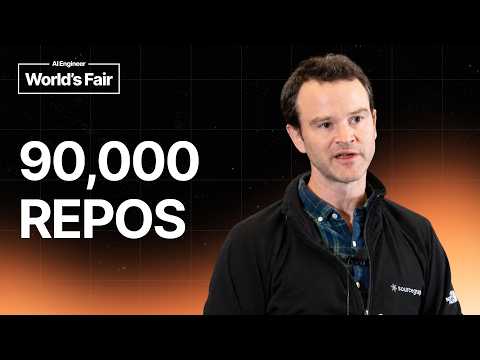
Dan Adler connects faster code generation to a growing maintenance burden, then explains why agents need codebase-wide search, compiler-informed context and coordinated changes across repositories.
An agent can create duplicate functionality when it cannot discover an existing library. Codebase-wide visibility addresses the missing context behind that locally successful edit.
Enterprise remediation requires finding affected code and understanding what runs in production, as well as producing a correct patch in one repository.
Agentic Batch Changes combines coding agents where judgment is needed, deterministic scripts for repeatable edits, and CI, PR feedback and tracking for coordinated rollout.
The Mercari example illustrates how a search can expand two known problem repositories into 80 additional potential findings before a consistent configuration fix is applied.

 ▶ Watch ↗