 ▶ Watch ↗
12:57

Conference affiliation: Harvey
Joey Wang is an engineering lead at Harvey who helped build Spectre, its internal platform for running coding agents in the cloud. Engineers who preferred Cursor wanted to test changes against Harvey’s own software. Joey’s team put that capability in Spectre, where other agents could use it too. Engineers could switch agents and still use the same tests, review process and record of who requested a change.
Based in San Francisco, Joey started his career at Google and spent nearly a decade in mobile engineering at Uber and Figma. By 2021, Figma’s mobile team had grown to more than 20 people. New engineers often asked him how a feature worked and who owned its code. Joey built a map of Figma’s mobile app in FigJam, connecting screenshots and labeling the services and teams behind each interaction. Someone planning a change could start with the screen a user saw and trace it back to the people they needed to involve.
At Harvey, Joey was the founding engineer of Vault, a workspace where legal teams organize and analyze documents. Vault initially served projects with hundreds to thousands of files. A single acquisition could bring tens of thousands of documents in waves, sometimes minutes before a negotiation. Joey was among the engineers who worked on Vault as the team adapted it to those demands. He also led Harvey’s Mobile & Voice initiative before turning to background agents for coding and professional services.
In Building Spectre, Joey and Gabe Pereyra explain how a teammate can pick up an agent’s work after its sandbox shuts down. Each task has a persistent run record that keeps its history, the changes the agent produced and the session context a fresh worker needs to continue. A colleague can ask a follow-up question in the original Slack thread without reconstructing the investigation. Joey gives particular weight to follow-up after a pull request opens. If an automated check fails overnight, an agent can read the failure and push a fix to the same pull request, ready for the reviewer in the morning.
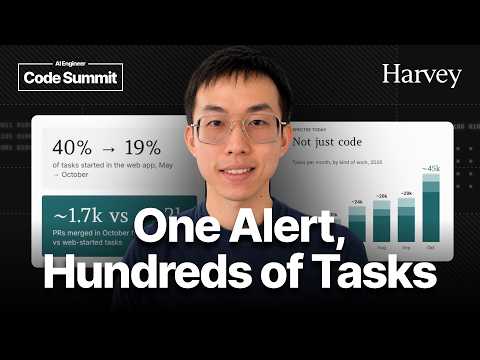
The team also made Spectre’s actions callable from the command line, so one agent could delegate work to others. Joey used that capability on a project an agent divided into ten milestones. He kept one for himself and sent the other nine to Spectre, where tasks could run and be tested in separate sandboxes. When another engineer submitted roughly 950 tasks in three hours, the cluster filled and everyone else had to wait. Joey saw that as a scheduling problem for his team to solve. Their fair launch queue gives priority to people waiting at a keyboard, reserves a share of capacity for each user and lets users borrow spare capacity when the cluster is quiet.
▶ Watch ↗12:57
Loading more talks and highlights…