Matt Gibiec, also known as Mateusz Gibiec, connects application reliability with the practical needs of the people using and changing software. His solutions engineering work at Dynatrace has focused on helping customers identify problems before users are affected. At the AI Engineer World’s Fair 2026, he presented an extension of that concern: giving coding agents the operational context they need to understand the consequences of their changes.
From computer engineering to customer systems
Gibiec studied computer engineering at Lawrence Technological University from 2014 to 2018 and participated in varsity soccer. The university recognized him among its 2018 graduates receiving the Engineering Society of Detroit’s Outstanding College Student of the Year award. His early engineering work included dashboard controls for a student racing vehicle, putting software inside a larger physical system. A 2018 account of his career plans describes his intention to combine technical problem-solving and communication in a software consulting role at Dynatrace.
His subsequent work on government applications connected those skills to services used by employees and residents. In an article co-authored with Maria Siatos, he examined observability for critical applications, including geographic information systems such as ArcGIS. Understanding whether such an application works requires connecting the user’s experience with its databases, infrastructure, networks, and security. A slow interaction and a backend change may be parts of the same problem; looking at either in isolation can obscure what needs fixing.
Giving coding agents operational context
In “Your AI Agent Has No Nervous System”, Gibiec argued that coding agents can work quickly while remaining blind to the environment their code affects. Missing context can leave them guessing, repeating unsuccessful attempts, or proposing changes that create operational and security problems. His nervous-system analogy describes the feedback they lack: information about how services actually run and depend on one another.
He introduced Bluebox by Dynatrace as an observability agent for coding agents. His explanation connects runtime information to three development decisions:
Testing against real dependencies: Production dependencies can inform local testing, helping expose changes that work on a developer’s laptop but disrupt other services.
Diagnosing and fixing problems: Early issue detection and evidence connecting a problem to the change that caused it can guide a fix that accounts for the rest of the system.
Planning with usage data: Information about actual application use can brief an agent before it builds, while a human retains control over the final fix.
These ideas extend the concern in his government application work: assessing software requires understanding what happens beyond the component being examined. For operators, that means connecting system health to the user’s experience. For coding agents, it means bringing those dependencies and consequences into development decisions.
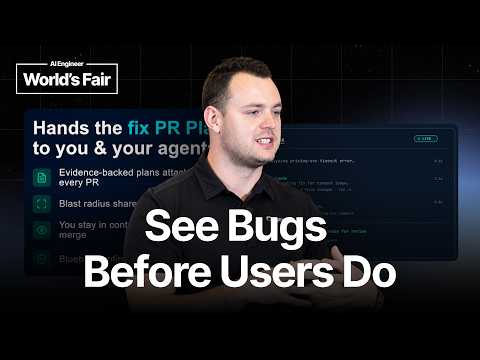
Matt Gibiec introduces Bluebox by Dynatrace as a way to give coding agents production context: service dependencies, historical behavior and repository changes that inform testing, diagnosis and fixes, with a human deciding what ships.
A coding agent needs context about service dependencies and application usage to judge changes beyond the code immediately in front of it.
Bluebox proposes bringing production dependency information into local testing so developers can consider connected workloads before merging a feature.

 ▶ Watch ↗