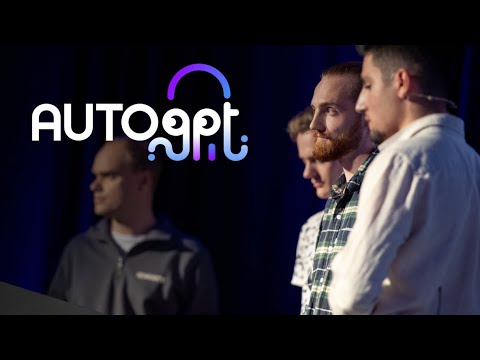
Reinier van der Leer, known online as Pwuts, is a founding engineer at AutoGPT, where he works on software that turns language-model capabilities into useful agents. His contributions address the practical problems between receiving a request and completing it: retrieving relevant information, maintaining task scope, recognizing failed actions, and measuring whether an agent reliably succeeds.
From hardware projects to autonomous software
Van der Leer’s work spans physical devices, community infrastructure, and application development. Alongside freelance development and consulting as a system architect, he has built software for Delft’s electrical-engineering study association, including its Flutter app and website API. His projects often connect a complicated underlying system to something people can use directly.
An early example is Metertrekker, a smart-meter reader he began developing in 2019. He built the electronics and firmware to extract meter readings, check their integrity, and send measurements through MQTT into a database and dashboard. Getting the checks right proved unexpectedly difficult: a change in line endings made valid readings fail checksum validation. The project developed from a breadboard experiment into a custom circuit board, with software structured to make additional measurement types easier to support.
In 2022, he served as project lead for the MCH2022 hacker-camp badge, handling planning, budget, and inventory. He also contributed to its browser tooling. For the MCH2022 WebUSB library, he converted an existing implementation to TypeScript, improved it, and added documentation. The library lets browser software communicate with the badge, manage files, and install or run applications. His role combined organizational work with the engineering needed to make programmable hardware more approachable.
By spring 2023, van der Leer was working on AutoGPT’s memory architecture. His vector-memory refactoring, merged that May, reorganized memory handling and text processing as groundwork for further improvements. His accompanying design work examined how an agent could retrieve information useful to its next action, rather than simply accumulate material from previous steps.
What makes an agent useful
Van der Leer’s technical thinking treats autonomy as a collection of engineering problems that must work together. Three concerns recur in his authored AutoGPT work:
Retrieval tied to the task: His memory-system design connects retrieval with structured planning. An agent needs meaningful points in its execution cycle at which to search for relevant information and bring it into context. Storing more material does little good if the system cannot select what matters for the next decision. He distinguishes preparing useful memories, finding them, and supplying them to the model as separate problems.
Task adherence and self-correction: In his analysis of agent performance, he argues that an agent must preserve the user’s requested scope and recognize when an action has failed. Continuing as though an unsuccessful step worked can compound errors. Tool interfaces therefore need clear inputs, outputs, side effects, and failure messages that give the agent enough information to recover.
Repeated evaluation under practical constraints: The same analysis treats success as a rate measured across attempts, with time and cost included in the assessment. More elaborate planning and memory can consume additional tokens without helping every task. A capable agent can also fail because it takes too long. These tradeoffs make evaluation a question about the whole system’s behavior, rather than the quality of an isolated response.
Building for everyday use
His work has continued as AutoGPT has expanded into a platform for building and running agent workflows. Users can describe an outcome or assemble steps visually, then run workflows on demand, on schedules, or through triggers. That product direction puts the surrounding software—execution, integrations, and operational reliability—at the center of making agents useful.
Security has become another part of that work. In March 2025, van der Leer joined fellow AutoGPT team members Bently and Nick in GitHub’s Secure Open Source Fund program. AutoGPT subsequently strengthened its security policies, incident handling, and automated vulnerability scanning. His participation extends the same practical concern that runs through his earlier projects: building a system means accounting for what happens when it encounters real inputs, real failures, and real users.
AutoGPT’s roadmap connects conversational task requests to shared development tools, measurable progress, and the safety required for agents that act on a user’s behalf.