Machine transcription with reviewed terminology and names. Some recognition errors may remain. Timestamps refer to the original livestream.
7:50:03It's great to be here. I'm Michael Manapat. I'm a co-founder of Rowspace.
7:50:08Rowspace is an agentic platform that uses AI to help financial services partners like Apollo deal with messy, fragmented data.
7:50:18We essentially use agents to do the work of data engineering, to reconcile data from across
7:50:25a variety of systems so that portfolio managers, traders, and so forth can make decisions faster
7:50:31and more accurately.
7:50:33I'm joined here with Jack McDonald, who is Chief Operating Officer of Redding Ridge,
7:50:38one of Apollo's credit units.
7:50:40And maybe to kick it off, Jack, I'd love to hear a little bit about you and what your
7:50:44business does.
7:50:45Yeah, thank you, Michael.
7:50:46I'm Jack McDonald.
7:50:47I am a principal at Apollo and COO of Redding Ridge Capital, which is our structured credit
7:50:54and CLO manager that is captive to Apollo.
7:50:57We're a fully separate entity operating company that manages about $50 billion in assets and
7:51:04all across the structured credit ecosystem, primarily CLOs.
7:51:10I've been at Apollo since 2020.
7:51:12wear various different hats throughout my time there
7:51:17across our financial institutions group,
7:51:20our asset-backed group, and now currently at Reading.
7:51:23So yeah, happy to be here.
7:51:24Awesome.
7:51:26So something that we've noticed in talking to a huge number of financial firms
7:51:31is that there's a pretty wide gap between when AI is nice to have
7:51:36and when AI can actually become mission-critical to a business.
7:51:39And I think in Apollo's case, we're seeing that AI can really be transformative in how the firm operates.
7:51:47I'd like to hear some examples from you on the kinds of work your part of the business was doing,
7:51:52what made it complex, and what you're seeing now with AI.
7:51:56Yeah. So at Apollo, and specifically Reading Ridge, we manage many different fund entities, investments.
7:52:03We're getting thousands and thousands of data points on a daily basis coming in across all of our investments.
7:52:11We manage probably 1,000 name loan pools and have credits across multiple different businesses that we're assessing on a daily basis and investing in.
7:52:21CLO management is very active, and it's traded in the broadly syndicated loan market.
7:52:25So having all that information at your fingertips is very, very important.
7:52:29So at Apollo, what we're doing is, at Reading specifically, is trying to enhance and ensure that all of our data and our data quality is accurate, consistent, and in a format that we can utilize and make us much more practical and thoughtful when we're making decisions in a much fast-paced environment.
7:52:51so all of this information is privatized and is not very what i'll say widely in the marketplace
7:52:59like how public equities or public fixed income trades it's very uh fragmented in various documents
7:53:06so we've looked to companies like row space to partner with to come in and actually sit with
7:53:13our teams work with us and understand the actual calculations and information that we're looking to
7:53:19and what's actually the golden source of truth
7:53:22and then continuing to enhance the AI engines
7:53:25to understand that and repeat that
7:53:27and just make us that much more efficient.
7:53:29I think we have a bunch of engineers in the audience
7:53:31and we've spoken a lot to you and I
7:53:34on fire drills that the firm does
7:53:36that used to take a team working a week,
7:53:40if not more.
7:53:42Can you make it concrete for us
7:53:43and maybe walk us through an example
7:53:44of something that was painful, time-consuming,
7:53:48hard to do before that now you can do more easily
7:53:51with road space and AI?
7:53:53Yeah, happy to.
7:53:54And I'll give kind of two examples that I like to look to.
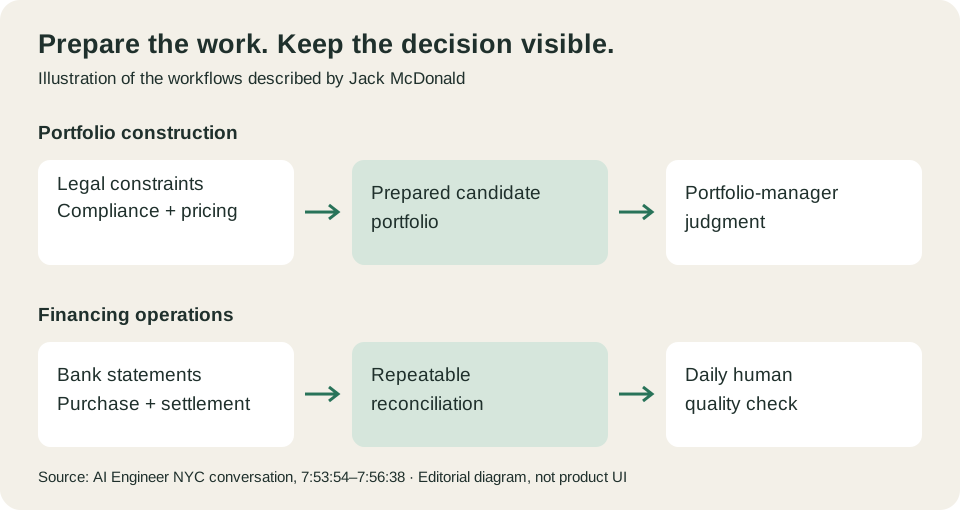
7:53:58The first being is just on the portfolio construction side.
7:54:01So CLOs are very test-specific.
7:54:04They're very rules-based.
7:54:06They have a very specific waterfall of where money flows.
7:54:10So those all live in deep indenture documents
7:54:13and multiple different legal agreements.
7:54:15that, so sitting from like a portfolio manager's perspective
7:54:19in portfolio construction,
7:54:21they are reviewing those documents,
7:54:23building Excel-based models
7:54:24and building mock portfolios with, call it,
7:54:27anywhere from 200 to 400 single credit names
7:54:30to create a portfolio,
7:54:31which would typically take a PM
7:54:34before kind of adopting row space,
7:54:36anywhere from two to three days in a manual Excel.
7:54:40Today, we're able to kind of get the latest
7:54:42and greatest information that's real time,
7:54:44create a portfolio that would take somebody days to now do it in the matter of minutes.
7:54:49And then that allows these PMs to kind of build something to call it 80, 90% completion,
7:54:56and then kind of use their judgment and their thought to further refine that portfolio,
7:55:00that last 10% to make it theirs.
7:55:03That's one of the most tangible examples that's kind of pulling in various forms of data and,
7:55:09you know, information from across multiple different things, whether it's in doc libraries,
7:55:14our trade and compliance systems and real-time pricing and stuff like that.
7:55:21The other one that I think I would look to is our warehouse purchase activity.
7:55:27So how we run our business operates with having a bunch of bank financing
7:55:32and we can go out and buy loans in the fixed income market at any given point.
7:55:37Historically, we would kind of do a trade rec and trade activity on a weekly basis
7:55:42that would go around of here's your sale purchase activity from the week, here's what we bought,
7:55:47here's what we sold. And it was very manual. We were going into various, like literally going
7:55:51into bank accounts to understand statements, where things actually settled. And it was an
7:55:58individual team that was going and wrecking that out and then sending a reported email to
7:56:02the management team to say, here's the recap. Today, what we're doing now is we've been able
7:56:08to take that exact same report, drop it into row space from a visualization perspective.
7:56:14That report was then created and now repeatable in the span of a minute.
7:56:19And now all of that is automated.
7:56:21And then from our team's perspective, we are just QAing that and checking it each day to
7:56:26make sure that that looks right.
7:56:27And now it's a much more rinse and routine type process, which historically has taken
7:56:32many hours of the week for two to three individuals on our team to actually wreck that out.
7:56:37Yeah, I love both of those examples.
7:56:39So, you know, you aren't just reading the output of a chatbot to be informed.
7:56:45I think your team are making training decisions, performing management decisions.
7:56:49So accuracy and quality are high.
7:56:51This is a two-part question.
7:56:53I think a lot of people will ask us or ask generally,
7:56:56why can't you just plug this stuff into Claude or chat to your team and see what happens?
7:57:01and for someone like you,
7:57:03how does your team get the confidence
7:57:05in a product like Rowspace
7:57:07or other AI tools to say,
7:57:09we are going to make business decisions on this,
7:57:13make trades, build portfolios, all of that.
7:57:15How do you get to that level of trust?
7:57:18Yeah, I would say Claude
7:57:20and the open AIs of the world
7:57:22and like the chat GPTs,
7:57:23all the LLMs are very beneficial,
7:57:26but it's all general information
7:57:28that that's being worked off of
7:57:30and none of your own actual data.
7:57:31So it's great for research or kind of building new ideas
7:57:35or getting up to speed on some type of product
7:57:39or investment quite quickly.
7:57:42Where Rowspace is different
7:57:43and what we've kind of taken our approach to this,
7:57:46the AI build out at Redding
7:57:48has been around owning our own data
7:57:50and having some type of platform and technology
7:57:53that sits on top of that, that we know is to be true.
7:57:56So the Rowspace team, which has been much different from what we've seen from other technology companies that we've worked with, is their boots on the ground.
7:58:06So Michael sits with our team on a daily basis, learning and understanding our information flow.
7:58:12Because for one piece of data, that might come from 20 different sources, and there's only one that's actually right.
7:58:20So the Rowspace team is spending the time
7:58:22with our portfolio management team,
7:58:24with our finance teams,
7:58:25to understand the calculations,
7:58:28understand what data is actually correct,
7:58:30and override other sources of information,
7:58:32and kind of aggregate that.
7:58:34So to that end, we're able to kind of
7:58:36have trust in the system,
7:58:38and appreciate that, okay,
7:58:40we've had our team go in and validate
7:58:43that this information is correct,
7:58:44and we can rely on it,
7:58:45and it's coming from all of our,
7:58:46whether it's our trade order management system,
7:58:49whether it's from our performance system,
7:58:51whether it's from Bloomberg or any pricing index that we're pulling in,
7:58:55and know that it's accurate.
7:58:56Whereas in a lot of other, you know, call it systems,
7:59:00throughout even our own company, it's very fragmented,
7:59:03and we have to kind of lift one piece of information from over here
7:59:06and bring it back over here and kind of pull that together manually,
7:59:09whereas RowSpace is now just automating that all for us.
7:59:12Glad to hear that.
7:59:14You want to talk about the firm at a higher level.
7:59:17It seemed to me for a long time, even early last year before cloud code became a thing,
7:59:24when Kurser was still in the TAP application era, that Apollo was among the most AI-pilled
7:59:30of the financial firms we spoke to.
7:59:33that was everything from the firm's view on how to invest in an AI world.
7:59:38But operationally, we began talking to you a long time ago, and you were in the we must
7:59:43rebuild the firm in an AI-native way, must have a platform, not point solutions.
7:59:48So I'm just curious, where did that come from?
7:59:51And what is it about Apollo's culture that made you so AI-pilled even before things took off?
7:59:58Yeah.
7:59:59So
8:00:00Apollo has always prided itself in being kind of the leader of the alternative asset management space and the financial services industry broadly.
8:00:09We pride ourselves in being very innovative and being at the forefront of all things change and what that looks like.
8:00:15So I think from the onset and the way our management team approaches how we operate is always being up to skill and enhancing our team's capabilities and being able to be nimble and adopt to where the market's going.
8:00:29I think we appreciated that the AI world is here and we need to adapt and adopt it, not discredit it or not utilize it.
8:00:38So we've been very forward and open-minded about adopting new technologies and bringing those into our workflows and how we can be more efficient.
8:00:45and free up capacity for people to be more thoughtful and think and replace manual processes.
8:00:51So I think at the core of its level we have always been a very innovative firm that is
8:00:57very flat and open culture to be open to those types of change.
8:01:01And then I'm blanking on the second part of your question.
8:01:05Sorry.
8:01:07Oh, so am I.
8:01:12Well, maybe we can keep on going.
8:01:14So I think one thing that we've been thinking about is software engineering that has completely changed as a discipline.
8:01:22Like the world is completely different if you are a technology company like Rowspace.
8:01:27And maybe arguably law and customer service are almost there.
8:01:33Where do you think finance is on the spectrum of AI is here, it's made a difference, or we haven't even gotten to the bottom of the first inning?
8:01:42And what do you think is a two-part question again, so remember the second part.
8:01:46If we're early on, what's necessary to really change the shape of finance with AI?
8:01:51Yeah, I think that's a great question.
8:01:52So I think finance broadly, these banks and large organizations are massive.
8:01:57They have a lot of, you know, back-end, what I'll call middle back-office support.
8:02:02And I think there's a lot of room to grow and enhance there.
8:02:05I think probably as you appreciate now of working with us that we are extremely complicated
8:02:11and have a lot of complexity in everything that we do.
8:02:14So it's not really straightforward.
8:02:16I think in finance broadly,
8:02:19especially in call it the asset management,
8:02:21investment banking, the bank institutional world,
8:02:25I still think it's very early.
8:02:27I think there's some value for some of the model creation
8:02:33or getting up to speed on some company quite quickly
8:02:37and pulling and aggregating that type of research.
8:02:38but I think that's lower value add, at least of where we stand today,
8:02:43and that's going to evolve.
8:02:45I think there's probably a need where there's less junior support
8:02:49over time for certain functions like that,
8:02:51but I think from where we are today and what we see
8:02:55from at least my perspective at Reading,
8:02:57I think we're just trying to adopt this technology
8:03:00and make it as efficient as possible for routine tasks
8:03:05that frees up capacity for other projects
8:03:09because we kind of have endless things to do
8:03:11and enhance at our company.
8:03:12And that's just giving us a lot more flexibility
8:03:14to adopt that.
8:03:15Yeah, yeah.
8:03:16So maybe on that note, I'm curious,
8:03:19there's a world in which AI just becomes something
8:03:22that helps speed up tasks,
8:03:24saves you on OpEx, things like that.
8:03:27And maybe in the same way,
8:03:29no given firm now has an advantage
8:03:31because they use Excel.
8:03:33because everyone uses Excel and it's just a productivity tool.
8:03:36There's also a world in which AI actually materially makes a competitive advantage
8:03:41or helps reify Apollo's lead in structuring and creative deals and so forth.
8:03:48Do you have a take on whether AI is going to be just a useful but a general commodity
8:03:54or it's going to be something that can actually structurally make a business more competitive in a durable way?
8:04:00I think if it's adapted and utilized properly, it will make you more competitive.
8:04:06I think at its core, and especially around asset management and investing type companies
8:04:11that are in the actively traded markets, it comes down to your process and the information
8:04:17at your fingertips.
8:04:18Knowing that you have a strong process in place to go out and execute and knowing your
8:04:23available liquidity or where things are pricing and what the value is at any given point is
8:04:27crucial.
8:04:28So that just gives you more competitive edge.
8:04:31And I think that exists today in the actively traded markets,
8:04:36but in the private markets, it's evolving,
8:04:38which we've kind of been at the forefront of trying to move on the broad Apollo machine.
8:04:43And I think having that will just turn into a competitive advantage over time
8:04:48where firms will be able to get further ahead as they're having access to better information.
8:04:55their teams know that it's accurate
8:04:59and stuff is not misaligned
8:05:01because the last thing we want to do is
8:05:04do something or make a decision that was misinformed
8:05:07or had misinformation and then that streamlines down the chain
8:05:10to both the enterprise and to our investor base
8:05:13at the end of the day.
8:05:14That makes sense.
8:05:16I wanted to ask you what your prediction was
8:05:19for what Apollo would be like when we're talking five years
8:05:22observing all the change.
8:05:24I think that's unfair.
8:05:25I can't even predict if my team is going to use Codex or Claude Code next week, so I want
8:05:30to ask you about five years in the future.
8:05:32But I'm curious for you personally, what are you hoping to see in terms of your job, team,
8:05:39how AI use in Apollo evolves, what conditions have to hold for the technology to actually
8:05:45be truly valuable?
8:05:47How are you thinking about things over the next few months?
8:05:50Yeah, I think it comes back to some of the stuff I touched on before.
8:05:53of just one having just you know full confidence in any type of information that's flowing out at
8:05:59the end of the day to our investor base that's accurate correct and we don't have to spend hours
8:06:04manually checking that to make sure that that's validated and having the confidence that we're
8:06:09sharing you know no issues and or mistakes um because we do have just a wide investor base
8:06:15over 400 global investors.
8:06:19I would also say being much more
8:06:21tech-enabled in mindset.
8:06:23I think our team has not lacked that to date,
8:06:26but it's kind of been an afterthought
8:06:28around the use of technology.
8:06:30And I think the more that we can develop
8:06:32and enhance these tools
8:06:33that make routine tasks more efficient,
8:06:37it frees up capacity to add more thought
8:06:40or think more creatively around
8:06:42why does this process exist
8:06:44and how does it work today?
8:06:45and how can we actually enhance that, or should we change that,
8:06:48or should we bring in a new type of technology
8:06:50and adopt that going forward?
8:06:52And our team has not lacked that today,
8:06:55but it's kind of been a secondary thought
8:06:57where I think ideally our workforce is positioned
8:07:00to think about that more on a go-forward basis,
8:07:03and that's kind of their primary thought
8:07:05is they're tackling different problems.
8:07:07This is specifically at Redding Ridge Day-to-Day
8:07:09and kind of scaling our organization.
8:07:12I think we have time for one more.
8:07:13I think one of my learnings from working with you has just been how unimaginably complex and creative the work is
8:07:19and how it takes a lot of effort, both human and AI, to get things to work.
8:07:24A lot of people in this room who either want to work on the technology side of AI and finance,
8:07:29or perhaps finance side, is there anything that you would mention to them from,
8:07:32here's something that you should know or keep in mind when trying to apply AI to domains like yours?
8:07:39I would say it comes down to we are extremely complex organizations and it's not as straightforward.
8:07:45And typically things might look a little bit novel or strange and out of place, but it's probably actually there for a reason or structured in a specific way.
8:07:54I'm sure as you guys have come in, you appreciate that we're super nuanced and complicated.
8:07:59So spending the time and really putting boots on the ground to sit with whatever team or front office professional that you're working to build a tool for or enhance is time well spent.
8:08:12And I think the success and, you know, where we are today with the Rowspace product and kind of being ahead of our roadmap and expectations has been, you know, due to the fact that Michael and the team have spent ample time sitting on the ground with our team, like pretty much every single day and, you know, understanding our workflows, which I think is crucial.
8:08:32Awesome. Well, I guess last thing I'll say is that, shameless plug, both Rowspace and Apollo Technology are hiring people who want to apply AI to finance.
8:08:41So please reach out to either of us if you are interested.
8:08:45Jack, thanks so much.
8:08:46Yeah, this is great.
8:08:48Thank you, guys.