
A correct report still needs a reason to run
Going live proves that software exists. It does not establish that people will use it, or that its output will produce the value promised in a business case. Michele Grant, creator of Leading at Scale, approaches agent deployment through her experience in enterprise transformation and acquisition integration. Trust has to be built into the operating process before launch.
She asks three questions of an agent: what value does it create, who is accountable for it, and what evidence justifies giving it more autonomy? A pilot can establish that the software functions. Production adds decisions about permitted actions, ownership, recorded evidence, and escalation. Engineers can implement those decisions, but leadership has to make them.
Grant carries an illustrative acquisition through the talk: a $15 billion deal targeting $400 million in net synergies, with an integration management office coordinating 40 workstreams. Analysts collect updates, reconcile them against the general ledger, compare actuals with the plan, and assemble the weekly steering-committee report. An agent automates the first draft. After a four-week pilot, its reports match the analysts’ work line for line. That is the beginning of the deployment decision.
Measure the change in decisions, not just report speed
The steering committee needs a written value case before production use. Grant separates three measurements that can otherwise disappear inside a vague claim of time saved:
- Report cycle time: establish how long compilation takes today and set a target. In her example, the report moves from five business days to two.
- Redeployed analyst capacity: four analysts spending half their week on the report represents 80 hours. Releasing those hours creates value only if the integration lead assigns them to work that needs attention. Compute, licensing, and human-review costs still count against the benefit.
- Detection time: measure the delay between the first sign of a material problem and the committee seeing it. A faster report does not necessarily reveal a slipping initiative sooner.
Each measure needs a baseline. Without one, a convincing demonstration can become its own business case: the agent looks faster, but nobody can say what improved or whether the improvement mattered. The acquisition and capacity figures are teaching examples, not results from a disclosed deployment.
Keep the decision with a named owner
Grant applies three lines of accountability. Management owns the controls and output; the integration lead remains responsible for the report. Risk and compliance challenge how the agent operates, with scrutiny proportional to its authority. Internal audit provides independent assurance based on material risk. An internal draft reviewed by an analyst creates a different exposure from figures published directly to the board.
Someone also has to supervise the agent every day. That person needs to understand its limits, interpret its output, override or reverse it, and stop it safely. Giving a person a review task without those capabilities does not establish meaningful oversight.
Grant records the division of work in a one-page Human Works Standard. At each decision, it names the authorized human, required evidence, and escalation path. The analyst decides whether a variance is an accounting-timing difference or a real cash shortfall. The workstream lead decides how to remedy it. The integration lead decides whether to mark the initiative at risk. The agent prepares the analysis supporting those decisions.
The diagram follows a constructed mismatch through that division of work. The reported amount and ledger amount remain distinct until a person resolves the discrepancy.
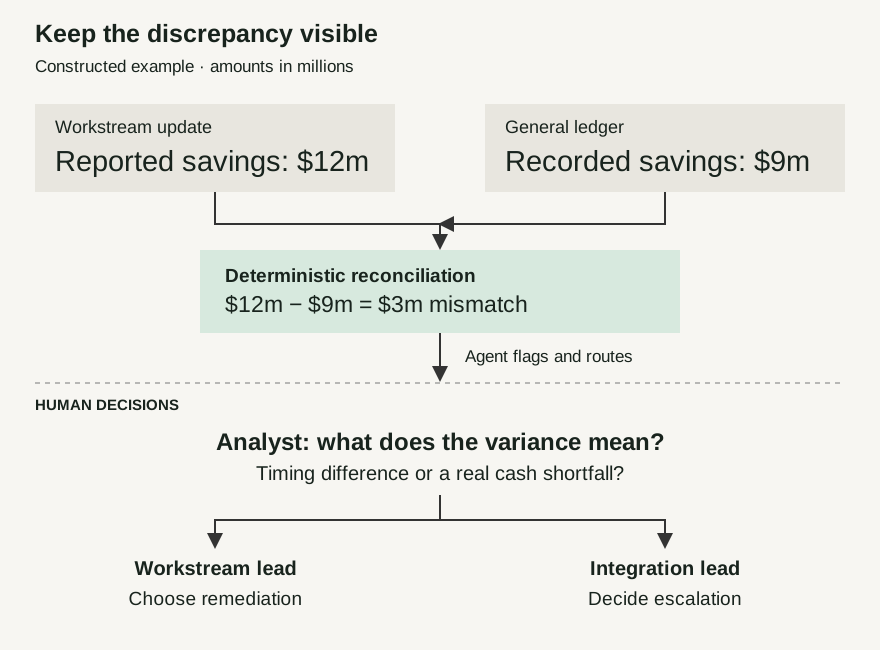
Illustrative amounts; the decision sequence follows Grant’s explanation at 4:36:44 and 4:38:53.
The reason to delay is an unowned decision. If nobody can declare an initiative off track, a more accurate flag still goes nowhere.
Build evidence that survives a model change
Greater autonomy rests on evidence from the system’s operation. Grant wants an auditable decision log containing the data ingested, tools executed, prompt and model versions, generated output, and human sign-off. Core reconciliation and financial arithmetic run in deterministic, finance-approved code. The model’s narrative helps someone understand the result; it does not replace the underlying records and calculations.
If reported savings disagree with the general ledger, the agent flags and routes the discrepancy. It does not quietly change the number to make the report agree.
A maintained inventory records the accountable executive, data lineage, system dependencies, validation results, escalation path, and shutdown procedure. It also defines regression triggers. A changed prompt, base model, or source API can change the agent’s behavior even when its product name stays the same. Grant calls for revalidation before those changes return to production.
Autonomy can advance—and move backward
An autonomy scorecard makes the next deployment decision explicit:
- Shadow mode: analysts continue producing the report while the agent runs beside them; the team compares the outputs.
- Supervised draft: the agent prepares the report and an analyst reviews every line item.
- Exceptions plus sampling: the analyst reviews flagged initiatives and a random sample of apparently clean ones.
- Exception-focused review: the analyst concentrates on high-risk anomalies, supported by periodic independent sampling.
The final stage changes where failures hide. When people see only what the agent flags, a missed material issue can stay invisible. Independent sampling checks the apparently clean work and measures the severity of missed issues. A falling override rate is ambiguous: the agent may have improved, or the humans may have stopped looking as closely.
The scorecard puts those controls beside cycle time, redeployed hours, and detection time. The committee can promote the agent, hold its current authority, or return it to more supervision. Autonomy is a decision supported by continuing evidence.
Grant closes by returning to the acquisition. An agent does not create $400 million in synergies by writing the report. Procurement, supply-chain, and operating teams still have to do the integration work. The agent’s contribution is earlier, verified information that gives those people time to act.