Machine transcription with reviewed terminology and names. Some recognition errors may remain. Timestamps refer to the original livestream.
5:01:38Okay.
5:01:39Yeah.
5:01:40Do we want to call it Jiro or no?
5:01:42Yeah, we could call it Jiro.
5:01:43We could just be like, this is our agent Jiro.
5:01:45I think it's also like a helpful potential cut,
5:01:46which is like if we ask Jiro,
5:01:48are you ready to get started?
5:01:50Yeah, sure.
5:01:50And then our video can move,
5:01:53Jiro can draw something,
5:01:55acknowledgement, whatever.
5:01:56Yeah, yeah, yeah.
5:01:56It can be like a transition pain,
5:01:58transition cut.
5:02:00All right, let's get started.
5:02:02Thanks, guys, for coming to listen to a talk
5:02:04on the AIE online track.
5:02:06I guess coming to listen is not quite right
5:02:08because obviously you guys are not in the room with us.
5:02:11Making the long, long trip.
5:02:12Yeah, making the long, long trip.
5:02:13Yeah, yeah, yeah.
5:02:14The arduous journey to YouTube.com.
5:02:15Whenever we do these kinds of talks, we always want to play around with the format a little bit.
5:02:19I'm not a huge fan of just standing in front of a loom and doing slides late at night in my room.
5:02:23So I dragged Cliff along to do something a little bit different.
5:02:26We wanted to do this in a little bit of a podcast format.
5:02:28And part of that is just because it's nice to have multiple people to riff with and bounce ideas off of.
5:02:33But also because we wanted to find a way to include Jiro, our agent.
5:02:37So obviously, on our side, Jiro is not quite in the room with us.
5:02:41He's kind of living on this computer.
5:02:42But when you guys are watching this on YouTube, hopefully you'll have all three of us present.
5:02:47You'll have me and Cliff talking and then Jiro will be sort of in the middle, drawing things out and describing, describing things.
5:02:53Jiro, please wave hi for the viewers.
5:02:55Yeah, Jiro, please wave hi for the viewers.
5:02:57So this talk is all about agentifying a SecMaster.
5:03:01This is part of AIE New York, which, of course, is very, very focused on the finance and like AI and finance in 2026.
5:03:09and so i think uh before we really dive in maybe it makes sense for just us to briefly introduce
5:03:15ourselves and then we probably want to just give some definitions even like what is a sec master
5:03:19what is a cloud agent how do you like use agents to do any of these things um so i'll go first
5:03:23my name is amol i am the ceo of a company called nori agentic and as you might have guessed we
5:03:29spend a lot of time thinking about cloud agents and how we can put agents in the cloud to solve
5:03:33problems, both in finance and kind of all in a bunch of different industries. And yeah, Cliff.
5:03:39I'm Cliff. I'm the CTO at Nori Agentic. We've been working on dev tooling, AI agents,
5:03:44this form factor for almost two years now. And before that, I was working on data engineering
5:03:48and building out a new data platform for a startup hedge fund. And before that,
5:03:52staff software engineering. And there's kind of a through line in all those things with data
5:03:55engineering, dev tools, some amount of cloud inference, some amount of web apps.
5:04:00Yeah, it's kind of funny, actually. This is almost like a perfect talk for you. Like,
5:04:02I'm sort of the odd person out. My background's in ML, so I've been doing the AI ML thing for
5:04:0712 years, but I don't know anything about finance. You know all the finance stuff.
5:04:11So it's kind of an interesting conversation, right? Because we have two potentially very
5:04:14different audiences in the room. You have the finance folks who maybe don't know anything
5:04:18about AI, and you have the AI engineer folks who maybe don't know anything about finance.
5:04:22So maybe it makes sense to even just get started with some definitions like,
5:04:25what is a cloud agent and what is a SEC master before we can even dive into how these things
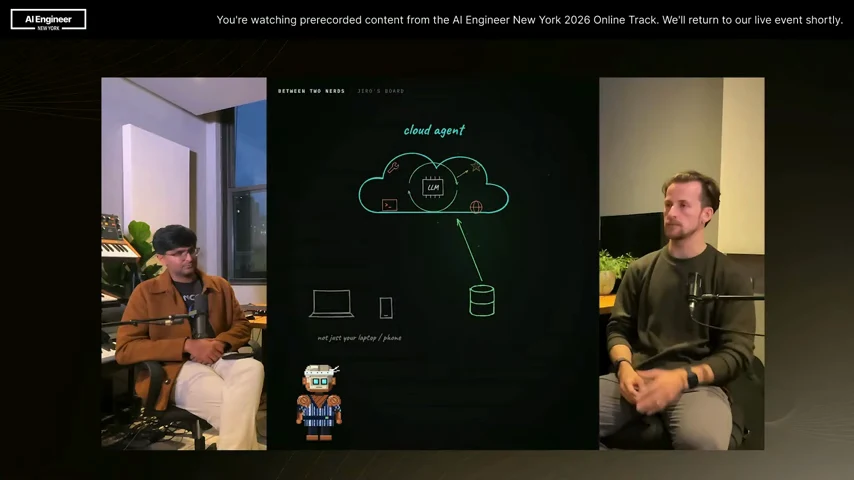
5:04:30fit together. Yes. So cloud agent, the most succinct definition, I think, for just agent to
5:04:37start an LLM or a model that you run in a loop and give access to tools. And so it can take some
5:04:43action that you hopefully find useful. Specifically cloud agents, you take that whole form factor,
5:04:48usually the code that is calling the model in a loop and you put it in some cloud process and
5:04:52you give it access to tools that don't exist on your laptop or your phone or wherever else.
5:04:56And now that whole entity, the hopeful, useful primitive, runs in the cloud, hopefully taking action with either your company's data and processes or your own needs.
5:05:08And I mean, so much of the important data now lives in the cloud.
5:05:11So like in some sense, it actually is like a very natural home for all of that to even run.
5:05:15Yeah, I think it's there's a certain historicity of, I think, when we saw local agents take off.
5:05:21Right.
5:05:21With the Claude Code moment last year.
5:05:23Right.
5:05:23And before that, with earlier agent primitives.
5:05:26Right.
5:05:27I think it's almost like a quirk of history that it became local first.
5:05:31Yeah.
5:05:31Just to start.
5:05:32In the long run, we're going to see it take a lot longer for actual on-edge
5:05:37devices to deliver value.
5:05:39So that's cloud agents, agents that run in the cloud that you can basically do things
5:05:43with asynchronously and talk through across a bunch of different platforms.
5:05:46What about a Secmaster?
5:05:47Yes.
5:05:48Now, we probably want to spend more time here because I think that this is a lot harder.
5:05:51It's harder for the average, I think, person who is not in finance to understand what a
5:05:55a sec master is compared to the other way around. And I think that people in finance have heard a
5:05:58lot more about agents than the other way. Yeah. And software engineers have heard about a stack
5:06:02master. Yeah. I certainly felt that way several years ago, kind of jumping into that field to
5:06:07bring data engineering expertise to help a startup hedge fund begin trading. So I mean,
5:06:11training, I think is the place to start. So you have in theory, a tradable universe of assets that
5:06:17are core to your business as an asset manager, many different types of asset managers. We don't
5:06:22even need to go there right now. But for your business to operate, you need some master database
5:06:26of all the securities that are in that tradable universe. Yeah. And so it's basically just like
5:06:31a table. Like for the engineering side, you can kind of think of this as a table that lives in
5:06:35Snowflake or Databricks or something like that. But in practice, it's actually like a really,
5:06:39really important operational primitive. Yeah. And I think it's,
5:06:44if you just give the rote definition of identifiers and assets and instruments,
5:06:48and you start to explain the difference between,
5:06:51okay, you have instruments and some of them are securitized
5:06:54and there will be different asset classes.
5:06:56And okay, that seems like most of it.
5:06:58Yeah.
5:06:58And actually?
5:06:59Actually, building the thing, going inside the primitive,
5:07:03there's a lot of complexity, a lot of accidental complexity.
5:07:06And once you get a centralized representation,
5:07:08it makes all the downstream processes very, very easy.
5:07:10And that's why almost every asset manager has one.
5:07:13Yeah.
5:07:14But actually munging all that data together
5:07:16And every time you bump into a new asset class or a new ID format, a new upstream source of data, you actually have new needs that you need to abstract inside the security master.
5:07:25I mean, I tend to think of it almost like an operational primitive where you just have all of this data, all these different data sources and all these different data consumers.
5:07:32And if you don't have something in the middle that basically ensures that the right data is getting to the right places, it's impossible to otherwise guarantee in a distributed way that you're going to have clean data, that you're going to be able to report the right things, that your audits are correct, that your pricing models are correct.
5:07:47Like all of that stuff essentially is downstream of having a good, clean sec master.
5:07:52Yeah.
5:07:52So the sec master for most analysis that you're going to run, it's going to be the left side of almost every join.
5:07:59Yeah.
5:07:59It's going to be the starting point for a lot of analysis that you do.
5:08:02Yeah.
5:08:02And that drives some of the biggest processes at any asset manager.
5:08:06Right.
5:08:06And that could be everything from your reporting requirements to looking at historical performance to understanding your...
5:08:14I'm sorry, this is just regulatory.
5:08:15Like you literally have to have some sort of a record of what assets you have.
5:08:18Yeah, exactly.
5:08:19Yeah.
5:08:20I think it's very easy as software engineers for us to jump over some of the accidental complexity that gets encapsulated within an abstraction.
5:08:28Sure.
5:08:28and so the comparison i've been thinking about when we've explained this to other engineers on
5:08:33our team and talking with our customers it's like date time libraries yeah it's very it's very easy
5:08:39for engineers to think oh it's a daytime library yeah you're just tracking the time how hard could
5:08:44it be and then you realize like time zones are a thing and like people track things differently and
5:08:48it's all sorts of pain yeah everything from the localization to how people see the same
5:08:52representation to actually moving something between different time zones and uh daylight
5:08:56savings actually hits at different points in different countries.
5:09:00So just like the briefest snapshot of all the accidental complexity that you hide inside
5:09:05the perimeter of the Secmaster, I think the easiest place to start, just so people grasp
5:09:11this, is publicly traded equities.
5:09:13Yeah.
5:09:13Like a Google or an Apple stock or something like that.
5:09:15You go to the exchange, you buy Google or something like that.
5:09:17Yeah.
5:09:18And this is by far the easiest asset class to even handle.
5:09:21And already you just mentioned one of the first quirks, which is Google.
5:09:25that's not even one-to-one between tickers and company.
5:09:28Yeah, what do you mean by Google?
5:09:29Like, are you buying Alphabet stock?
5:09:30Are you buying Google stock?
5:09:31There's actually two completely different
5:09:32things. Yeah, and there's Google Class A and B.
5:09:33And they are different on different exchanges,
5:09:35and they're different in different countries.
5:09:37So tickers aren't unique.
5:09:38They're not one-to-one with the actual entities.
5:09:41Right.
5:09:41And then on different exchanges,
5:09:42you can actually have the same stock listed
5:09:45across potentially a different exchange in the EU.
5:09:49Right.
5:09:49You might have actually different listings
5:09:51of the same underlying shares.
5:09:53So you got this rat's nest of data, basically, and it's really, really hard to unentangle.
5:09:58And you have to basically have a team of people
5:10:00who are doing this pretty labor-intensive role of keeping this all clean.
5:10:04Yeah. And so a lot of it's kind of architecting how the SecMasters work for the area or particular asset classes that your business will be investing in.
5:10:13I think that, especially in the publicly traded world, oftentimes most of the structure to the data comes from the moments where that data encounters different centralizing forces.
5:10:25So the two biggest examples are the regulatory constraints and the actual exchanges where it's traded.
5:10:32Right.
5:10:32So kind of point of sale, point of exchange.
5:10:34And those two have the effect of creating most of the identifiers that you care about in the publicly traded world.
5:10:39Right.
5:10:39So if those are the assets that you're interested in, you have to make sure that you have those identifiers.
5:10:45You have to make sure they're aligned.
5:10:46You have to make sure you have them somewhere recorded in your company, because anytime anybody wants to do anything with those assets, they have to reference them back to those things.
5:10:53Yeah. And at first it can be relatively easy because you're dealing with a particular asset class.
5:10:57You're dealing with one intersection of different centralizing structures.
5:11:02You can just be like, I'm just going to use Bloomberg's IDs for everything and not worry about it.
5:11:06Yeah, so you have Bloomberg's IDBB Globals.
5:11:09It's like a column in the source data that you're going to get from them.
5:11:11And these are called FIGGYs sometimes because of a previous acronym.
5:11:15It's called FIGGY?
5:11:16F-I-G-G-Y?
5:11:17Yeah, it's like Financial Instrument Global Identifier.
5:11:20Okay.
5:11:20But I don't know if it's officially renamed.
5:11:23Sure, yeah, sure, whatever.
5:11:24It's a little bit easier to say than IDBB Global.
5:11:26And so from that, that's going to answer a lot of your problems.
5:11:29Yeah.
5:11:30At the moment you get a little bit bigger, then it starts to get a little bit messy.
5:11:32Once there's a little bit more complexity.
5:11:34Yeah.
5:11:34or you're not dealing with things that are understood in the Bloomberg universe of assets.
5:11:38And so actually one of the things I think is really interesting is the last three years,
5:11:42I think, has seen a massive growth for asset managers in assets that are not of this sort
5:11:47of like standardized, globalized public entities, right?
5:11:51Like Google and Apple in some sense are pretty well understood, but so many people are now
5:11:55investing in like data centers and like clusters of GPUs.
5:11:58And if you're just like buying a data center from somebody or buying like shares of a data
5:12:02center, that's not something that trades on a liquid market. And so you have to like track that
5:12:05in some other way. Yeah. So, I mean, this is not my area of expertise, but the data centers are
5:12:11a very interesting one because I think it touches on multiple different areas of private, privately
5:12:17traded instruments. Right. So you might have actual real estate that's involved in where do
5:12:22we build this data center? The actual land. Yeah. And then from there, there might be a
5:12:25privately owned company that does issue equity. Maybe it's held by a publicly traded company.
5:12:32Maybe there's some publicly traded bonds issued to fund some part of this, or maybe there's private
5:12:37credit that's taken on to fund the construction. I mean, increasingly the GPUs itself feel like
5:12:42an asset class. Yeah. And there actually are efforts right now to securitize GPUs.
5:12:47GPU clusters. Yeah, sure. Well, I mean, because another private asset that's a very interesting
5:12:51niche is airplanes.
5:12:53Sure.
5:12:53So one reason why
5:12:54the entry costs
5:12:55for the airline business
5:12:57are low is because...
5:12:58Oh, low.
5:12:58Low.
5:12:59The entry costs are so low
5:13:00is because it holds collateral
5:13:02against itself
5:13:02when you're losing these
5:13:03planes. Oh, interesting.
5:13:03You could lose the plane.
5:13:04Yeah.
5:13:05So it's going to get us to
5:13:07most private assets.
5:13:09This is actually
5:13:09a helpful distinction.
5:13:10Most private assets
5:13:10are not very fungible.
5:13:12Yeah, sure.
5:13:12Yeah, yeah,
5:13:13That's kind of a homework
5:13:14of the problem
5:13:14that we're going to come back to.
5:13:15There are some of these
5:13:16private assets that actually are...
5:13:18Are weirdly fungible.
5:13:19Weirdly fungible,
5:13:19like airplanes or GPUs.
5:13:21Yeah. So it might be worth even diving into then the specifics, right? So what does it mean to agentify a securities master? And I think it could be helpful to even ground this in a particular example, which is, you know, we're working very closely with one of these big asset managers in New York City, one of the benefits of being in New York, New York local. Like, let's talk through a little bit of like what problems that they are running into. And then how are they using agents to solve that problem?
5:13:43Yeah, so a lot of this is that last distinction we hit on for private assets.
5:13:52And the first important distinction here is that the amount of data and the amount of work related to each asset,
5:14:00it scales linearly with a number of assets because they're unique.
5:14:03So each private asset, it's not like you can easily write software that will handle a group of these private assets because each one is different.
5:14:11Yeah, oftentimes.
5:14:12There's no API that you can hit to be like, give me the price of this data center.
5:14:16The price lives in a contract somewhere.
5:14:18Yeah.
5:14:18And if you're part of a business like a VC where the number of these different assets already scales linear to the amount of time put in,
5:14:27so the number of different checks that you write is already very related to the number of different person hours spent with those potential investments.
5:14:35It's extremely manual.
5:14:36It's very manual.
5:14:37And it might be, you know, that might be scalable because it's already, you know, the source data is proportional to the person hours and then the downstream effects then cost proportional person hours.
5:14:46But then once you start looking at everything from real estate to private credit and the different ways that these assets can be packaged, that ends up being its own whole new way that the scale of the data increases.
5:14:58So you have this like, you have this like, you know, exponentially increasing complexity.
5:15:03How does that then impact?
5:15:05Like, let's dive into this kind of specific use case.
5:15:07So we're working with this asset manager.
5:15:08Like, what are the things that they are trying to do?
5:15:10And then where do agents come in?
5:15:12Yeah.
5:15:12So they're already seeing a process where they've created a new sec master.
5:15:16Yep.
5:15:17And they have both internal and external sources.
5:15:19Yep.
5:15:20Many of these are quantitative, but some of them are actually related to different documents
5:15:25and other unstructured sources of data.
5:15:28And they have data pipelines that are mapping that.
5:15:30And just the lowest barrier for adoption is accurately being able to tie out individual changes to upstream pieces of evidence.
5:15:41Yeah, yeah.
5:15:41And that, just for a couple hundred columns or a couple hundred rows with even fewer than that columns, is already a very labor-intensive process.
5:15:50And they manage a lot more than a couple hundred assets.
5:15:53Yeah, yeah, yeah, yeah.
5:15:54So just to give a kind of layman's view of this, right?
5:15:57Like anytime an asset, anytime one of these rows in this table changes, there's a guy, like somebody who gets called up, who basically has to then go and figure out why that change happened.
5:16:08Right.
5:16:08Yeah.
5:16:09So basically be able to look at any cell in the table and look at the lineage for what produced that.
5:16:14Not every row.
5:16:15It's every cell.
5:16:15Every cell.
5:16:16Yeah.
5:16:16Yeah.
5:16:17So every row slash column.
5:16:18Yeah.
5:16:19And.
5:16:20So extremely labor.
5:16:21Like anytime anything changes for any of these columns and rows, there's a person who basically has to go and find the provenance for that data.
5:16:28And yeah, I can't undersell the trickiness raised by the intersection of both software and finance here.
5:16:35Sure.
5:16:35Because that person is not going to both be able to perfectly understand all the Python data munching and data flows, whether that's like some notebooks that run in Snowflake all the way down to like the build your own.
5:16:47We have our own lake house and we're running our own Apache Spark jobs.
5:16:50If they are a finance expert, someone who's conducted a lot of operational work in back office for different managers...
5:16:56They probably don't have that software engineering system.
5:16:58A lot of those people are really savvy, actually, with how they can use Python to solve problems on their machine with different CSVs or tie-outs or exports from Excel.
5:17:06But being able to look at the repo and understand...
5:17:11It's interesting, spreadsheets and software are kind of opposite views of the same process.
5:17:17space. Yeah. Where it's like with a spreadsheet, you see the data and you don't see the logic.
5:17:21And then with a software, you know, all these data pipelines, you see the process and the logic,
5:17:26but you don't see the data. Yeah. And so there's completely different representations. And on the
5:17:29flip side of it, you have the software engineer who has implemented the data pipelines and they've,
5:17:33but they don't have the financial knowledge. They don't know what it looks like for something to be
5:17:37incorrect in this particular cell that's now causing problems for an investment professional
5:17:41who needs to look at data and have it be correct. Right. Right. Right. So, so you have this process
5:17:45that right now, anytime a cell changes,
5:17:47and for private data,
5:17:48it's not even like you can go hit an API.
5:17:50You literally have a guy going through a Google Drive
5:17:52or going through somebody's emails
5:17:53to find a PDF of a contract
5:17:55to make sure that the data is correct.
5:17:57Yeah.
5:17:58Is this the most up-to-date version?
5:17:59Is this the latest notarized version of the contract
5:18:02and not some draft that was sent back and forth?
5:18:05Is the actual information I need here
5:18:06or is there a more recent update?
5:18:09And so I just feel like in those terms, right,
5:18:12it's just so obvious that cloud agents
5:18:14would solve this problem.
5:18:15yeah yeah or maybe you know ameliorate the problem yeah solve is a tough word yeah so i think this
5:18:21kind of gets to like the most interesting part of the problem which is why is this hard yeah we as
5:18:28software engineers as software professionals we see agents solving accidental complexity every
5:18:33single day yes so i think it's helpful to just deep dive why is this hard both from a technical
5:18:37perspective and a business perspective yeah and to your point about there's someone who needs to go
5:18:44look for this, right? Being able to know what good looks like, what correct looks like,
5:18:49that's more of a business question. Or it can also be a search problem where,
5:18:55you know, when have you seen enough? When do you have all of the evidence? It's tough to prove.
5:19:00It's going to be different from different companies in different situations. Yeah.
5:19:03For different assets, even. Exactly. And yeah, I mean, one of the reasons why this particular
5:19:08instance, this particular project is a good fit is because they've already actually thought very
5:19:13hard about what does that workflow look like? What does it look like to reconcile inconsistencies or
5:19:19any changes with the data? What would they want that back office function to actually look at
5:19:25step by step? And when would they want them to escalate an inconsistency they're seeing up to
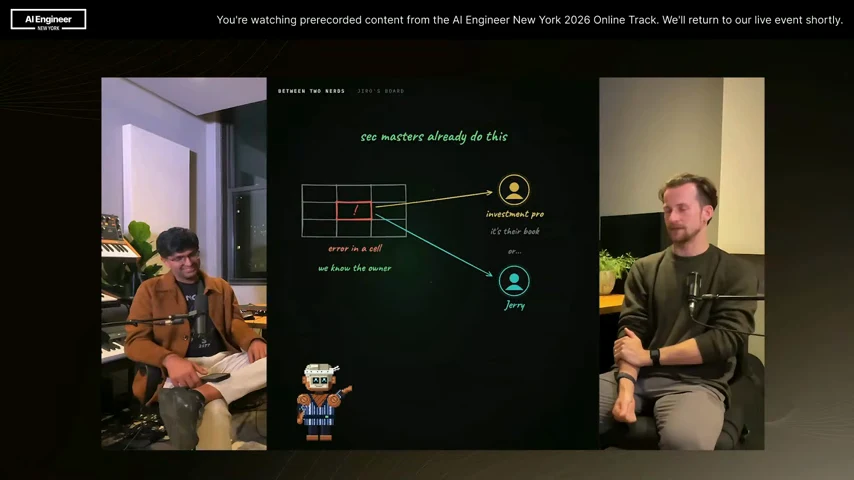
5:19:30a data owner or to a financial? Sec masters already have this sort of process in place.
5:19:34If there's an error somewhere, they already know, okay, there's an error in the cell. We know who
5:19:39is going to be owner of that cell? Yeah, it could be everything from there is an investment
5:19:43professional whose book or whose investments are related to this particular number. It could be
5:19:53actually, you know, when this particular data source doesn't look correct, we talked to Jerry.
5:19:58Sure. Because he
5:20:00was the one who talked to them on the initial extracts of data that they sent over.
5:20:03Yep.
5:20:04So this, I think, is like the first of the problems of why this is hard.
5:20:08It's like a type of knowledge, yeah.
5:20:08Yeah, there's knowledge that's not encoded in either the code or the spreadsheets or a lot of the purpose behind the tasks.
5:20:16The tasks are very encoded at your company, but the purpose behind those tasks is often not.
5:20:21And that lives with all of the people who are making up those different functions.
5:20:25Which I think also gets to the second part of why this is difficult.
5:20:29In order to properly assist them, you need to make assistive technologies.
5:20:34And this is a common failure pattern we've seen, especially on the software side of the market for the past year or
5:20:40There's so many people who want the agents to take everything to 100%.
5:20:43And so they create these software factories, quote unquote, that are really inflexible.
5:20:49you know they they spin up some process where it's like oh i tagged this agent and it'll like
5:20:53run in s in uh ec2 and then there's no thought put into well what if you need to intervene what
5:21:00if you need the agent to be able to do something else but if you need to respond there's got to be
5:21:03this like very rich human interaction pattern and if your thought process is i'm just going to have
5:21:09this thing run autonomously and try and do the whole thing to 100 well you're going to fail
5:21:14because there's actually like so much depth that like a human needs to even if it's just
5:21:18accountability. Sometimes you need a human just to be able to hit the merge button.
5:21:22Yeah. And it's kind of funny that people are shooting for that particular target when that's
5:21:28one of the biggest benefits of agents is their malleability and the ability to correct them.
5:21:34I mean, I think it's mid-task. I think a big part of it is, and this is kind of the thing about
5:21:38cloud agents. I think a lot of people think, oh, a cloud agent is just something that we can just
5:21:42have an endpoint and then kick off a task. But actually the real cloud agent infrastructure
5:21:46is when it feels seamless.
5:21:48It feels so seamless to be able to talk to it in the cloud
5:21:51as if it was running on your computer or on your phone
5:21:54or you were just talking to it over a voice call.
5:21:57And that's the level of depth and product area
5:22:00that most people just don't want to do
5:22:01because it's hard.
5:22:02It's hard to build that.
5:22:03Yeah, I know that's the second part that's difficult,
5:22:05which is from the technical side.