Anatomy and origins
Inside a skill folder
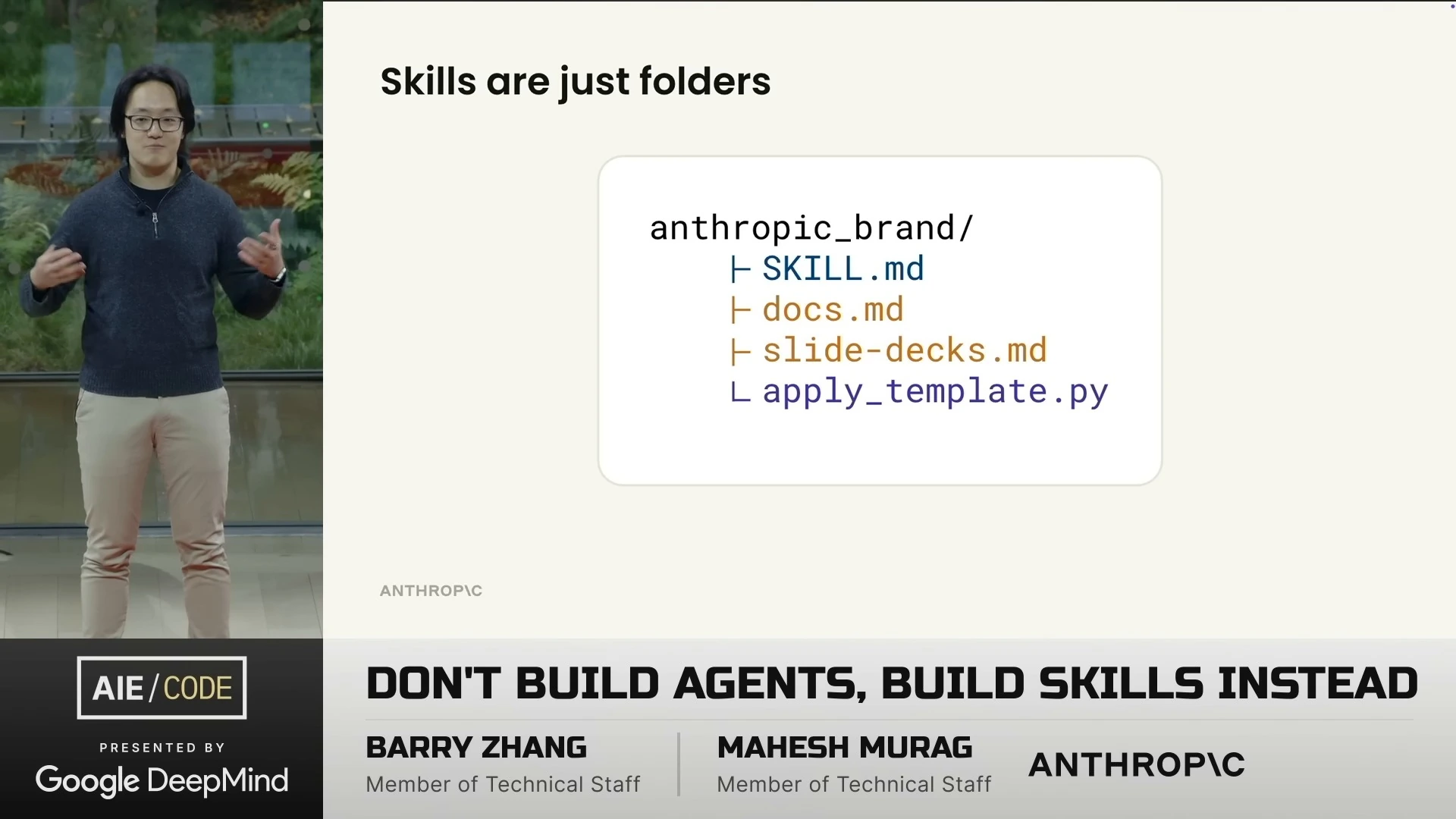
Barry Zhang and Mahesh Murag showed an example folder on stage. In the slide below, anthropic_brand holds two guides, docs.md and slide-decks.md, beside a Python script called apply_template.py. SKILL.md gives the agent a place to start. The rest of the folder can hold material that only a particular task needs.
Following a PDF form from request to output
Imagine handing an agent a blank application and asking it to fill in your mailing address. Anthropic’s PDF skill covers several jobs, including extracting text, combining documents and filling out forms. The agent chooses its next action from the request and what it has observed. Here the description advertises form filling, giving the agent a reason to open the skill. Once it opens SKILL.md, the form-filling instructions send it to a separate guide.
The first decision is easy to miss by looking at a page: does this PDF contain editable fields, or does it just have blank lines printed on it? The guide starts with a script that checks. For a fillable form, another script lists the fields, including each field’s identifier and position. The agent renders the page as an image so it can match those identifiers to the labels a person sees. That is how it can tell which box is for a mailing address and which is for a signature.
The agent pairs the requested values with the field identifiers and passes them to fill_fillable_fields.py. The script checks the supplied identifiers and values and writes a filled-in PDF. To check this particular request, open the output and look for the mailing address in the box labeled for it. A scanned application without editable fields takes a different path through the same guide. If the user had only asked for a summary, there would be no reason to open the form instructions at all. Reading detail only when it becomes useful is called progressive disclosure.
How the format developed
Language-model applications introduced a reuse problem: useful instructions were scattered across conversations and individual knowledge. LangChain’s September 5, 2023 Hub announcement described uploading, discovering and retrieving prompt templates, with commits preserving earlier versions. It also identified model-specific behavior as an obstacle to transferring prompts unchanged. Sharing text made reuse easier without making its effects universal.
Repository instruction files addressed standing project knowledge. GitHub’s October 29, 2024 Copilot release documented automatically including .github/copilot-instructions.md in chat requests when present under the enabled setting. This made repository conventions durable across requests. Task-specific packages address a different applicability boundary: a document-editing procedure may be useful only during document work, whereas repository conventions can matter throughout a project.
The October 2025 launch announcement introduced skills as a Claude feature. In December the format became an open standard, and GitHub announced Copilot support. A shared format meant authors could distribute the same folder to more than one host. What each host can execute still depends on its tools and permissions.
On October 22, 2026, Anthropic announced donation of Agent Skills to the Agentic AI Foundation, including its name, logo, GitHub organization and domain. The announcement proposed versioned releases, a formal proposal process and security guidance. Shared stewardship concerned the package format; authors and hosts still needed to maintain and execute individual procedures. Earlier reuse mechanisms remained useful: standing repository instructions supply project context, task-specific skills supply selected guidance, and scripts execute fixed operations.
Package and activation
The package contract
SKILL.md is the entry point: YAML front matter supplies structured metadata; its Markdown body supplies instructions.
| Field | Contract |
|---|---|
| name | Required; 1–64 characters; matches directory; lowercase alphanumerics/hyphens; no leading, trailing or consecutive hyphens. |
| description | Required; 1–1024 characters. |
| Optional | license; compatibility (≤500 characters); metadata (string pairs); experimental allowed-tools. |
The folder may also contain references, scripts and assets. A reference explains something needed for a branch of work. A script performs an executable operation. An asset supplies material used by the task, such as a template. These roles explain why a skill can be more than one Markdown file without requiring every package to contain code.
Here is the part of the PDF skill folder used in the walkthrough. The first two files tell the agent what to do; the scripts carry out individual operations.
pdf/
  SKILL.md
  forms.md
  scripts/
    extract_form_field_info.py
    convert_pdf_to_images.py
    fill_fillable_fields.py
The host—the application running the agent—must discover the package and deliver its instructions.
Progressive loading
Files retained by an application do not become model-visible context merely because the application stores them. Their relevant contents must be delivered in model input. Because that input has finite capacity, loading every procedure and reference would consume space even when most are irrelevant. Context budgeting explains the broader constraint.
Progressive disclosure reveals detail when it becomes relevant. In a skill library, names and descriptions advertise available procedures. Activating one brings its instructions into input; a later read can add a supporting reference. The package remains stored throughout. A context pointer identifies deferred material and the condition for consulting it. This is the skill-specific application of revealing detail on demand.
Discovery locations, catalog filtering and activation mechanisms depend on the host. Deferring content introduces another access step.
Invocation and trigger boundaries
A trigger describes when a skill should be selected. Explicit invocation makes the user identify the procedure; model-selected invocation asks the model to judge relevance from its description. The first shifts selection effort to the user. The second adds recurring description context and uncertainty: even a relevant procedure may be skipped. Matt Pocock develops this tradeoff in Building Great Agent Skills; his preference for explicit invocation reflects his workflow rather than a universal rule.
The description must distinguish intended work. A near miss resembles an applicable request but requires a different procedure. Consider a skill for analyzing CSV data, where CSV is a text format for tabular records. These example requests share vocabulary, yet imply different work:
| Example request | Intent | Analysis skill |
|---|---|---|
| Summarize trends in this CSV. | Analyze records | Applicable |
| Write a script to upload CSV rows into a database. | Build an importer | Near miss |
| Explain an HTTP redirect. | Explain a protocol behavior | Unrelated |
Selection generally uses relevance judgment. Test overlapping descriptions and requests that should select no skill.
Invocation controls require host-specific interpretation. Claude Code documents /skill-name for direct invocation. Its disable-model-invocation extension prevents automatic invocation and excludes the description from model context; user-invocable separately controls user invocation. These are Claude Code behaviors. A direct command exercising that path does not validate the model’s automatic relevance judgment.
Authoring and execution
Writing usable procedures
Authoring begins with the work and its boundary. Put recognition information in the description, where it is available before selection. Once loaded, the procedure should identify prerequisites, meaningful decisions, essential constraints and observable completion conditions. A useful completion condition describes what must exist or be checked, rather than merely telling the agent to finish carefully. Fuller instruction design belongs in Prompt Engineering.
Separate the steps from the knowledge needed to perform them. Routinely required constraints belong where every relevant execution encounters them. Conditional templates and specialized explanations can sit behind explicit pointers. Pocock’s requirements-document example keeps its always-needed template readily available, whereas his domain-modeling procedure defers templates for optional outputs. The organizing question is when the information is needed.
Anthropic’s DOCX skill handles Word documents. Its description excludes PDFs, spreadsheets and unrelated coding. Its body distinguishes reading, creation and editing, references package-relative scripts and asks for generated pages to be rendered and inspected. Applicability, procedural choice, resource location and output verification each serve a different stage.
Choose specificity according to fragility and variation. Prose preserves judgment where several approaches are valid. A parameterized script can constrain the pattern while allowing inputs to vary. An exact script suits an invariant, fragile operation. The skill then explains when to run it and how to interpret its result, rather than asking the model to reconstruct the same algorithm repeatedly.
Boundaries also affect maintenance. A broad entry point can accumulate unrelated branches; many tiny skills can create competing descriptions and repeated guidance. Give shared definitions and templates one authoritative location. Remove stale additions, move specialized material to its branch and test suspected no-ops—sentences whose removal does not change useful behavior. A deletion test compares behavior with and without the instruction; brevity alone is not the acceptance criterion.
Resources, tools and authority
Reading an instruction, consulting a reference, applying a template and executing a script are different operations. Instructions guide choices; references supply explanatory material; templates supply reusable output structure; scripts execute code. Mentioning a file does none of these by itself. The agent needs a way to access the resource and, for executable work, an environment capable of running it.
Model Context Protocol (MCP) supplies a shared interface for obtaining capabilities from servers. Its tools expose operations, resources expose information and prompts return reusable messages. A bundled reference file is therefore distinct from an MCP resource, and a skill folder is distinct from an MCP prompt. A skill can explain how to combine connected tools into a procedure.
Guidance meets execution controls
Procedural input informs an agent, while capability availability and authorization determine whether a proposed operation can run.
Read the diagram as text
- Skill instructions. Procedural guidance delivered to model input.
- Reference or template content. Information supplied by accessing a resource.
- Agent proposes an operation. Guidance informs the choice; it does not establish authority.
- Required capability available?. Check the executor, connection and required dependencies.
- Operation authorized?. Applicable host and downstream controls decide permission.
- Execute operation. An available script runner or connected capability performs work; results still require verification.
- Unavailable: inspect dependencies. Instructions cannot create the missing executor.
- Rejected: operation does not run. Procedural guidance does not override the authorization decision.
- Skill instructions → Agent proposes an operation: Guidance: procedure and constraints.
- Reference or template content → Agent proposes an operation: Data: supporting content.
- Agent proposes an operation → Required capability available?: Control: proposed operation.
- Required capability available? → Unavailable: inspect dependencies: No: required capability absent.
- Required capability available? → Operation authorized?: Yes: capability available.
- Operation authorized? → Rejected: operation does not run: No: permission denied.
- Operation authorized? → Execute operation: Yes: applicable checks permit.
Naming a tool does not install it, connect its server or supply credentials. Before an operation can run, the host must have the capability and the operation must be permitted. Authorization decides whether a particular operation is allowed; isolation limits which resources execution can access. Instruction text cannot independently enforce either boundary. See AI Security and Sandboxes and Execution Isolation for their implementation.
Metadata can affect permissions when a host explicitly interprets it. In Claude Code, allowed-tools pre-approves listed operations for the invoking turn; it does not restrict the entire available tool pool. Other permission settings govern unlisted operations. Distinguish those documented host effects from prose asking an agent to behave cautiously.
Evidence and repair
Testing selection
An evaluation case specifies a request, starting conditions and expected behavior. For selection, the expectation is whether a procedure should activate. Include relevant requests, paraphrases, vague requests, close nonmatches and unrelated work. Also test with the competing descriptions users will actually have installed. Evaluation cases and diagnostic cases explain the broader design.
A missed selection occurs when an applicable skill is not activated. An inappropriate selection occurs when a skill activates outside its intended boundary. Positive cases expose the first problem but cannot reveal the second. Philipp Schmid’s Don’t Ship Skills Without Evals emphasizes realistic requests and negative cases because users may neither know skill names nor recognize that selection failed.
| Case | Expected selection | Loading evidence | Outcome evidence |
|---|---|---|---|
| Analyze CSV trends | Analysis skill | Record delivered instructions | Check analysis requirements |
| Build CSV importer | Leave analysis skill unused | Record any inappropriate loading | Check importer behavior |
| Explain HTTP redirect | Leave analysis skill unused | Record any inappropriate loading | Assess explanation separately |
Log advertisement, selection and successful delivery separately. Repeat requests; reserve unseen validation phrasings. Loading alone does not prove compliance.
Testing procedural usefulness
Successful loading establishes that the instructions reached the model. Whether they helped requires a comparison. A baseline is the configuration against which a candidate is assessed; an ablation removes a component to examine its contribution. Compare the same task under controlled conditions, preserving outputs and grading separately. If both configurations meet a requirement, that check shows no added benefit from the skill, though it can still guard against regressions.
Proposed comparison: no skill, directly delivered instructions, and automatic selection. Keep task, model, tools, starting state and allowances fixed.
Direct delivery bypasses automatic selection. Its benefit alone cannot validate routing; compare loading and outcomes before choosing a repair.
A verifier checks an observable requirement. Check generated artifacts or external state where possible; use human review or a calibrated model rubric for qualities that resist mechanical checks. OpenAI’s evaluation guide separately checks whether an installation command ran and whether package.json exists. Neither observation substitutes for the other, and neither alone proves that the application works. See requirements and graders.
SkillsBench paper version 1 illustrates why comparisons matter. Its main results evaluated 84 containerized tasks, with five trials per task across seven model–harness configurations and deterministic outcome verifiers. Curated skills improved average performance across the tested configurations, but 16 tasks had negative differences. Self-generated skills showed no average benefit in their supported configurations. More instructions were not automatically better instructions.
Run repeated trials and reserve task variants that did not guide authoring. Compare individual requirements and regressions alongside aggregate results. Measure duration, tokens, unnecessary actions or human correction when those affect the local decision. An improvement has a price, and a shorter execution is useful only if it still meets the requirements. Uncertainty and paired comparisons explain how to interpret variable results.
Finding the failed boundary
A trace is a linked record of observable execution events: calls, responses, errors and results. It can show whether instructions were delivered, which resources were accessed and which operations occurred without requiring private reasoning. Observability and agent failure diagnosis provide the broader methods. For skills, use that record to find the earliest boundary whose expected behavior lacks evidence.
For automatic selection, inspect catalog exposure, instruction delivery, dependencies, then outcomes. Direct invocation can bypass catalog advertisement.
Supabase reported a concrete information-placement problem: agents sometimes skipped security references, so the authors moved essential requirements into SKILL.md. One case asked for a database view—a named query—over data protected by row-level security, which restricts accessible rows. The check looked for security_invoker=true. PostgreSQL 15 documents that this option checks underlying relations using the invoking user’s privileges rather than the view owner’s. It is one authority choice, not a complete security configuration.
Pedro Rodrigues’s Skills and MCP account shows why tool access and product guidance can matter separately. Supabase’s written report also measures loading separately from task completeness. Its reported experience supports inspecting whether essential guidance was reached; it does not establish that every similar failure needs more text. Change the description to test recognition, change instructions to test procedural guidance, or repair dependencies to test executability—then rerun the affected checks.
Maintenance and reference
Versioning and portability
Treat the description, instructions and bundled resources as one reviewable revision. A repository commit, tag or content hash can identify it; a metadata version label is an optional convention. Preserve the evaluated revision so a changed candidate can be compared with it or withdrawn. Software Engineering Fundamentals explains controlled change and release identity.
The tested unit includes its execution configuration. Record the package revision, host version, model and effective settings, available skill catalog, tool dependencies and evaluation-case revision. Unchanged files can behave differently after a model, endpoint or harness update. Resource limits, timeout handling and retry policies can also change outcomes. Record these conditions rather than attributing every difference to the skill.
| Change | Checks to reconsider |
|---|---|
| Description or catalog | Applicable requests, near misses, competing skills and loading |
| Instructions or references | Required guidance reached; task requirements and regressions |
| Script or dependency | Executability, permissions and resulting artifacts |
| Host or model | Selection, content delivery, capability support and outcomes |
Portable files do not guarantee portable behavior. Supabase Evals pins its skill repository as a Git submodule, installs into native harness directories and uses a load_skill tool in its AI SDK harness. This separates package identity from host adaptation. Paths, executors, permissions and extension semantics still require verification. Harness Engineering covers that receiving machinery.
Before distribution, rerun selection and outcome checks on every configuration being supported. Retain a previously evaluated package for rollback. If guidance has become stale, duplicates another procedure or no longer improves relevant outcomes, revise or retire it and test the resulting collection. Removing a skill can change selection just as adding one can.
Frequently asked questions
Is a skill just a prompt?
A skill packages reusable instructions with optional resources and a discovery mechanism. A prompt is model input; skill instructions become part of that input when loaded. See Prompt Engineering.
How does a skill differ from a tool, MCP prompt or agent?
A tool exposes an operation, an MCP prompt returns reusable messages, and an agent chooses actions. A skill supplies procedural guidance and optional resources that the agent can use.
Does installing a skill make it activate?
No. Available files still require discovery and instruction delivery.
Why can explicit invocation work when automatic selection fails?
Direct invocation can bypass the model’s relevance judgment. It may establish that the named procedure can be loaded, while leaving its description’s automatic selection behavior untested.
Must a skill contain scripts?
No. A skill can consist of instructions or reference guidance. Add a script when an executable operation serves the procedure.
When should a procedure become code?
Use code for stable sequences that need consistent execution. Keep judgment in instructions where legitimate approaches vary; scripts can accept parameters where only part of the operation varies.
Can the same package run unchanged in another host?
Sometimes, but shared packaging does not establish matching tools, permissions, paths or invocation behavior. Validate the receiving configuration, especially executable dependencies and host extensions.
Does task success prove the skill helped?
No. The agent may succeed without it. Compare matched tasks with and without the package, repeat trials and inspect requirement-level changes.
Do skills update model weights?
Loading a skill changes the guidance available during inference, not model parameters. Persisting a procedure makes it reusable in later sessions; it does not itself perform model training.
Open questions
How should selection remain reliable as catalogs change? Overlapping descriptions can interfere, yet selection tests tied to names require maintenance. Progress would mean repeatable catalog-change experiments that preserve intent boundaries and useful outcomes.
How much of a skill’s value survives a host or model change? Shared files leave permissions, tools and instruction-following behavior unresolved. Useful evidence would compare identified packages across supported configurations while recording both loading and outcomes.
When does deferred detail become too easy to miss? Extra pointers reduce initial context but create access decisions; Supabase reported moving essential security guidance into the main instructions. Progress would identify placement rules that preserve essential constraints across varied tasks and hosts.
Can agents generate procedures that generalize beyond the failures used to author them? SkillsBench v1 found no average benefit from its self-generated condition. Progress requires improvements on independent task variants, with reliable verifiers and repeatable starting states.