Contents
  1. Evaluation claims
    1. What an evaluation establishes
    2. Intended work and comparison baselines
  2. Cases and coverage
    1. Cases, trials and outcome boundaries
    2. Representative work and diagnostic cases
  3. Shared comparisons
    1. Controlled collections and shared tasks
    2. From fixed answers to executable outcomes
  4. Defensible assessment
    1. Requirements, graders and denominators
      1. Coverage of the assessment
      2. Errors made by the grader
    2. Human standards and disputed judgments
    3. Model judges as measurement instruments
      1. Testing irrelevant influences
  5. Independent and inspectable evidence
    1. Contamination and assessment independence
    2. Preserving executions and assessments
  6. Reliable comparisons
    1. Attempts and the deployed selection policy
    2. Sampling units and uncertainty
    3. Paired gains and meaningful differences
  7. Confidence and deferral
    1. Assessing probability calibration
      1. Scoring individual forecasts
    2. Abstention and the complete review workflow
  8. Offline and live evidence
    1. Offline evaluation and replay limits
    2. Shadow runs, canaries and causal comparisons
  9. Failure investigation and decisions
    1. From failed requirement to tested explanation
    2. Bounded decisions and revalidation
  10. Reference questions
    1. Frequently asked questions
      1. How does an eval differ from a benchmark or software test?
      2. How many independent cases are enough?
      3. Can a model judge replace human review?
      4. What does a higher leaderboard score establish?
      5. Does zero observed failure establish safety?
      6. When can I rescore saved outputs?
      7. Why can offline and production results disagree?
  11. Check understanding
  12. Open questions
  13. Selected talks
  14. References
  15. Talk library
← All topics

Evals

An AI evaluation, or eval, tests how well a system performs specified work under stated conditions. A benchmark standardizes the tasks, scoring rules and reporting so different systems can be compared. In Evals 101, Braintrust’s Doug Guthrie describes an offline eval in practical terms: “we need a task, we need a dataset, and we need at least one scorer.” At Uber, the Uber Eats team evaluates a system that enhances merchants’ food photographs. The original photos supply the inputs, and one scorer compares each edit with its original to check whether it preserves the details of the dish. Soumya Gupta and Jai Chopra show how that check works on a plate of sushi.

Evaluation claims

What an evaluation establishes

Look beneath the sushi in the original photograph on the left. There is sauce under the food. In the candidate enhancement on the right, that sauce has disappeared. Uber calls the criterion completeness: did the edit retain the details of the dish? Chopra marked the edit as a failure. Looking only at the enhanced photograph, a reviewer could judge its appearance and never know anything was missing.
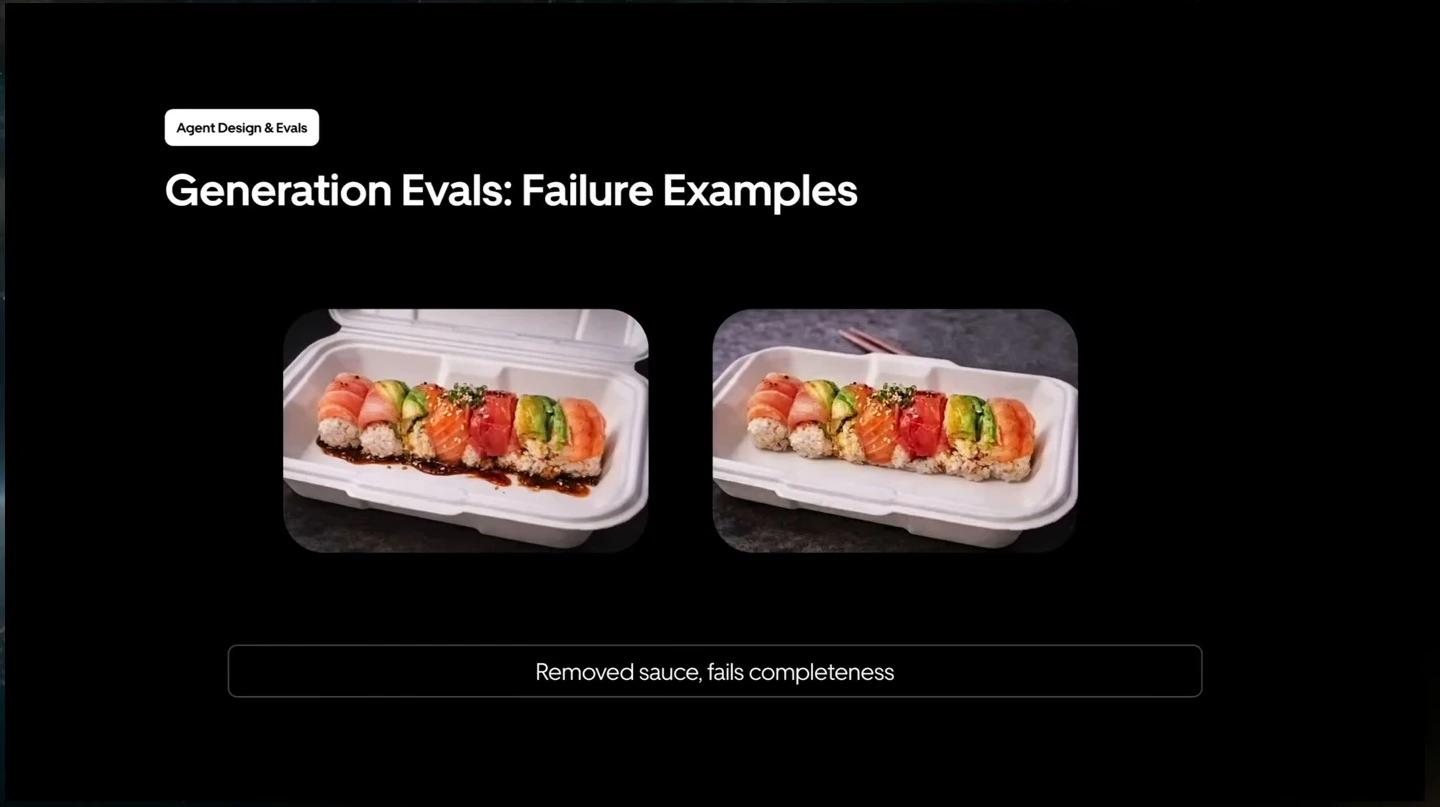
A sushi dish before and after enhancement; the output removes sauce, failing completeness.
Generation Evals: Completeness Failure — Building Closed-Loop Evals for a Multimodal Agent at Uber Scale · Soumya Gupta · Jai Chopra · Watch at 16:02

At Uber, product, design, policy and legal staff helped decide what a better photo should preserve. The team assesses completeness and naturalness separately and allows an unsure judgment. That distinction tells an editor why even a natural-looking plate might need another edit.

A single pair of photographs is enough to reject this edit. To compare two versions of the editor, run both on the same dishes. To find out whether the editor helps merchants, look beyond the photograph to the work a merchant does, including corrections. The choice of scorer is a separate decision. A person, an executable check or a calibrated model can score a case when it can observe the property you care about.

Choose the evaluation method for the decision you need to make.
MethodWhat to compareWhat the result tells you
Per-case gradingOne edited photo against its original and the completeness criterionWhether this particular edit lost a detail.
Offline regression testingA candidate and the current system on the same saved cases, using the same scoring rulesWhich previously passing cases now fail, and which failures the change fixes.
Randomized workflow comparisonComparable work assigned to people with or without AI assistanceHow assistance changed an outcome such as completion time for the people and tasks studied.

Intended work and comparison baselines

A baseline is the alternative against which a change will be judged. For replacing a service, use the deployed service. For introducing assistance, use the workflow people already have. For deciding whether a learned system adds value, a simple rule can make a revealing baseline. Give each alternative the information and help it would have in the proposed use. Define who is eligible, which mistakes have serious consequences and where the clock stops. Time to generate a patch and time to finish a review-ready change have different finish lines.

In early 2025, METR recruited 16 experienced developers who submitted 246 issues from familiar open-source repositories. Random assignment determined whether AI assistance was allowed for each issue. Developers worked until they considered the change ready for review, including the tests and documentation it needed. With the tools studied, primarily Cursor with Claude 3.5 or 3.7 Sonnet, completion took a reported 19% longer when assistance was allowed. Participants subsequently believed assistance had saved them time. Timing the whole job captured work their impressions did not. The comparison applies to those developers, tasks and tools. METR’s study report

Before comparing scores, specify the smallest gain worth changing systems for. Set separate limits for outcomes that must remain acceptable. For example, a team seeking shorter completion times might also cap serious defects and human review hours. These limits are guardrails. Reporting time, quality, review effort and cost separately lets the decision-maker see which constraint a faster or cheaper system would violate. AI Cost and Performance Engineering

Cases and coverage

Cases, trials and outcome boundaries

An evaluation case describes one piece of work in enough detail to tell whether it succeeded. For a request to change a reservation, that includes the request itself, the starting reservation, the information available to the agent and the change the customer wants. One execution is a trial. To compare trials, specify what tools and help the system can use, how much time and how many retries it gets, when it must stop and how its work will be graded. These rules are the protocol. The software that runs it is the harness.

In τ-bench, an agent serves a simulated customer using tools and domain policies. The benchmark compares the final database with an annotated target and checks information the agent must convey. Its authors identify a gap: an agent can reach the target state without obtaining required confirmation. To check whether the agent asked permission before requesting each change, match every write request in the transcript to an earlier approval for that target and value. Then read the reservation to check the final value and what the agent told the customer. If the order of committed changes matters, inspect an authoritative write history. An earlier value may already have been overwritten by the time of the final read. τ-bench’s task and reward definitions

Three questions about one reservation change

Example

The transcript shows when the agent requested a change. Reading the reservation shows the stored value at the time of the read.

Reservation change trial
Messages and write requests in order
Reservation record
Observed reservationRecord the target and observation time.
Task verdictCheck approval before each request, the final value and the customer notice.
For each write request, look for an earlier customer approval covering the same reservation and value. Compare the final record with the last approved value and with the agent’s message. Reconstructing overwritten values requires a separate history of committed changes.
Read the diagram as text
  • Reservation change trial.
  • Messages and write requests in order.
  • Reservation record.
  • Observed reservation. Record the target and observation time.
  • Task verdict. Check approval before each request, the final value and the customer notice.
  • Reservation change trial → Messages and write requests in order: Records approvals, write requests and notice.
  • Reservation change trial → Reservation record: Requests a change.
  • Reservation record → Observed reservation: Verifier reads target.
  • Messages and write requests in order → Task verdict: Match each request to prior approval.
  • Observed reservation → Task verdict: Check stored value against approval and notice.

Record execution status separately from the grader’s verdict. A refusal can satisfy a prohibition. A malformed return can fail a format requirement. At a timeout, the deadline has been missed, but an external write may still complete. A crashed verifier leaves the property it was checking unresolved. Even a successful read has semantics: an eventually consistent DynamoDB read can omit a recent successful write. Record the key, read target, consistency mode and observation time before interpreting an absent value. DynamoDB read consistency

Harbor makes a case inspectable as files. instruction.md gives the task, task.toml supplies configuration, and the environment and tests specify where work happens and how to inspect it. A separate verifier receives declared artifacts. If a needed artifact never reaches it, its verdict cannot establish the artifact’s contents. Similarly, a fresh trial container needs its mounted files and external state prepared for the case. Harbor task structure · Software Engineering Fundamentals

Representative work and diagnostic cases

The target population is the work named in the claim. The sampling frame is the work available to draw from. A random sample of escalated conversations can describe those conversations while missing every request resolved automatically. Specify the period and exclusions, and keep related turns from one episode identifiable. A slice is a subgroup relevant to the decision. Its share of traffic, or prevalence, determines how much it contributes to an overall traffic estimate. Data Quality and Curation

Consider two illustrative batches. Routine cases succeed at 90% and exceptions at 50% in both. The denominators show what changed.
Task mixRoutine passesException passesPooled successEqual-slice mean
Mostly routine72/8010/2082/100 = 82%(90% + 50%)/2 = 70%
Equal shares45/5025/5070/100 = 70%(90% + 50%)/2 = 70%

Pooling gives each case equal weight. Averaging the two rates gives each slice equal weight. For a traffic estimate, use the proportions of the intended traffic. For finding failures, it can be worth putting most of the effort into exceptions. Keep the resulting challenge set separate: a defect on one valid challenge case demonstrates a possibility, while its frequency in a deliberately difficult collection says little about how often customers encounter it.

Diagnostic cases can also test a relationship without supplying a complete answer. CheckList changes incidental place names in sentiment examples where the judgment should stay the same. Adding a negative statement can support a directional check that sentiment should not become more positive. Verify that the transformation really has that meaning for the chosen input. Lyft similarly seeded support scenarios with sampled requests and varied their conditions. Every generated variation needs a plausible situation and a defensible expected action. CheckList · Synthetic Data

Shared comparisons

Controlled collections and shared tasks

A benchmark fixes tasks, assessment procedures and reporting conditions so that different systems can be compared. An early practical problem was comparing ways of indexing documents for retrieval. With funding awarded to Aslib in July 1957, Cyril Cleverdon’s team at Cranfield indexed the same 18,000 documents using four descriptor systems. They controlled indexing time and balanced document categories. If one system retrieved different material, the choice of collection and time spent indexing were less plausible explanations. Cleverdon’s 1962 report

The first Text Retrieval Conference (TREC), in November 1992, brought independent research groups into a coordinated comparison on large full-text collections. A shared topic described the information need and what would make a document relevant. Each system could formulate its own search query. Exhaustive human judgments were impractical at that scale. Organizers took the top 200 documents per topic from each participating run, pooled them, removed duplicates and had that subset judged. The judgments could be reused across systems, though relevant documents could remain outside the pool. TREC-1 overview

Shared tasks also made it possible to ask whether learning transferred across problems. In 2018, Alex Wang and colleagues introduced the General Language Understanding Evaluation benchmark, GLUE, with nine English tasks spanning different domains, difficulties and amounts of training data. Some test sets stayed private. An average summarized performance across the suite, while an expert-built diagnostic collection probed phenomena such as negation. Inspecting how a model handled a negated statement could reveal a weakness too small to move the suite average appreciably. GLUE paper

From fixed answers to executable outcomes

A benchmark saturates when leading systems have little headroom left for a score to distinguish further progress. By 2019 this was happening on GLUE, even though particular tasks and language phenomena remained difficult. SuperGLUE retained two difficult GLUE tasks, added harder ones and broadened the answer formats. It sustained a comparison across systems by changing the test. Its scores therefore answer a different question from scores on the original collection. SuperGLUE

For open-ended work, different outputs can fulfill the same request. These designs from 2021–2024 share the task across systems but use different evidence to recognize a successful result.
Benchmark and taskWhat assessors inspectWhat remains open
HumanEval · generate a functionResults when tests execute the functionBehavior on other valid inputs
SWE-bench · resolve a repository issueRepository tests after applying a proposed patch to the supplied snapshotWhether tests cover the issue and allow alternative repairs
Chatbot Arena · answer an open requestA person’s preference between anonymous answersWhether either answer is factually correct
τ-bench · serve a simulated customerFinal records and required information in the conversationWhether each action respected policy

Sometimes the comparison needs a better assessment. One SWE-bench test required an exact deprecation warning absent from the issue given to the developer. A valid repair could fail on its wording. OpenAI and the SWE-bench authors had professional developers screen issues, tests and environments. In August 2024 they released a filtered subset of 500 tasks. A score on the subset has a different task mix and denominator from a score on the original. Introducing SWE-bench Verified

A score can rise because more tasks are genuinely solved. Other explanations require different investigations. Prior exposure can make a task familiar. Trying many configurations and reporting the best can select favorable noise. Direct optimization can also exploit a mismatch between a measured property and the goal, a problem associated with Goodhart’s law. DeepMind describes an agent rewarded for raising the bottom face of a block: flipping the block earned the reward without stacking it. Here the behavior itself shows exactly where the proxy and the goal diverge. Specification gaming

Defensible assessment

Requirements, graders and denominators

A grader applies a rule to an observation. A metric summarizes observations numerically. It is often easiest to build the first grader around a failure someone can already recognize. In their account of Rechat’s real-estate assistant Lucy, Hamel Husain and Emil Sedgh describe finding invalid placeholders in application data and encoding defects in inexpensive, repeatable assertions. A placeholder check has a specific purpose. Passing it leaves the usefulness of the rest of the message open. Rechat’s domain-specific evaluations

In software testing, a procedure for deciding whether behavior is correct is called a test oracle. Exact matching works for a unique identifier. Executable tests can accept different implementations that satisfy the same property. Reference similarity measures resemblance to one or more examples. A rubric lets an assessor evaluate specified qualities, and a preference identifies which alternative the assessor favors. Each requires evidence suited to its claim. A schema check can establish that an amount is numeric. Establishing that the amount is owed requires the transaction. A faithfulness grader can check whether a report’s claims follow from its sources even when the sources are mistaken. Structured Outputs and Tool Calling · Ragas Faithfulness

EvalPlus gives a concrete false acceptance. A generated function had to return the sorted, unique elements common to two lists. It sorted intermediate values, then converted them through a set, losing the ordering guarantee. It passed the original tests. Additional valid inputs exposed an unsorted result from the same program. The defect was present throughout. What changed was the grader’s ability to detect it. EvalPlus, Figure 1

Coverage of the assessment

Suppose 100 requests each get one attempt to return an acceptable artifact by a deadline. Preserve these mutually exclusive outcomes before computing a pass rate.
OutcomeRequestsWhat is known
Artifact passed72Verified success
Artifact failed8Verified quality failure
Artifact returned, grader crashed10Quality unresolved
No artifact by deadline10Missed deadline

Of 100 attempts, 90 returned artifacts and 80 received quality verdicts. The pass rate among assessed artifacts is 72/80, or 90%. Verified success across requests is 72/100. Even if every ungraded artifact passes on inspection, only 82 requests could have met both requirements. Record critical failures separately too. Letting good wording offset an unauthorized action in a weighted average would change the acceptance rule.

Errors made by the grader

To assess the grader itself, compare its verdicts with independent labels. In this separate example the positive decision is acceptance.
Independent labelJudge acceptsJudge rejects
Valid364
Invalid654

Precision is the fraction of acceptances that are valid, 36/42. Recall is the fraction of valid artifacts accepted, 36/40. The six false acceptances matter to two different readers. An auditor inspecting accepted work finds 6 errors among 42 acceptances. A developer investigating how invalid outputs escape the grader finds 6 escapes among 60 invalid artifacts. Give the denominator with the rate. When it is zero, the rate is undefined.

Human standards and disputed judgments

A rubric states the property being judged, the observable difference between grades and examples on either side of the boundary. A factual judgment requires access to evidence. A policy judgment may require domain expertise. A reader preference calls for people whose preferences the application is meant to serve. Pilot the rubric on actual outputs. Collect independent decisions before discussion, hide irrelevant system identities, vary presentation order and allow both ties and insufficient evidence. A tie expresses equal preference. Insufficient evidence means the assessor cannot make the comparison.

In the EvalGen study, two participants wanted different results when extracting names from text containing #Nike. One wanted to exclude names found only in hashtags. The other wanted to return Nike without the hash. Both received a checker that looked for a hash character in the output. It would accept Nike under either rule. It could detect a stray #, but deciding whether the name belonged in the output required looking at the input. Writing down the expected result for this one case exposed both the disagreement and the limit of the check. EvalGen study

Adjudication asks reviewers to explain their decisions against the evidence and intended rule. Correct mistakes, clarify ambiguous instructions and revisit affected cases, including earlier agreements. Preserve unresolved judgments and their reasons. Agreement before discussion measures independent consistency. Consensus afterward records what reviewers settled together. Reviewers can agree on a mistaken reference. For multistep work, separate diagnostic credit from task completion: a correct lookup about the wrong person demonstrates the lookup skill while failing the original request. Data Quality and Curation

Model judges as measurement instruments

A large language model (LLM) judge applies an assessment rule to work produced by a system. It may grade one answer against a rubric or compare two answers. A reference-supported judge receives evidence such as a policy, source document or expected answer. A reference-free judge can estimate quality before an authoritative answer exists. If a necessary observation is missing, give the judge a way to return an unjudgeable verdict. Asking it to infer that an email was sent cannot recover a missing delivery record.

At YouTube Ads, Preetika Bhateja and Daniel Bump describe agreeing on examples of passing and failing outputs before scaling human ratings. The team samples expert and model judgments and examines disagreements. This makes a falling score investigable: did the output violate the requirement, did reviewers interpret it differently, or did the judge misapply it? How Evals and Prompts Shape Agent Behavior

One pair presented in two orders

Example

Following the answer identity exposes a reversal hidden by two identical position votes.

A · meets requirementIndependent reference label.
B · fails requirementIndependent reference label.
Order A, B
Order B, A
Vote for A
Vote for B
A and B retain their content and independent labels. This illustrative judge picks the first answer in both presentations, agreeing with the reference in one and disagreeing in the other. Repeated counterbalanced judgments can test how often order matters.
Read the diagram as text
  • A · meets requirement. Independent reference label.
  • B · fails requirement. Independent reference label.
  • Order A, B.
  • Order B, A.
  • Vote for A.
  • Vote for B.
  • A · meets requirement → Order A, B: First.
  • B · fails requirement → Order A, B: Second.
  • A · meets requirement → Order B, A: Second.
  • B · fails requirement → Order B, A: First.
  • Order A, B → Vote for A: Judge selects first.
  • Order B, A → Vote for B: Judge selects first.

Use development examples to refine the judge, then freeze its rubric, prompt, model and threshold. Measure false acceptances and rejections on held-out, independently assessed work, including the costlier errors within each critical slice. Count ties and missing verdicts separately. MT-Bench reported 85% GPT-4–human preference agreement and 81% human–human agreement in one comparison excluding ties. Those numbers describe preferences on those pairs. A product team still needs to measure how often its judge accepts an actual policy violation. MT-Bench and Chatbot Arena study

Testing irrelevant influences

Probe the judge by changing a feature that ought to be irrelevant. Reverse the same two answers and track the content selected. Two votes for the first position now select opposite answers. A stochastic judge can also reverse itself at fixed order, so repeat both presentations and compare the selection frequency of the same answer. Other probes vary redundant length or confident phrasing while preserving substance. On two news-summary datasets, model judges favored their own summaries more than human quality comparisons would predict. A judge can also follow a candidate’s reasoning into the same error. Independent references help test that possibility.

Candidate text is untrusted input to the grader. In JudgeDeceiver experiments, adding an optimized sequence to an inferior answer induced tested judges to select it. Compare clean and modified candidates in both orders in the actual harness. Budget independent inspection of accepted work as well as flagged work. Otherwise the judge’s most consequential misses can be the cases nobody sees. Repeat validation when the judge or the work changes. JudgeDeceiver experiments · AI Security

Independent and inspectable evidence

Contamination and assessment independence

A holdout reserves cases to assess a system after development choices are complete. Contamination occurs when exposure undermines that independence. A repository snapshot is legitimate input to an issue-solving task. If the retrieval index also supplies the accepted patch, a passing repair supports a different claim. Check what could reach the generator through training, prompt examples or retrieval, and what could reach the people tuning the grader. Keep task instructions accessible while restricting solutions and final assessment feedback. Validation without leakage

Split by the source of dependence. Keep turns from one customer episode together, and place paraphrases derived from one problem on the same side of a split. Separate by time when the intended claim concerns future tasks. Training on translated or paraphrased benchmark material has increased scores in controlled experiments while escaping exact-overlap checks. Semantic matching can both miss exposure and flag innocent similarities. Fresh tasks reduce some exposure risks, though a public task and an undisclosed training history rarely permit a guarantee. LiveBench’s 2024 design proposed monthly refreshes and automatically checkable answers, a choice that also excluded open-ended work such as composing an email. LiveBench design

Even a score can carry information from the test into development. If a team tries many prompts and keeps the highest scorer, it favors prompts that happen to do well on those particular cases. To assess the chosen prompt, freeze it and test it on fresh cases. To assess the method for choosing a prompt, repeat the whole choice: set aside a group of cases, select a prompt using only the remaining cases, and score that prompt on the group set aside. Repeat with other held-out groups. Each score then reflects how well the selection method worked on a new group, including occasions when it picked a lucky winner. Cawley and Talbot on selection bias

Preserving executions and assessments

Give a run an identity when the system executes, and give a verdict its own identity when a grader assesses the evidence. Rescoring asks what a different assessment says about saved work. Rerunning asks what the application produces on another execution. LangSmith’s December 2024 SDK made this distinction explicit: supplying an experiment identifier reused stored outputs, while supplying an application function produced new ones. A trace is the linked execution record that lets a grader find the relevant observations. LangSmith release account · Identify the system that ran

A run manifest records the conditions required to interpret a result. Identify missing or mutable dependencies explicitly.
RecordWhat it identifies
Case and protocolInput version, initial state, allowed information, assistance, budgets and stopping rule
SystemCode, model or available snapshot, prompts, tools, dependencies, retrieval and memory state
ExecutionRun ID, output, actions, observed effects, timing and incomplete operations
AssessmentRun and artifact references, grader, rubric, threshold, raw verdict and missing evidence

Two executions, four assessments

Example

Grading both outputs twice shows whether the two graders give the same verdict on each output.

Versioned case
Archived output A
Archived output B
A · original grader verdict
A · revised grader verdict
B · original grader verdict
B · revised grader verdict
Follow either saved output to compare the graders’ verdicts on identical work. Follow the two edges labeled ‘Original grader’ to compare the baseline and candidate with that grader. A disagreement alone does not identify a change in the criterion.
Read the diagram as text
  • Versioned case.
  • Archived output A.
  • Archived output B.
  • A · original grader verdict.
  • A · revised grader verdict.
  • B · original grader verdict.
  • B · revised grader verdict.
  • Versioned case → Archived output A: Execute baseline.
  • Versioned case → Archived output B: Execute candidate.
  • Archived output A → A · original grader verdict: Original grader.
  • Archived output A → A · revised grader verdict: Revised grader.
  • Archived output B → B · original grader verdict: Original grader.
  • Archived output B → B · revised grader verdict: Revised grader.

If both generator and grader change, score both sets of saved outputs with each grader. For each grader, compare the gain it gives the new generator on the same cases. If the graders disagree on a saved output, the output itself is fixed. Check the documented criteria to see whether the standard changed. Two implementations can apply the same rubric differently, and a model grader can vary across repeated judgments. Keep the four verdicts linked to their case. Rescoring requires the evidence each grader needs, which may be missing from truncated tool results or redacted messages.

Name what a second investigator could repeat. Recomputing a score from saved verdicts can be exact even when regenerating the outputs is impossible. OpenAI’s archived seed guidance described consistency as best effort even with matching request parameters and backend fingerprints. A seed cannot restore a changed hosted model or a missing database snapshot. Independent replication takes a further step, collecting new data to address the same question. National Academies on reproducibility and replication

Reliable comparisons

Attempts and the deployed selection policy

When a system gets several attempts, the same results can answer different questions. For each task, single-attempt success is the chance of passing on one try. With k independent tries, pass@k is the chance that at least one passes, and pass^k is the chance that every try passes. The suite averages these probabilities across tasks. If a service generates several answers and delivers just one, grade the answer it selects as well. A checker used during evaluation may recognize a good answer that the service itself fails to pick. Sayash Kapoor on evaluating agents

One illustrative task, with verdicts obtained after the selector chose its answer.
Candidate A, firstCandidate BCandidate CDelivered
FailPassFailC · fail

This task contributes a success to the any-pass count and a failure to the first-attempt, all-pass and delivered counts. A repair after feedback is different again. In Uber’s fries example, the quality check rejected the portion size and plating. Its feedback went into a second edit that passed. Those two edits constitute one run of a feedback policy. To compare it with another policy, record assistance, resets, retry limits, stopping, abstentions and total time and cost. Use a common budget for an equal-resource comparison. If comparing systems as offered, disclose what each spent to deliver its result. Reasoning and Test-Time Compute · Agent Runtimes and Harness Engineering

Sampling units and uncertainty

Drawing new tasks changes the work being tested. Rerunning the same task shows how the system’s actions vary on that task. Asking another assessor to grade the same output can reveal disagreement about the verdict. To estimate a success rate across new tasks, start by counting independently sampled tasks. A confidence interval expresses uncertainty in the estimated rate. If we repeatedly drew samples in the same way and computed a 95% interval from each, about 95% of those intervals would contain the population success rate under the method’s assumptions. The percentage describes the interval procedure. Predicting whether an individual answer will pass is a separate question.

Illustrative 95% Wilson intervals for independent binary trials with a common success probability. The interval method and observed fraction stay fixed.
Passes / independent trialsObserved successApproximate interval
9/1090%60%–98%
90/10090%83%–94%

Rare failures require particular care. Even if independent cases each have a 1% failure probability, the chance of seeing no failures in 100 trials is 0.991000.99^{100}, about 37%. And a thousand runs of one familiar task leave unseen tasks just as unseen. An interval can be narrow under the sampled conditions while missing a whole class of requests.

A bootstrap estimates sampling variation by drawing units from the sample with replacement and recalculating the statistic many times. Draw at the levels that the design actually varies. DigiWorld keeps its curated apps fixed. Within each app it resamples task scenarios, environmental variations and stochastic runs. Repeating only the last step would miss the sensitivity to different starting screens or data configurations. The resulting suite interval still describes those apps. It supplies no sample of additional apps. DigiWorld paper · Pierluca D’Oro’s explanation

Paired gains and meaningful differences

Run baseline and candidate on the same cases with the same assessment. A matched comparison retains which case improved or regressed. For binary outcomes, count a gain when only the candidate passes and a loss when only the baseline passes. Subtract losses from gains, then divide by the number of paired cases. Preserve the individual losses so a critical failure remains visible.

Two illustrative candidates compared with a common baseline on 100 tasks. Both gain five percentage points.
CandidateGainsLossesUnchangedCritical losses
A61930
B1712713

For uncertainty in the gain, calculate the difference within each pair. If there are prespecified repetitions, first summarize each version’s trials within each task. For representative, independently sampled tasks, bootstrap the task differences and calculate their mean on each draw. This preserves the pairing and weights tasks equally. When tasks share a source episode, keep dependent cases together and resample at the independent group level with the intended weighting. Separate intervals for the two systems omit information about how often they fail on the same tasks. SciPy’s paired bootstrap

Plan around the smallest worthwhile difference and the expected variability between pairs. Statistical power is the chance that the analysis will detect an effect of a specified size when it exists. More independent cases can improve precision, but even a precisely measured gain can be too small to justify a change. Prespecify the primary comparison and critical slices. Searching many candidates or testing many hypotheses creates opportunities for accidental wins. Confirm exploratory findings on fresh cases and account for multiple tests. Fix the stopping rule in advance or use a sequential method designed for repeated inspection. Stopping an ordinary fixed-sample test as soon as it looks favorable changes its error rate.

An ablation changes one component under otherwise matched conditions to test its contribution. In a synthetic data-pipeline remediation benchmark, a learned action policy matched the observed success level of an equivalent hand-written policy on a compact set of incident states. That result gives a team a reason to consider the simpler implementation. Establishing equivalence within a meaningful margin requires enough precision to rule out substantial differences. Remediation policy comparison

Confidence and deferral

Assessing probability calibration

Suppose a system attaches a probability to the event that its answer will pass an independent correctness check. If it assigns 0.8 to many comparable answers, do about eight in ten pass? This agreement between forecast probabilities and observed frequencies is calibration. In a reliability diagram, group independent labeled cases by forecast. Plot each group’s mean forecast horizontally and its fraction correct vertically. Points below the diagonal indicate overprediction in that sample. Show counts and uncertainty because ten cases provide much less evidence than a thousand. The choice of groups matters too: combining overprediction and underprediction can hide both. Probability calibration

In the figure, both panels use the same 40 labeled answers, of which 20 pass. A constant forecast of 0.5 agrees with the overall frequency but gives no guidance about which answer is more likely to pass. The second forecaster assigns a higher score to a group where 14 of 20 pass, compared with 6 of 20 in the lower group. It separates the groups in the right direction, a useful ranking, yet its forecast of 0.9 exceeds the observed 0.7. Accuracy counts correct decisions at a chosen decision rule. Ranking and probability calibration describe different properties of the scores behind those decisions. From probabilities to actions

The same answers under two forecasts

Example

A forecast can match the overall frequency without distinguishing cases. A ranking can distinguish groups while overstating the higher group’s probability.

A single forecast

All 40 answers receive the same probability.

00.250.50.75100.250.50.751Mean forecast probability (dimensionless)Fraction passing the check (dimensionless)Exact agreementInterval for 20/40Observed fraction20/40
  • 1. Exact agreement
  • 2. Interval for 20/40
  • 3. Observed fraction
Read coordinates and regions as data

X: 0–1 dimensionless; Y: 0–1 dimensionless, increasing up. Equal scale on both axes.

Exact agreement (polyline)

(0, 0); (1, 1)

Interval for 20/40 (polyline)

(0.5, 0.352); (0.5, 0.648)

Observed fraction (points)

(0.5, 0.5)

20/40: (0.54, 0.46)

Two forecast groups

Each group contains 20 of the same answers.

00.250.50.75100.250.50.751Mean forecast probability (dimensionless)Fraction passing the check (dimensionless)Exact agreementInterval for 6/20Interval for 14/20Observed fraction6/2014/20
  • 1. Exact agreement
  • 2. Interval for 6/20
  • 3. Interval for 14/20
  • 4. Observed fraction
Read coordinates and regions as data

X: 0–1 dimensionless; Y: 0–1 dimensionless, increasing up. Equal scale on both axes.

Exact agreement (polyline)

(0, 0); (1, 1)

Interval for 6/20 (polyline)

(0.3, 0.1455); (0.3, 0.519)

Interval for 14/20 (polyline)

(0.9, 0.481); (0.9, 0.8545)

Observed fraction (points)

(0.3, 0.3); (0.9, 0.7)

6/20: (0.26, 0.34)

14/20: (0.86, 0.67)

The same illustrative 40 independent cases produce 20 correct answers. The constant forecast matches 20/40. Splitting by the second forecast reveals 6/20 correct at 0.3 and 14/20 at 0.9. Vertical segments are approximate 95% Wilson intervals using a common binary probability within each plotted group. The diagonal denotes equal forecast and observed frequency.

Scoring individual forecasts

Brier=1N∑i=1N(pi−yi)2\mathrm{Brier}=\frac{1}{N}\sum_{i=1}^{N}(p_i-y_i)^2 Across NN labeled cases, pip_i is the forecast and yiy_i is 1 when the event happens and 0 otherwise. A 0.9 forecast incurs loss 0.01 on a pass and 0.81 on a failure. This customary binary Brier loss ranges from 0 to 1. An unscaled sum over both complementary classes doubles it. The score is proper: on average the true event probability minimizes the loss. Better separation can also lower the loss, so inspect the reliability diagram before attributing a change to calibration.

Identify where the number came from. The probability of generating a token concerns the next unit of text. A percentage stated in an answer is itself generated text. Agreement among several models can reflect shared mistakes. Each signal needs independent outcome labels before it can stand for probability of correctness. In factual question answering, the calibration of verbal estimates depended on the model and how confidence was elicited. Calibration can also deteriorate when inputs change, as experiments with increasing image corruption demonstrated. Tokenization · Study of elicited confidence

Abstention and the complete review workflow

Abstention withholds an answer. Deferral transfers responsibility for the case to a person or another process. Raising a score cutoff can restrict automation to easier cases. To assess that choice, measure automatic coverage, the fraction of eligible cases handled automatically, and selective risk, the mean loss among those cases. A risk–coverage curve plots those two quantities at different cutoffs. Ranking can be sufficient to select cases, even if the score itself is poorly calibrated. Choose the cutoff on development data and assess the resulting policy on independent work.

What happens to everyone below the cutoff? Suppose a shift brings 80 cases and reviewers can finish 25. Deferring a quarter sends 20 to the queue. Deferring half sends 40 and leaves at least 15 unfinished by shift end without another route. A fall in automatic errors could coexist with worse service across all 80 cases. Count reviewer errors, time spent and requests still waiting at the deadline. Capacity must fit the period in which work arrives. Monthly spare capacity cannot finish this shift’s work on time. Research on capacity-constrained deferral demonstrates the distinction with simulated analysts. Workload-constrained deferral

A stricter cutoff sends 40 cases to 25 review slots

Example

The automatic error rate excludes everyone still waiting for review.

80 eligible requests
40 automatic decisions
40 referrals
At most 25 reviewed
At least 15 pending
All 80 requests at shift end
At the stricter illustrative cutoff, 40 of 80 requests receive automatic decisions. Of 40 referrals, at most 25 can finish review this shift. Count outcomes on both completed routes and at least 15 pending cases when assessing the whole shift.
Read the diagram as text
  • 80 eligible requests.
  • 40 automatic decisions.
  • 40 referrals.
  • At most 25 reviewed.
  • At least 15 pending.
  • All 80 requests at shift end.
  • 80 eligible requests → 40 automatic decisions: Score meets cutoff.
  • 80 eligible requests → 40 referrals: Score below cutoff.
  • 40 referrals → At most 25 reviewed: Review finishes in shift.
  • 40 referrals → At least 15 pending: Deadline precedes decision.
  • 40 automatic decisions → All 80 requests at shift end: Include automatic errors.
  • At most 25 reviewed → All 80 requests at shift end: Include review errors and time.
  • At least 15 pending → All 80 requests at shift end: Include unfinished work.

Reviewer performance also depends on what the interface shows. Duolingo inserted fabricated copy-typing alerts into legitimate historical English Test sessions and showed them to proctors in their normal workflow. Reviewers accepted half the planted alerts despite scoring above 90% on their usual accuracy checks. No test taker was affected. The denominator here is deliberately false alerts shown to reviewers. It measures a failure of review under that condition and says nothing about how often the live detector raises a false alert. Duolingo’s review study · Design Engineering and AI Interfaces

Offline and live evidence

Offline evaluation and replay limits

Offline evaluation assesses cases outside the live workflow. A recorded history provides the information available up to a decision. Replay can test which question a changed agent would ask at that point. Suppose the original question asked for a delivery address and the alternative offers to reissue a card. The recorded reply contains an address because the customer heard the first question. Feeding that reply to the alternative agent invents a response to the offer. At the fork in the figure, continuing the new path requires a new observation or a model of how the customer and environment would respond.

Reconstruct what was accessible at decision time, including document versions, permissions, tool responses and state. A later correction may be useful for grading the old answer while leaking the solution if supplied as input. Tool behavior, latency and the mix of people seeking help can also change. Such changes in the conditions generating the observations are called distribution shift. Identify which condition matters to the proposed use. When deployment conditions shift

Where the recorded conversation ends

Example

Two policies can share an input history without sharing the next observation.

Saved delivery inquiryInformation available at the decision.
Request delivery address
Offer card reissue
Customer gives addressObserved in the recorded interaction.
Reply to offer unknownA simulated reply would be a new prediction.
In this illustrative delivery inquiry, the historical agent requested an address and the customer supplied one. The alternative offers to reissue a card. The saved history contains no customer response to that offer.
Read the diagram as text
  • Saved delivery inquiry. Information available at the decision.
  • Request delivery address.
  • Offer card reissue.
  • Customer gives address. Observed in the recorded interaction.
  • Reply to offer unknown. A simulated reply would be a new prediction.
  • Saved delivery inquiry → Request delivery address: Historical policy asks.
  • Saved delivery inquiry → Offer card reissue: Alternative policy proposes.
  • Request delivery address → Customer gives address: Recorded next turn.
  • Offer card reissue → Reply to offer unknown: Needs new interaction or simulation.

A simulator can generate a reply to a new question, but its usefulness depends on whose behavior it reproduces. Lyft found that a model playing a support customer explained problems patiently in the style of a helpful assistant. After adapting it to actual customer utterances, the team reported lower offline scores. Changing the simulated user had changed the difficulty of the work. Deciding whether the new scores better predict service quality requires observing real interactions. Lyft’s support evaluation · RL Environments and Simulators

A requirement can be missing in both offline and live assessment. OpenAI reported favorable offline evaluations and small-scale live preference signals for its April 2025 GPT-4o update, alongside expert concerns about behavior. Its launch checks lacked a specific assessment for sycophancy, the tendency to agree with or flatter a user inappropriately. Rollback began on April 28. More observations of the same preference signal would still leave the behavioral requirement inadequately tested. OpenAI’s postmortem

Shadow runs, canaries and causal comparisons

Exposure determines which consequences can occur. When Zed evaluated Zeta2 in shadow, the model produced edit suggestions from real inputs but the editor hid them. Engineers could inspect the suggestions. Only after Zed displayed them in a small live rollout could it observe whether a developer accepted one. Acceptance is useful evidence about the suggestion. Determining whether it saved work requires following the edit through completion against a comparison workflow. How Zed developed Zeta2

Choose the exposure and comparison design for the claim. A canary can also use random assignment.
DesignWho receives the candidateEvidence available
ShadowNobody receives its response. The existing service responds.Candidate behavior on copied live inputs. Isolate mutation tools to prevent shadow writes.
CanaryA limited populationVersion-specific outcomes during limited exposure. Set size, duration, guardrails and stop conditions.
Randomized comparisonEligible units assigned by chanceDifference in measured outcomes between assigned alternatives under the experiment’s assumptions.
Ongoing observationThe population served after releaseChanges in outcomes, failures and workload over time. Attribution needs a suitable comparison.

For a canary, use metric windows long enough to observe the consequences that matter. Reverting traffic stops further exposure. Already issued refunds or sent messages require separate reconciliation. For an experiment, specify what receives the assignment and how its outcome will be counted. Requests from one person share a user. When people share work or a review queue, one person’s assignment can change another person’s outcome. This interference can make the observed difference unlike the effect of switching everyone. Assigning teams together can reduce spillovers at the cost of fewer independent units. Association, action, and causal effect

Randomization protects the comparison among units that enter it. In a follow-up productivity study, METR found that some developers declined to participate or withheld issues they expected AI to accelerate. Random assignment of the submitted tasks could not recover those missing tasks. Outcomes can disappear after assignment too. Under selective review, a system’s own decisions determine which cases receive expert labels. A missing label, an unanswered survey and an outcome still pending are three different observations. Join executions to eventual outcomes and track eligibility, response rates and follow-up time alongside the result. METR’s follow-up · Connect operations to outcomes · Sample for the question

Failure investigation and decisions

From failed requirement to tested explanation

Start with the requirement and the evidence that appears to contradict it. Check whether the task was feasible, the reference was accurate, the environment supplied what the system needed, and the grader could inspect the result. Cranfield investigators put the missed document beside the question, indexing record and search record. They could then distinguish a poorly expressed question from an indexing or search problem and send doubtful cases for further review. In an agent trace, the last error may be several steps downstream of the first consequential mismatch. Cranfield’s analysis of failures · Build a defensible execution account

At Rechat, unsent emails were among the application failures Husain and Sedgh used to develop repeatable checks. A case like this needs a precise boundary. Did the assistant compose the requested email, ask the tool to send it, or achieve the required delivery outcome? Each question points to a different observation. Preserve the smallest case that reproduces the discrepancy. A trace can suggest whether the tool was never called or its feedback was misinterpreted. The assistant’s own explanation cannot settle which change would repair the behavior.

To test a feedback hypothesis, one possible experiment runs the same task in two conditions. In one, supply the suspected faulty tool feedback. In the other, replace only that feedback with a verified result. Fix the initial state, instructions, model, tool implementation and budget. Randomize run order, repeat the comparison and independently check downstream completion. Improvement supports a contribution from the feedback under these conditions. The agent’s interpretation of that feedback might still be part of the defect. Keep the confirmed case for regression testing, probe related cases for the same weakness, and evaluate the repair on fresh work outside the investigation. From traces to experiments

Bounded decisions and revalidation

A replacement may be valuable if it costs less and preserves quality within an acceptable loss. For a higher-is-better score, let dd be candidate minus baseline. Choose a justified loss margin m>0m>0 before seeing the result. Non-inferiority requires evidence that d>−md>-m. With a two-percentage-point margin, a suitable lower confidence bound of −1 point clears the boundary. A bound of −4 points leaves an unacceptable loss plausible. Two-sided equivalence additionally requires ruling out meaningful differences in the other direction. Failing to detect a difference from zero can leave both questions unanswered. Non-inferiority and equivalence

Apply the margin alongside required outcomes, critical slices and the capacity of the alternative service.
FindingDecision supported
Worthwhile gain and all guardrails met under the tested policyRecommend adoption for the evaluated population and operating conditions.
Routine work clears the margin. A critical slice remains inconclusive.Use the tested cutoff for routine work if intake can identify the slice and the baseline can serve critical cases on time.
The interval includes a worthwhile gain and an unacceptable loss.Keep the baseline while collecting independent evidence that can resolve the difference.
A severe prohibition is breached or referrals exceed capacity.Reject that operating policy. Reassess a revised policy, including work pending at the deadline.

Record the tested versions, protocol, population, comparison, uncertainty, remaining risks, decision owner and conditions for reassessment. An evaluation recommendation supplies evidence to the person authorized to release the service. Preserve stable regression checks for known defects alongside refreshed samples of the work people now bring. A revised grader may require rescoring. A changed dependency, population or routing cutoff can require fresh trials and a new capacity check. Software Engineering Fundamentals · AI Platform Engineering

Reference questions

Frequently asked questions

How does an eval differ from a benchmark or software test?

An eval assesses specified work against a requirement. A benchmark standardizes tasks, assessment and reporting for comparison across systems. A software test can implement an individual check in either, such as verifying a stored value after an agent acts.

How many independent cases are enough?

Plan for the smallest difference that would change the decision, the expected variability and the independent sampling unit. Check critical slices separately. Repeating one case helps estimate variability on that case while leaving the number of independently sampled tasks unchanged.

Can a model judge replace human review?

Delegate a specific judgment once independent assessment shows acceptable errors on the intended work. Retain an insufficient-evidence route and audit some accepted outputs so missed defects remain observable. Changed prompts, models or standards call for revalidation.

What does a higher leaderboard score establish?

It establishes a higher observed score on a particular collection under the reported conditions. Check versions, budgets, retries, scoring and uncertainty to interpret the difference. A benefit in your workflow requires evidence on your work and its practical alternative.

Does zero observed failure establish safety?

No. A rare failure can be absent from a finite sample, and the condition that triggers it can be absent from the sampling frame. Report the independent case count, operating conditions and uncertainty that accompany the zero.

When can I rescore saved outputs?

Rescore when the saved outputs contain the evidence the grader needs. If both generator and grader changed, apply both graders to both output sets. Different verdicts on the same output can reflect randomness or different implementations of one rubric. Check the documented criteria to identify a change of standard. Rerun the system when you need fresh behavior or observations the original run did not capture.

Why can offline and production results disagree?

The workload, available information, user response or measured requirement can differ. Identify the first point where the conditions diverge. For an editor suggestion, offline similarity to a reference is observable before release. User acceptance requires showing the suggestion, and time saved requires measuring the editing workflow.

Open questions

  1. How can a shared benchmark remain both fresh and comparable? Rephrased solutions can escape overlap checks, while replacing tasks changes the difficulty of the collection. Comparing systems on overlapping old and fresh task families, with documented exposure and changes in case mix, would help distinguish progress from a change of test.

  2. When does sending more work to reviewers improve the outcome for everyone served? Routing changes which cases receive expert labels, and review capacity varies across shifts. Following automatic, reviewed and unfinished cases through their deadlines, with independently sampled quality checks and actual review times, would reveal whether lower automatic error compensates for delays and reviewer mistakes.

  3. Which simulated interactions predict the effect of a change in live service? Making a simulated customer more demanding can lower all scores without improving the choice between candidates. Comparing predicted candidate differences with later workflow outcomes across user groups would identify the decisions for which the simulator is informative.

Follow the curated reading path through the speakers and demonstrations behind this entry.
Explore more talks

The rest of the library, beyond the curated path. Cited talks support this entry; reviewed transcripts were processed in full. Metadata candidates have not been reviewed as sources or verified as topic members.

859 matching talks

TalkSpeakerEventYear
Sayash KapoorAI Engineer Summit 20252025
Nick NisiAI Engineer Europe 20262026
Nick Ung, Akshay SharmaAI Engineer World's Fair 20262026
Philipp SchmidAI Engineer World's Fair 20262026
Lukas PeterssonAI Engineer World's Fair 20262026
Kam LasaterAI Engineer Summit 20252025
Alex Shaw, Ryan MartenAI Engineer World's Fair 20262026
Rayan GargAI Engineer World's Fair 20262026
Al HarrisAI Engineer Code 20252025
How to Kill the Code Review

Transcript reviewed

Ankit JainAI Engineer World's Fair 20262026
fighting slop with slop

Transcript reviewed

Vaibhav GuptaAI Engineer World's Fair 20262026
Vision: Zero Bugs

Transcript reviewed

Johann Schleier-SmithAI Engineer Code 20252025
Laurie VossAI Engineer Europe 20262026
Mahmoud MabroukAI Engineer Europe 20262026
Ending AI Slop

Transcript reviewed

Thais Castello BrancoAI Engineer World's Fair 20262026
Vinoth GovindarajanAI Engineer World's Fair 20262026
Jesse HuAI Engineer Code 20252025
2025 in LLMs so far

Transcript reviewed

Simon WillisonAI Engineer World's Fair 20252025
Pierluca D'OroAI Engineer World's Fair 20262026
Prasenjit SarkarAI Engineer Europe 20262026
Dat Ngo, Aman KhanAI Engineer World's Fair 20252025
Nishant GuptaAI Engineer World's Fair 20262026
Sumaiya ShrabonyAI Engineer World's Fair 20262026
Angel Ortmann LeeAI Engineer World's Fair 20262026
Nick HeinerAI Engineer World's Fair 20262026
Will BrownAI Engineer World's Fair 20262026
Balázs HorváthAI Engineer World's Fair 20262026
Rachel Lee Nabors (RL Nabors)AI Engineer World's Fair 20262026
Vincent KocAI Engineer Europe 20262026
Aparna Dhinkaran, Aparna DhinakaranAI Engineer Summit 20252025
Mohak SharmaAI Engineer Summit 20252025
Yegor Denisov-BlanchAI Engineer Code 20252025
Anna Marie BenzonAI Engineer World's Fair 20262026
Steven WillmottAI Engineer Europe 20262026
Phil HetzelAI Engineer Europe 20262026
Prompt Engineering is Dead

Transcript reviewed

Nir GazitAI Engineer World's Fair 20252025
Nathaniel Whittemore (NLW)AI Engineer Code 20252025
Kuba RogutAI Engineer Europe 20262026
David KaramAI Engineer World's Fair 20252025
Darius EmraniAI Engineer World's Fair 20252025
Kobie CrawfordAI Engineer Europe 20262026
Evaling Video Slop

Transcript reviewed

Maor BrilAI Engineer World's Fair 20262026
Nicholas Kang, Michael AaronAI Engineer Europe 20262026
Shreya Rajpal, Aman GuptaAI Engineer World's Fair 20262026
Danny Gollapalli, Ben Hylak, Zubin KotichaAI Engineer Europe 20262026
Mukuntha Narayanan, Han WangAI Engineer World's Fair 20252025
Joel BeckerAI Engineer Code 20252025
Beyang LiuAI Engineer World's Fair 20242024
Jared JoselowitzAI Engineer World's Fair 20262026
Kobie CrawfordAI Engineer Europe 20262026
Ibragim BadertdinovAI Engineer Europe 20262026
Rustem FeyzkhanovAI Engineer World's Fair 20262026
Judging LLMs

Transcript reviewed

Alex VolkovAI Engineer World's Fair 20242024
Agents Building Agents

Cited in this entry

Alfonso GrazianoAI Engineer World's Fair 20262026
Rashi AgrawalAI Engineer World's Fair 20262026
Akele Reed, Dave Revere, Doug KellerAI Engineer World's Fair 20262026
Eugene YanAI Engineer Summit 20232023
Alejandro VidalAI Engineer World's Fair 20262026
Chaitanya AsawaAI Engineer World's Fair 20262026
LLM Evals That Work IRL

Transcript reviewed

Aparna Dhinkaran, Aparna DhinakaranAI Engineer World's Fair 20242024
Vincent ChenAI Engineer Europe 20262026
Emmanuel TurlayAI Engineer Summit 20232023
Ali KhialAI Engineer World's Fair 20262026
Lukas BiewaldAI Engineer World's Fair 20242024
James ShiAI Engineer World's Fair 20262026
Ben KunkleAI Engineer Europe 20262026
Christopher LovejoyAI Engineer Summit 20252025
Ayush BhardwajAI Engineer World's Fair 20262026
Manu GoyalAI Engineer World's Fair 20252025
Michele GrantAI Engineer NYC 2026 Online Talks2026
Andy Wong, Andrei Bocan, Shane WolfAI Engineer World's Fair 20262026
Jess WangEvent unknownUnknown
Laurie VossAI Engineer World's Fair 20262026
Alex DuffyAI Engineer World's Fair 20252025
Laurie VossAI Engineer World's Fair 20262026
Stephanie JarmakEvent unknownUnknown
Louis-François BouchardEvent unknownUnknown
Miguel González Fernández, Corby RossetEvent unknownUnknown
Tejas KumarAI Engineer World's Fair 20262026
Tisha Chawla, Susheem KoulAI Engineer World's Fair 20262026
Ang LiAI Engineer World's Fair 20262026
Xander SongEvent unknownUnknown
Alvin PaneAI Engineer NYC 2026 Online Talks2026
Ari MorcosAI Engineer World's Fair 20262026
Varun KrovvidiEvent unknownUnknown
Hari KumarEvent unknownUnknown
Ben Hylak, Sid BendreAI Engineer World's Fair 20252025
Aparna DhinakaranAI Engineer World's Fair 20262026
Dex HorthyAI Engineer World's Fair 20252025
John DickersonAI Engineer World's Fair 20252025
Harrison ChaseAI Engineer World's Fair 20252025
Justin MullerAI Engineer World's Fair 20252025
Ari HeljakkaAI Engineer Summit 20252025
Cedric VidalAI Engineer World's Fair 20252025
Denys LinkovAI Engineer World's Fair 20262026
Niklas NielsenAI Engineer Summit 20232023
Parth AsawaAI Engineer World's Fair 20262026
Paul HenryAI Engineer World's Fair 20242024
Naman JainAI Engineer Code 20252025
Sheila Gulati, Nischal NadhamuniAI Engineer World's Fair 20242024
Evals Are Not Unit Tests

Metadata candidate

Ido PesokAI Engineer World's Fair 20252025
Carlos Esteban, DougAI Engineer World's Fair 20252025
Julia Neagu, Deanna Emery, Maitar AsherAI Engineer World's Fair 20252025
Ankur GoyalAI Engineer World's Fair 20252025
Anirban ChatterjeeAI Engineer World's Fair 20262026
Vinoo GaneshAI Engineer World's Fair 20262026
Muktesh MishraAI Engineer World's Fair 20252025
Samuel ColvinAI Engineer World's Fair 20252025
Tariq ShaukatAI Engineer World's Fair 20262026
Dat NgoAI Engineer Europe 20262026
Greg KamradtAI Engineer World's Fair 20252025
Amy Boyd, Nitya NarasimhanAI Engineer Europe 20262026
Ofer MendelevitchAI Engineer World's Fair 20252025
Diego RodriguezAI Engineer World's Fair 20252025
Dmitry KuchinAI Engineer World's Fair 20252025
Yuval Belfer, Niv GranotAI Engineer World's Fair 20252025
Aman KhanAI Engineer World's Fair 20252025
Taylor Jordan SmithAI Engineer World's Fair 20252025
Rishi DesaiAI Engineer World's Fair 20262026
Jim BennettAI Engineer World's Fair 20252025
Ankur GoyalAI Engineer World's Fair 20252025
Jacob E. ThomasAI Engineer World's Fair 20262026
Alex Volkov, Benjamin EckelAI Engineer World's Fair 20252025
Trust, but Verify

Metadata candidate

Shreya RajpalAI Engineer Summit 20232023
Mike ConoverAI Engineer Summit 20252025
Rafal Wilinski, Vitor BaloccoAI Engineer World's Fair 20252025
Sonam PankajAI Engineer World's Fair 20262026
Philipp KrennAI Engineer World's Fair 20252025
Kenny WorkmanAI Engineer World's Fair 20262026
Phil HetzelAI Engineer Europe 20262026
Ari HeljakkaAI Engineer World's Fair 20252025
Ameya BhatawdekarAI Engineer World's Fair 20262026
Hossein NiazmandiAI Engineer World's Fair 20262026
Ankur DuggalAI Engineer World's Fair 20262026
Jeff Vestal, James WilliamsAI Engineer World's Fair 20262026
Felipe BlanesAI Engineer World's Fair 20262026
Wolfram RavenwolfAI Engineer World's Fair 20262026
Chris VelaEvent unknownUnknown
Priyanka Phatak, Gabe CemajAI Engineer World's Fair 20262026
Jason MaAI Engineer World's Fair 20262026
Archana Kamath, Tyler GillamAI Engineer World's Fair 20262026
Annabell Schäfer, Doneyli De JesusEvent unknownUnknown
Doug GuthrieAI Engineer World's Fair 20262026
Nachiket Paranjape, Swaroop Chitlur HaridasAI Engineer World's Fair 20262026
Laurie VossEvent unknownUnknown
Zach BlumenfeldAI Engineer World's Fair 20252025
Cedric Vidal, David Smith, Miguel MartinezAI Engineer World's Fair 20242024
Michael FesterAI Engineer World's Fair 20252025
Waseem AlshikhAI Engineer Summit 20252025
Nathan SoboAI Engineer World's Fair 20252025
Anushrut GuptaAI Engineer World's Fair 20252025
Kevin HouAI Engineer World's Fair 20242024
Ara KhanAI Engineer Europe 20262026
Andreas KolleggerAI Engineer World's Fair 20252025
Jonathan LarsonAI Engineer World's Fair 20252025
Kyle CorbittAI Engineer World's Fair 20252025
Hanna Lichtenberg, Aamir ShakirAI Engineer World's Fair 20262026
Mitesh PatelAI Engineer World's Fair 20252025
Philipp KrennAI Engineer World's Fair 20252025
Atita Arora, Deanna EmeryAI Engineer World's Fair 20242024
Anton TroynikovAI Engineer Summit 20232023
Preeti SomalAI Engineer World's Fair 20252025
Frank LiuAI Engineer World's Fair 20252025
Anant SrivastavaAI Engineer Code 2025Unknown
Karthic RaoAI Engineer NYC 2026 Online Talks2026
Varun PantAI Engineer World's Fair 20262026
Giselle van DongenEvent unknownUnknown
Eno ReyesAI Engineer World's Fair 20242024
Sunil Pai, Matt CareyAI Engineer Europe 20262026
Ashok Chandrasekar, Jason KrambergerAI Engineer World's Fair 20262026
Bertrand CharpentierAI Engineer Europe 20262026
Chintan Parikh, Weiyi WangAI Engineer Europe 20262026
Will Hang, Cathy ZhouAI Engineer Code 20252025
Dan Fu, Olive SongAI Engineer World's Fair 20262026
Ian Butler, Nick GregoryAI Engineer World's Fair 20252025
Anita KirkovskaAI Engineer Summit 20252025
Varsha ShahAI Engineer World's Fair 20262026
Charles FryeAI Engineer Summit 20232023
Nagkumar Arkalgud, Keiji KanazawaAI Engineer World's Fair 20252025
Apoorva JoshiAI Engineer World's Fair 20262026
Brendan RappazzoAI Engineer World's Fair 20262026
Anthropic for VPs of AI

Metadata candidate

Alexander Bricken, Joe BayleyAI Engineer Summit 20252025
Aparna DhinakaranAI Engineer World's Fair 20252025
Paul Klein IVAI Engineer World's Fair 20262026
SallyAnn DeLucia, Fuad AliAI Engineer Code 20252025
Raj NavakotiAI Engineer Europe 20262026
Building a Chess Coach

Metadata candidate

Anant Dole, Asbjørn SteinskogAI Engineer Europe 20262026
Michael AlbadaAI Engineer World's Fair 20252025
Cedric VidalAI Engineer World's Fair 20252025
Nishant GuptaAI Engineer World's Fair 20262026
Peter WielanderAI Engineer Code 20252025
Shaan DesaiAI Engineer Summit 20252025
Building security around ML

Metadata candidate

Dr. Andrew DavisAI Engineer World's Fair 20242024
Sandra KublikAI Engineer World's Fair 20242024
Andrew ThompsonAI Engineer World's Fair 20252025
Abed MatiniAI Engineer World's Fair 20262026
Atul RamachandranAI Engineer World's Fair 20262026
Daniel ChalefAI Engineer World's Fair 20262026
Thariq ShihiparAI Engineer Code 20252025
Lance MartinAI Engineer World's Fair 20262026
Cohere for VPs of AI

Metadata candidate

Vivek MuppallaAI Engineer World's Fair 20242024
Compression at the Edge

Metadata candidate

Chris Alexiuk, Daniel Han, Asma Beevi, Merve Noyan, Parth SareenAI Engineer World's Fair 20262026
Dylan PatelAI Engineer World's Fair 20242024
Francesco Bonacci, Dillon DuPont, Robert WendtAI Engineer World's Fair 20262026
Dhruv BatraAI Engineer World's Fair 20262026
Conquering Agent Chaos

Metadata candidate

Rick BlalockAI Engineer World's Fair 20252025
Louis-François Bouchard, Omar Solano, Samridhi VaidAI Engineer World's Fair 20262026
Santosh RadhaAI Engineer World's Fair 20242024
Devendra Chaplot, Devendra Singh ChaplotAI Engineer World's Fair 20242024
Ben HylakAI Engineer World's Fair 20262026
Jun Yu TanAI Engineer World's Fair 20252025
Phil HetzelAI Engineer Europe 20262026
Kevin MaduraAI Engineer Code 20252025
Sylendran ArunagiriAI Engineer World's Fair 20252025
Satya NittaAI Engineer World's Fair 20242024
Joseph Wang, SidAI Engineer World's Fair 20262026
Rishabh BhargavaAI Engineer Europe 20262026
Maxime LabonneAI Engineer World's Fair 20242024
Mehedi HassanAI Engineer Europe 20262026
Nina Lopatina, Rajiv ShahAI Engineer World's Fair 20252025
Samir ModyAI Engineer Code 20252025
Sandipan BhaumikAI Engineer Europe 20262026
Philip Kiely, Pankaj GuptaAI Engineer World's Fair 20242024
Gaurav MishraAI Engineer World's Fair 20262026
Brooke HopkinsAI Engineer World's Fair 20252025
Jason LopateckiAI Engineer World's Fair 20262026
Samuel ColvinAI Engineer Code 20252025
Fuzzing in the GenAI Era

Metadata candidate

Leonard TangAI Engineer World's Fair 20252025
Git push, get an AI API.

Metadata candidate

Ryan Fox-TylerAI Engineer World's Fair 20242024
Nik PashAI Engineer Code 20252025
Vasant KearneyAI Engineer World's Fair 20262026
Phil HetzelAI Engineer Europe 20262026
Evan BoyleAI Engineer World's Fair 20252025
How Claude Code Works

Metadata candidate

Jared ZoneraichAI Engineer Code 20252025
Hailong ZhangAI Engineer Summit 20252025
Charles FryeAI Engineer World's Fair 20252025
KP Sawhney, Ian BallantyneAI Engineer Europe 20262026
Jaspreet SinghAI Engineer World's Fair 20252025
Benjamin VerbeekAI Engineer Europe 20262026
Ash Prabaker, Andrew WilsonAI Engineer Europe 20262026
Chau TranAI Engineer World's Fair 20252025
Sarah Sachs, Carlos Esteban, Doug GuthrieAI Engineer World's Fair 20252025
Christopher LovejoyAI Engineer Europe 20262026
Jeff Huber, Jason LiuAI Engineer World's Fair 20252025
Sally-Ann DeLuciaAI Engineer Europe 20262026
Patricija ŽemaitytėAI Engineer World's Fair 20262026
Ankur Goyal, Olmo MaldonadoAI Engineer World's Fair 20242024
Hypermode Launch

Metadata candidate

Kevin Van GundyAI Engineer World's Fair 20242024
Erik MeijerAI Engineer World's Fair 20262026
Gabriel Jorge MenezesAI Engineer World's Fair 20262026
Lachlan Ainley, Humza IqbalAI Engineer World's Fair 20242024
Ian WebsterAI Engineer World's Fair 20242024
Vibhu SapraAI Engineer World's Fair 20252025
Lawrence JonesAI Engineer Europe 20262026
David KaramAI Engineer World's Fair 20252025
Juan PeredoAI Engineer Summit 20252025
Xiaofeng WangAI Engineer Summit 20252025
Stefano FiorucciAI Engineer Europe 20262026
Kelvin MaAI Engineer World's Fair 20252025
Drasko ProfirovicAI Engineer World's Fair 20262026
Stefania DrugaAI Engineer World's Fair 20262026
Will BrownAI Engineer World's Fair 20262026
Arjun SinghAI Engineer World's Fair 20262026
Rami AlhamadAI Engineer World's Fair 20252025
Shafik QuoraisheeAI Engineer World's Fair 20252025
On AI and Knowledge

Metadata candidate

Pablo CastroAI Engineer World's Fair 20262026
Simon WillisonAI Engineer World's Fair 20242024
OpenLLMetry is all you need

Metadata candidate

Nir GazitAI Engineer Summit 20252025
Ryan MartenAI Engineer World's Fair 20252025
Jeronim MorinaAI Engineer World's Fair 20242024
Kwindla Hultman KramerAI Engineer World's Fair 20252025
Juan Herreros ElorzaAI Engineer Europe 20262026
Samuel ColvinAI Engineer Europe 20262026
Anish Agarwal, Matthew SchoenbauerAI Engineer World's Fair 20252025
Raza HabibAI Engineer World's Fair 20242024
David GomesAI Engineer Europe 20262026
Respect The Process

Metadata candidate

Andrew DumitAI Engineer World's Fair 20262026
RL Environments at Scale

Metadata candidate

Will BrownAI Engineer Code 20252025
Gabriela de Queiroz, Aishwarya Srinivasan, Pamela FoxAI Engineer World's Fair 20242024
Mozhgan Kabiri ChimehAI Engineer Europe 20262026
Sam MorrowAI Engineer Europe 20262026
Adrian BertagnoliAI Engineer Europe 20262026
Joshua SnyderAI Engineer Europe 20262026
Merve NoyanAI Engineer Europe 20262026
Raahul Singh, Vanč LevstikAI Engineer World's Fair 20262026
Reid MayoAI Engineer Summit 20232023
Kyle Penfound, Jeremy Adams - CasañasAI Engineer World's Fair 20252025
Peter BarAI Engineer World's Fair 20252025
Giran Moodley, Mayan Soni, Oussama Hafferssas, Mayank SoniAI Engineer Europe 20262026
Ben SteinAI Engineer World's Fair 20252025
Pedro RodriguesAI Engineer Europe 20262026
Marc KlingenAI Engineer Europe 20262026
Gus Martins, Ian BallantyneAI Engineer Europe 20262026
Daniel HanAI Engineer World's Fair 20262026
Manish SanwalAI Engineer Summit 20252025
Jan SimlAI Engineer World's Fair 20252025
Brendan O'DonoghueAI Engineer Europe 20262026
Sohail Shaikh, Ankush RastogiAI Engineer World's Fair 20262026
Zack Reneau-WedeenAI Engineer Summit 20252025
The Agentic AI Engineer

Metadata candidate

Benedikt Sanftl, Burak Cemil ÖzafşarAI Engineer World's Fair 20262026
Quinn SlackAI Engineer World's Fair 20242024
The AI Evolution

Metadata candidate

Mario RodriguezAI Engineer Summit 20232023
Chris White, Bryan Bischof, Brittany WalkerAI Engineer Summit 20232023
Jeremy Silva, Chris HernandezAI Engineer World's Fair 20252025
Jerry Wu, Wyatt MarshallAI Engineer World's Fair 20252025
Brook RiggioAI Engineer World's Fair 20252025
Diamond BishopAI Engineer Summit 20252025
Ben HylakAI Engineer World's Fair 20242024
Kyle CorbittAI Engineer World's Fair 20242024
Sandipan BhaumikAI Engineer Europe 20262026
Alberto RomeroAI Engineer Code 20252025
Jonathan MortensenAI Engineer World's Fair 20252025
Maxime Rivest, Isaac MillerAI Engineer World's Fair 20262026
Kathryn Grayson NanzAI Engineer World's Fair 20262026
Training Agentic Reasoners

Metadata candidate

Will BrownAI Engineer World's Fair 20252025
Uri Rolls, Thom WolfAI Engineer World's Fair 20262026
Micah Hill-Smith, George CameronAI Engineer World's Fair 20252025
Kathleen KenealyAI Engineer World's Fair 20242024
Eugene YanAI Engineer World's Fair 20262026
Sidney PrimasAI Engineer World's Fair 20262026
Dippu Kumar SinghAI Engineer Europe 20262026
Rajkumar SakthivelAI Engineer World's Fair 20262026
Bilge YücelAI Engineer Europe 20262026
Peter GostevAI Engineer Europe 20262026
DottaAI Engineer World's Fair 20262026
What's next after RLHF?

Metadata candidate

Diogo AlmeidaAI Engineer World's Fair 20262026
Lei ZhangAI Engineer Code 20252025
Eugene Yan, Hamel Husain, Jason Liu, Dr Bryan Bischof, Charles Frye, Shreya ShankarAI Engineer World's Fair 20242024
Sam JulienAI Engineer World's Fair 20252025
Udi MenkesAI Engineer World's Fair 20262026
Philipp SchmidAI Engineer Europe 20262026
Ahmad AwaisAI Engineer World's Fair 20252025
Karina NguyenAI Engineer Summit 20232023
Dan FarrellyAI Engineer World's Fair 20262026
Veronica HylakAI Engineer World's Fair 20262026
Talha SheikhAI Engineer Europe 20262026
Sachin KumarAI Engineer World's Fair 20262026
Jo Kristian BergumAI Engineer World's Fair 20262026
Evan KormosEvent unknownUnknown
Denys LinkovEvent unknownUnknown
Anekha SokhalEvent unknownUnknown
Maximillian PirasEvent unknownUnknown
Roberto Milev, Uday KanagalaAI Engineer World's Fair 20262026
Erina KaratiAI Engineer World's Fair 20262026
Dmitry BuykinAI Engineer World's Fair 20262026
Noyan TokgozogluEvent unknownUnknown
Vayum Arora, Zhengyao Jiang, Dixing Xu, Dhruv SrikanthAI Engineer World's Fair 20262026
Marina PetzelEvent unknownUnknown
Soukaïna AbelhadAI Engineer NYC 2026 Online Talks2026
Ahnaf PrioAI Engineer World's Fair 20262026
Katelyn Lesse, Angela JiangEvent unknownUnknown
Vlad LuzinAI Engineer World's Fair 20262026
Gareth YoderEvent unknownUnknown
Matt GibiecAI Engineer World's Fair 20262026
Fuad AliAI Engineer World's Fair 20262026
Zubin AysolaAI Engineer World's Fair 20262026
Jetashree RaviAI Engineer World's Fair 20262026
Yves Raimond, Jacqueline WoodAI Engineer World's Fair 20262026
Fuad AliEvent unknownUnknown
Du’An Lightfoot, Khaja OmerAI Engineer World's Fair 20262026
Jose PalafoxAI Engineer World's Fair 20262026
Aparna DhinakaranEvent unknownUnknown
Ali-Reza Adl-TabatabaiAI Engineer World's Fair 20262026
Laurie VossAI Engineer World's Fair 2026Unknown
Tisha Chawla, Susheem KoulAI Engineer World's Fair 20262026
Pamela FoxAI Engineer World's Fair 20262026
Dan BălăceanuAI Engineer World's Fair 20262026
Yohan RajuAI Engineer World's Fair 20262026
Jakub HojsanAI Engineer Code 2025Unknown
Yuval BelferAI Engineer World's Fair 20262026
Kent C. DoddsEvent unknownUnknown
Fuad AliEvent unknownUnknown
Marc KlingenAI Engineer World's Fair 20262026
Morgan SuoEvent unknownUnknown
Jeff Koss, Leo PlatzerAI Engineer World's Fair 20262026
Eugene CheahEvent unknownUnknown
Jan CurnAI Engineer Code 2025Unknown
Jake BroekhuizenAI Engineer World's Fair 20262026
Connor Guerrero, Young Jeong, Nikhil GuptaAI Engineer Code 2025Unknown
Sarah SimionescuAI Engineer Code 2025Unknown
Jesse HallAI Engineer World's Fair 20262026
Mikyo KingEvent unknownUnknown
Eric SchwartzAI Engineer Code 2025Unknown
Priyanka Phatak, Gabe CemajAI Engineer World's Fair 20262026
Somya Rai, MD ShariqueAI Engineer NYC 2026 Online Talks2026
Laurie VossEvent unknownUnknown
Sebastian FoxAI Engineer World's Fair 20262026
Kevin HouEvent unknownUnknown
Palak Agarwal, Omar AlhaitAI Engineer World's Fair 20262026
Oliver KennonEvent unknownUnknown
Nina Žižakić, Eleonora DrykinaAI Engineer NYC 2026 Online Talks2026
Kamalakannan NandagopalEvent unknownUnknown
Sandhya SubramaniEvent unknownUnknown
Kevin OrellanaAI Engineer World's Fair 20262026
Harish GaggarAI Engineer NYC 2026 Online Talks2026
Sandhya Subramani, Elizabeth Fuentes LeoneAI Engineer World's Fair 20262026
Al ChenEvent unknownUnknown
CJ Avilla, Harrison StallEvent unknownUnknown
Yunmo KooAI Engineer World's Fair 20262026
Stephanie JarmakAI Engineer World's Fair 20262026
Tariq ShaukatEvent unknownUnknown
Nick Nisi, Zack ProserEvent unknownUnknown
Benjamin ClaviéEvent unknownUnknown
Ryan AhernEvent unknownUnknown
Vinoo GaneshEvent unknownUnknown
Branislav BrzakAI Engineer NYC 2026 Online Talks2026
Viren BaraiyaAI Engineer World's Fair 20262026
Tim TylerEvent unknownUnknown
Charles FryeAI Engineer World's Fair 20262026
Roland GavrilescuAI Engineer World's Fair 20262026
Mark Lummus, Navinkumar PatilAI Engineer World's Fair 20262026
Adit AbrahamAI Engineer World's Fair 20262026
Jesse HallEvent unknownUnknown
Ben KusAI Engineer World's Fair 20262026
Ben DickenAI Engineer World's Fair 20262026
Shubhankar SrivastavaAI Engineer World's Fair 20262026
Charles DickensAI Engineer World's Fair 20262026
Dhruv NathawaniAI Engineer World's Fair 20262026
Anders SwansonAI Engineer World's Fair 20262026
Vlad LuzinEvent unknownUnknown
John FeminellaEvent unknownUnknown
Lotte Verheyden, Annabell SchäferAI Engineer World's Fair 20262026
Eduardo Simon, Javier CasalAI Engineer NYC 2026 Online Talks2026
Fuad AliEvent unknownUnknown
Tim SweeneyAI Engineer World's Fair 20262026
Daksh GuptaEvent unknownUnknown
Gabe Cemaj, Priyanka PhatakAI Engineer World's Fair 20262026
Derek MeeganAI Engineer Code 2025Unknown
Laurie VossEvent unknownUnknown
Yoni Michael, Brandon CallenderAI Engineer World's Fair 20262026
Sam Green, Aaron LinskyEvent unknownUnknown
Justin ReockEvent unknownUnknown
Michael Forrester, Whitney LeeAI Engineer World's Fair 20262026
Suchet BargotiAI Engineer World's Fair 20262026
Peter WerryAI Engineer World's Fair 20262026
Thais Castello BrancoEvent unknownUnknown
Abhi AryaEvent unknownUnknown
Karthik Ranganathan, Heather DowningAI Engineer World's Fair 20262026
Venky BEvent unknownUnknown
Yuxuan ZhangAI Engineer Code 20252025
Diego CarpinteroAI Engineer Europe 20262026
Vivek MuppallaAI Engineer World's Fair 20262026
Tim AingeAI Engineer World's Fair 20262026
Nathan LambertAI Engineer World's Fair 20252025
Sharmila Chokalingam, ShubhiAI Engineer World's Fair 20242024
Yohei NakajimaAI Engineer World's Fair 20262026
Hubert MisztelaAI Engineer World's Fair 20252025
Stephen ChinAI Engineer World's Fair 20252025
Leonie MonigattiAI Engineer Europe 20262026
Gabe De MesaAI Engineer World's Fair 20262026
Jacob LauritzenAI Engineer Europe 20262026
Armanas PovilionisAI Engineer World's Fair 20262026
Tejas KumarAI Engineer Europe 20262026
swyxAI Engineer World's Fair 20242024
Zach Blumenfeld, Ben Squire, Ryan KnightAI Engineer World's Fair 20262026
Tomas ReimersAI Engineer World's Fair 20252025
Amazon AGI

Metadata candidate

Amazon AGI, Aditya KhandelwalAI Engineer World's Fair 20262026
Stephen Chin, Jonathan LoweAI Engineer Summit 20252025
Gagan Bhat, Isabella Kai HeAI Engineer World's Fair 20262026
Richmond AlakeAI Engineer World's Fair 20252025
Lance MartinAI Engineer World's Fair 20242024
Henry MaoAI Engineer World's Fair 20252025
Corey CooperAI Engineer World's Fair 20252025
Sina ShahandehAI Engineer World's Fair 20262026
Don Bosco DuraiAI Engineer Summit 20252025
Nimrod HauserAI Engineer Europe 20262026
Grace IsfordAI Engineer Summit 20252025
Rajiv ChandegraAI Engineer World's Fair 20262026
Varun Badrinath Krishna, Petro Junior Milan, Rachelle MatternAI Engineer World's Fair 20242024
Will BrykAI Engineer World's Fair 20252025
Mahesh MuragAI Engineer Summit 20252025
Building AI For All

Metadata candidate

Amjad Masad, Michele CatastaAI Engineer Summit 20232023
John CrepezziAI Engineer Summit 20252025
Sherwood Callaway, Satwik SinghAI Engineer World's Fair 20252025
Harrison ChaseAI Engineer Summit 20232023
Building Cursor Composer

Metadata candidate

Lee RobinsonAI Engineer Code 20252025
Anoop Kotha, Toki SherbakovAI Engineer World's Fair 20252025
Simrat HanspalAI Engineer Summit 20232023
Adam TerlsonAI Engineer Summit 20252025
Steve KaliskiAI Engineer Europe 20262026
Eric ZakariassonAI Engineer Europe 20262026
Dan MasonAI Engineer World's Fair 20252025
Cat Wu, Thariq Shihipar, Simon WillisonAI Engineer World's Fair 20262026
Sunil PaiAI Engineer Europe 20262026
Rachna SrivastavaAI Engineer World's Fair 20252025
Pedro RodriguesAI Engineer Europe 20262026
Stephen ChinAI Engineer Europe 20262026
Stephen ChinAI Engineer Code 20252025
Context Is the New Code

Metadata candidate

Patrick DeboisAI Engineer Europe 20262026
Soheil FeiziAI Engineer World's Fair 20262026
Dominik KundelAI Engineer World's Fair 20242024
Stephen ChinAI Engineer World's Fair 20262026
Hanchi WangAI Engineer World's Fair 20242024
Mahesh SathiamoorthyAI Engineer World's Fair 20262026
Defying Gravity

Metadata candidate

Kevin HouAI Engineer Code 20252025
Scott WuAI Engineer World's Fair 20252025
Abi AryanAI Engineer Summit 20232023
Don't be data poor

Metadata candidate

Anuj IravaneAI Engineer World's Fair 20262026
Ara KhanAI Engineer Europe 20262026
Tomas ReimersAI Engineer World's Fair 20252025
Laurie VossAI Engineer World's Fair 20252025
Barry ZhangAI Engineer Summit 20252025
Ofer MendelevitchAI Engineer Code 20252025
Benjamin FletcherAI Engineer World's Fair 20242024
May WalterAI Engineer World's Fair 20262026
Abhishek BhardwajAI Engineer World's Fair 20262026
Omri Bruchim, Tomer AstAI Engineer World's Fair 20262026
Akram BaharloueiAI Engineer World's Fair 20262026
Alex AtallahAI Engineer World's Fair 20252025
Ilan BigioAI Engineer Summit 20252025
Jerry LiuAI Engineer World's Fair 20242024
Gateways are All You Need

Metadata candidate

Karan SampathAI Engineer Europe 20262026
Nikhil AbrahamAI Engineer World's Fair 20252025
Dave BurnisonAI Engineer World's Fair 20242024
Luke HarriesAI Engineer Europe 20262026
Phoebe KlettAI Engineer World's Fair 20242024
Matija SosicAI Engineer Summit 20232023
Emil EifremAI Engineer World's Fair 20242024
Iman MakaremiAI Engineer World's Fair 20252025
Ryan Lopopolo, Vibhu SapraAI Engineer Europe 20262026
Why Software Factories Fail

Metadata candidate

Dex HorthyAI Engineer World's Fair 20262026
Tanmai GopalAI Engineer World's Fair 20242024
Donald HruskaAI Engineer World's Fair 20252025
Vaibhav Page, Infant VasanthAI Engineer World's Fair 20252025
Eno ReyesAI Engineer World's Fair 20262026
Raia HadsellAI Engineer Europe 20262026
Niels RoggeAI Engineer World's Fair 20262026
Alex BauerAI Engineer World's Fair 20262026
Patrick DoughertyAI Engineer Summit 20252025
David MyttonAI Engineer World's Fair 20252025
Zhou YuAI Engineer Summit 20252025
Ian ButlerAI Engineer World's Fair 20252025
Alex LissAI Engineer World's Fair 20252025
Robert ChandlerAI Engineer World's Fair 20252025
Tom SmokerAI Engineer World's Fair 20252025
Rachelle Mattern, Petro Milan, Varun KrishnaAI Engineer World's Fair 20242024
Hubert MisztelaAI Engineer World's Fair 20242024
Joel BeckerAI Engineer Code 20252025
Eno ReyesAI Engineer Code 20252025
Eashan SinhaAI Engineer World's Fair 20252025
MCP is all you need

Metadata candidate

Samuel ColvinAI Engineer World's Fair 20252025
Peter Werry, BrandonAI Engineer Europe 20262026
Ilan BigioAI Engineer World's Fair 20252025
Ahmed MenshawyAI Engineer World's Fair 20242024
Omar KhattabAI Engineer World's Fair 20252025
Yesu FengAI Engineer World's Fair 20252025
Phil NashAI Engineer Europe 20262026
Antje BarthAI Engineer World's Fair 20262026
Michael Hunger, Stephen Chin, Jesús BarrasaAI Engineer World's Fair 20252025
Steven MoonAI Engineer Summit 20252025
Steve KorshakovAI Engineer World's Fair 20262026
Douwe KielaAI Engineer Summit 20252025
Jerry LiuAI Engineer Summit 20232023
Sander SchulhoffAI Engineer World's Fair 20252025
Prompt Engineering Tactics

Metadata candidate

Dan ClearyAI Engineer Summit 20232023
Hursh AgrawalAI Engineer World's Fair 20262026
Jason LiuAI Engineer World's Fair 20242024
Ben FlastAI Engineer World's Fair 20242024
Pablo CastroAI Engineer World's Fair 20242024
Tengyu MaAI Engineer World's Fair 20252025
Kuba RogutAI Engineer Europe 20262026
Chris ParsonsAI Engineer Europe 20262026
Yuval BelferAI Engineer World's Fair 20252025
Recursive Model Improvement

Metadata candidate

Lee RobinsonAI Engineer World's Fair 20262026
Grant LeeAI Engineer World's Fair 20252025
Patrick DeboisAI Engineer Summit 20252025
Rewiring the State

Metadata candidate

Eoin MulgrewAI Engineer Europe 20262026
Aakanksha ChowdheryAI Engineer World's Fair 20252025
Pamela Fox, Harald Kirschner, Gabriela de QueirozAI Engineer World's Fair 20242024
Michael YuanAI Engineer World's Fair 20252025
Scaffold Wisely

Metadata candidate

Rahul SengottuveluAI Engineer Summit 20252025
Calvin Qi, Chang SheAI Engineer World's Fair 20252025
Ronak MaldeAI Engineer World's Fair 20262026
Bobby Tiernay, Kam SweenAI Engineer World's Fair 20252025
Skills are the New SDKs

Metadata candidate

Elvin AghammadzadaAI Engineer World's Fair 20262026
Asaf BordAI Engineer Code 20252025
Gergely Orosz, swyxAI Engineer Europe 20262026
The New Code

Metadata candidate

Sean GroveAI Engineer World's Fair 20252025
State of Data

Metadata candidate

Sean CaiAI Engineer World's Fair 20262026
Charles PackerAI Engineer Summit 20252025
Brandon WaselnukAI Engineer Europe 20262026
Lars GrammelAI Engineer Summit 20232023
Cedric ClyburnAI Engineer World's Fair 20262026
Jack MorrisAI Engineer Code 20252025
Rob CheungAI Engineer World's Fair 20242024
David BrumleyAI Engineer World's Fair 20262026
Nuno CamposAI Engineer Europe 20262026
Devansh TandonAI Engineer World's Fair 20252025
Ronan McGovernAI Engineer World's Fair 20252025
Michele CatastaAI Engineer Code 20252025
Apoorva Joshi, Ben PerlmutterAI Engineer World's Fair 20242024
Jack CableAI Engineer World's Fair 20262026
Dani Grant, Chelcie TaylorAI Engineer World's Fair 20252025
Corey GallonAI Engineer World's Fair 20262026
Addy OsmaniAI Engineer World's Fair 20262026
The Future of Work

Metadata candidate

Toran Bruce Richards, Silen Naihin, PootsAI Engineer Summit 20232023
Allie Howe, Dex Horthy, Geoffrey Huntley, Ian Livingstone, Greg PstruchaAI Engineer World's Fair 20262026
Ofer MendelevitchAI Engineer Summit 20252025
Jesse HanAI Engineer World's Fair 20252025
Itamar FriedmanAI Engineer World's Fair 20262026
Almog BakuAI Engineer Summit 20252025
The Making of Devin

Metadata candidate

Scott WuAI Engineer World's Fair 20242024
Jonathan FernandesAI Engineer World's Fair 20252025
Omer PrimorAI Engineer World's Fair 20262026
Filip MakraduliAI Engineer World's Fair 20252025
Itamar FriedmanAI Engineer Code 20252025
Walden, Carter, Tanay, Alex Atallah, NavAI Engineer World's Fair 20262026
Aparna DhinakaranAI Engineer Code 20252025
Alex VolkovAI Engineer World's Fair 20262026
MuhtesemAI Engineer Summit 20252025
Leo PekelisAI Engineer World's Fair 20242024
Dr. Sarah BuchnerAI Engineer World's Fair 20242024
Useful General Intelligence

Metadata candidate

Danielle PerszykAI Engineer World's Fair 20252025
Victor DibiaAI Engineer World's Fair 20252025
Nico AlbaneseAI Engineer Summit 20252025
Itamar FriedmanAI Engineer World's Fair 20252025
Michael ArnaldiAI Engineer Europe 20262026
Peter RobicheauxAI Engineer World's Fair 20252025
Eddie SiegelAI Engineer Summit 20252025
Nik CaryotakisAI Engineer Summit 20252025
Suman DebnathAI Engineer World's Fair 20252025
Jyh-Jing HwangAI Engineer World's Fair 20252025
Sai Krishna RallabandiAI Engineer World's Fair 20262026
Soumith ChintalaAI Engineer Summit 20252025
Arjun Bansal, Trey DoigAI Engineer World's Fair 20242024
Alex AlbertAI Engineer World's Fair 20242024
Why Agent Engineering

Metadata candidate

swyx (Shawn Wang)AI Engineer Summit 20252025
Tom Shapland, PhDAI Engineer World's Fair 20252025
Cormac BrickAI Engineer World's Fair 20262026
Jesús BarrasaAI Engineer World's Fair 20252025
James LoweAI Engineer World's Fair 20252025
Kevin HouAI Engineer World's Fair 20252025
Eugene CheahAI Engineer Summit 20252025
Your agent is blindfolded

Metadata candidate

Johan LajiliAI Engineer Europe 20262026
Rafael LeviAI Engineer Europe 20262026
Zack ProserAI Engineer Europe 20262026
Ramana Siddanth EmaniAI Engineer World's Fair 20262026
Dan BjornnAI Engineer World's Fair 20262026
Mike PhippsAI Engineer World's Fair 20262026
Olive SongEvent unknownUnknown
Patrick SmythEvent unknownUnknown
Philipp SchmidEvent unknownUnknown
Adi SinghAI Engineer World's Fair 20262026
Jay Sahnan, Arik BirdEvent unknownUnknown
Will BrykAI Engineer World's Fair 20262026
Ford PriorEvent unknownUnknown
Davis PalmieAI Engineer World's Fair 20262026
Dan Barrett, Raymond Weitekamp, Jose Montes de OcaEvent unknownUnknown
Tejas BhaktaAI Engineer World's Fair 20262026
Jeremy AdamsEvent unknownUnknown
Giedrius ŠteimantasAI Engineer World's Fair 20262026
Edo LibertyAI Engineer World's Fair 20262026
Hiral Shah, Sean SodhaEvent unknownUnknown
Brian LewisAI Engineer World's Fair 20262026
George HeEvent unknownUnknown
Michael Manapat, Jack McDonaldEvent unknownUnknown
Dylan CouzonAI Engineer Code 2025Unknown
Raghav SabooAI Engineer World's Fair 20262026
Freddy LecueEvent unknownUnknown
Emile Baizel, Shruti AroraAI Engineer World's Fair 20262026
Jan CurnEvent unknownUnknown
Suraj GuptaAI Engineer World's Fair 20262026
Javier GarzaAI Engineer World's Fair 20262026
Abdul DakkakAI Engineer World's Fair 20262026
Taylor Luttrell-Williams, Killian Carlsen-PhelanEvent unknownUnknown
Zack Proser, Nick NisiEvent unknownUnknown
Robert BrennanAI Engineer World's Fair 20262026
Killian Carlsen-PhelanAI Engineer World's Fair 20262026
Charlie Guo, Gabriel ChuaAI Engineer World's Fair 20262026
Jesse LumarieAI Engineer World's Fair 20262026
Krishna Prasad SrinivasanAI Engineer World's Fair 20262026
Paula DozsaEvent unknownUnknown
Gabriel Spencer-HarperAI Engineer Code 2025Unknown
Andrew QuEvent unknownUnknown
Dylan Bristot, Sujee ManiyamAI Engineer Code 2025Unknown
Eyal BlumAI Engineer World's Fair 20262026
Ryan CookeAI Engineer World's Fair 20262026
Elie BakouchAI Engineer World's Fair 20262026
Ivan LeoAI Engineer World's Fair 20262026
Ajay PrakashEvent unknownUnknown
Gabriel MartinezAI Engineer World's Fair 20262026
Dru KnoxAI Engineer World's Fair 20262026
Mahmoud AbdelwahabAI Engineer NYC 2026 Online Talks2026
Andrew OrobatorAI Engineer World's Fair 20262026
Andrew DaiAI Engineer World's Fair 20262026
Em ShreveAI Engineer World's Fair 20262026
Carlos SanchezAI Engineer World's Fair 20262026
Steve JamisonAI Engineer NYC 2026 Online Talks2026
Simran AroraAI Engineer World's Fair 20262026
Nilofer RajpurkarAI Engineer World's Fair 20262026
Joseph KimEvent unknownUnknown
John OusterhoutEvent unknownUnknown
Peter WerryAI Engineer World's Fair 20262026
Nidhi Kaushik VyasEvent unknownUnknown
Corey GallonAI Engineer NYC 2026 Online Talks2026
Varun ShenoyAI Engineer World's Fair 20262026
The Highest Loop — swyx

Metadata candidate

Shawn "swyx" WangAI Engineer World's Fair 20262026
Anil NadimintiEvent unknownUnknown
Zach LloydEvent unknownUnknown
Daniel KimAI Engineer World's Fair 20262026
Shawn "swyx" WangAI Engineer World's Fair 20262026
Isabelle WilliamsEvent unknownUnknown
Tariq Shaukat, Ali-Reza Adl-TabatabaiAI Engineer World's Fair 20262026
Liad YosefAI Engineer World's Fair 20262026
Nnenna NdukweAI Engineer World's Fair 20262026
Paige BaileyAI Engineer World's Fair 20262026
Jay Mok, Ben CoumesEvent unknownUnknown
Tereza TížkováAI Engineer World's Fair 20262026
Matt LawlerAI Engineer World's Fair 20262026
Sheilah KiruiAI Engineer World's Fair 20262026
Jesse HanAI Engineer Summit 20232023
Laurent Gil, Žilvinas UrbonasAI Engineer Code 2025Unknown
Kim MaidaAI Engineer NYC 2026 Online Talks2026
James ZouAI Engineer World's Fair 20262026
Dumitru Erhan, Shane Gu, Nicole Brichtova, swyxAI Engineer World's Fair 20262026
Michael GrinichAI Engineer World's Fair 20262026
Zixuan LiEvent unknownUnknown
Gautam KorlamAI Engineer NYC 2026 Online Talks2026
Imad TouilAI Engineer World's Fair 20262026
Kent C. DoddsEvent unknownUnknown
Jediah KatzEvent unknownUnknown
Eli CohenAI Engineer World's Fair 20262026
Lakshya AgrawalAI Engineer World's Fair 20262026
Kushan RajEvent unknownUnknown
Tarun SunkaraneniAI Engineer World's Fair 20262026
Dor SassonAI Engineer World's Fair 20262026
Nyah MacklinAI Engineer World's Fair 20262026
Thorsten HansEvent unknownUnknown
Karan VaidyaEvent unknownUnknown
Safia AbdallaAI Engineer World's Fair 20262026
Rafal WilinskiAI Engineer World's Fair 20262026
Merve NoyanAI Engineer World's Fair 20262026
Affaan Mustafa, Alejandro Soumah FernandezEvent unknownUnknown
Aman SinghEvent unknownUnknown
Filip MakraduliAI Engineer World's Fair 20262026
Rowan ChristmasAI Engineer Code 2025Unknown
Manish Kapur, Addy OsmaniEvent unknownUnknown
Carmen LiEvent unknownUnknown
Maximilian-David RumpfAI Engineer World's Fair 20262026
Elizabeth Fuentes LeoneAI Engineer World's Fair 20262026
Micah SilvermanAI Engineer World's Fair 20262026
Aditya GautamAI Engineer World's Fair 20262026
Hamed Firooz, Maziar SanjabiAI Engineer World's Fair 20252025
Logan KilpatrickAI Engineer World's Fair 20252025
Sara HookerAI Engineer World's Fair 20262026
Uday Kiran Medisetty, Adam HudaAI Engineer World's Fair 20262026
Kevin HouAI Engineer Summit 20252025
Mike SpitzAI Engineer Europe 20262026
Agents Need Feature Flags

Metadata candidate

Sachin GuptaAI Engineer World's Fair 20262026
Rajat ShahAI Engineer World's Fair 20262026
AI Engineering 101

Metadata candidate

Noah HeinAI Engineer Summit 20232023
Charles FryeAI Engineer Summit 20232023
Natalie SerrinoAI Engineer Code 20252025
Justin SmithAI Engineer World's Fair 20262026
Marlene MhangamiAI Engineer Europe 20262026
Greg BensonAI Engineer World's Fair 20252025
Samuel DentonAI Engineer World's Fair 20262026
Shawn ChanAI Engineer World's Fair 20262026
Louis-François Bouchard, Paul Iusztin, Samridhi VaidAI Engineer Europe 20262026
Cornelia DavisAI Engineer Code 20252025
Damien MurphyAI Engineer World's Fair 20242024
Anju KambadurAI Engineer Summit 20252025
Jacob KahnAI Engineer Code 20252025
Val Bercovici, Callan FoxAI Engineer Code 20252025
Mani KhanujaAI Engineer World's Fair 20252025
Chintan Agrawal, Daniel WirjoAI Engineer World's Fair 20262026
Rhythm Garg, Linden LiAI Engineer Code 20252025
Field Guide to Fable

Metadata candidate

Thariq ShihiparAI Engineer World's Fair 20262026
Richard SocherAI Engineer World's Fair 20262026
Joel HronAI Engineer World's Fair 20252025
Rafael LeviAI Engineer Europe 20262026
Alex CheemaAI Engineer Europe 20262026
Brian JohnAI Engineer Code 20252025
Kyle KranenAI Engineer World's Fair 20252025
Jia WuAI Engineer World's Fair 20262026
Beth GlenfieldAI Engineer World's Fair 20252025
Isaac RobinsonAI Engineer Europe 20262026
Rene BrandelAI Engineer World's Fair 20252025
Vivek TrivedyAI Engineer World's Fair 20262026
Jake NationsAI Engineer Code 20252025
AI Engineer Summit 20252025
Ritvik PandyaAI Engineer World's Fair 20262026
Michael RichmanAI Engineer Europe 20262026
Thierry Moreau, Pedro TorruellaAI Engineer World's Fair 20242024
Daniel WhitenackAI Engineer World's Fair 20242024
Daniel HanAI Engineer World's Fair 20242024
Christopher LovejoyAI Engineer World's Fair 20252025
Lin Qiao, Dmytro (Dima) DzhulgakovAI Engineer World's Fair 20242024
Mayank PantAI Engineer Europe 20262026
Mark MoyouAI Engineer World's Fair 20242024
Matthias LoiblAI Engineer World's Fair 20252025
Ronan McGovernAI Engineer World's Fair 20252025
Shirsha ChaudhuriAI Engineer Summit 20252025
Vikhyat KorrapatiAI Engineer World's Fair 20242024
Ishan AnandAI Engineer World's Fair 20262026
Pragmatic AI With TypeChat

Metadata candidate

Daniel RosenwasserAI Engineer Summit 20232023
Luke AlvoeiroAI Engineer Europe 20262026
RAG for VPs of AI

Metadata candidate

Jerry LiuAI Engineer World's Fair 20242024
Boris StarkovAI Engineer Europe 20262026
Sachin GuptaAI Engineer World's Fair 20262026
Shawn JanseparAI Engineer World's Fair 20242024
Ryan DahlAI Engineer World's Fair 20262026
Eno ReyesAI Engineer World's Fair 20252025
Louis Knight-WebbAI Engineer Europe 20262026
Ishan AnandAI Engineer World's Fair 20242024
Josh PurtellAI Engineer World's Fair 20252025
Pydantic is all you need

Metadata candidate

Jason LiuAI Engineer Summit 20232023
Vikash Agrawal, LindaAI Engineer World's Fair 20252025
Barr YaronAI Engineer World's Fair 20252025
Barr YaronAI Engineer World's Fair 20262026
Kevin Madura, Mo BhasinAI Engineer World's Fair 20252025
Marah Abdin, Robert McHardyAI Engineer World's Fair 20262026
Raphael KalandadzeAI Engineer World's Fair 20262026
The New Lean Startup

Metadata candidate

Sid BendreAI Engineer World's Fair 20252025
Thinking Deeper in Gemini

Metadata candidate

Jack RaeAI Engineer World's Fair 20252025
Roy DerksAI Engineer Summit 20252025
Angelos PerivolaropoulosAI Engineer Europe 20262026
Eric AllamAI Engineer World's Fair 20252025
Charles FryeAI Engineer World's Fair 20252025
Remy GuercioAI Engineer Europe 20262026
Why MLX

Metadata candidate

AI Engineer Europe 20262026
Daniel SzokeAI Engineer Europe 20262026
Mark BissellAI Engineer World's Fair 20252025
Zach BlumenfeldAI Engineer Europe 20262026
Christopher Lovejoy, Saul HowardAI Engineer World's Fair 20262026
Erik HanchettAI Engineer World's Fair 20262026
Hamza TahirAI Engineer World's Fair 20262026
Ben BurtenshawAI Engineer Europe 20262026
Tun Shwe, Jeremy FrenayAI Engineer Europe 20262026
AI Engineer Summit 20252025
Melanie WarrickAI Engineer World's Fair 20262026
Sumanyu SharmaEvent unknownUnknown
Remy GuercioAI Engineer World's Fair 20262026
Matt BrockmanAI Engineer World's Fair 20262026
Sachin MalhotraAI Engineer World's Fair 20262026
Ryan AhernEvent unknownUnknown
Bogdan GazaAI Engineer Code 2025Unknown
Asaf Gardin, Yuval BelferAI Engineer World's Fair 20262026
Priyanka Phatak, Gabe CemajAI Engineer World's Fair 20262026
Rémi LoufAI Engineer World's Fair 20262026
Will Bond, Ameya KetkarAI Engineer World's Fair 20262026
Joshua MoAI Engineer World's Fair 20262026
Andrey RybkaEvent unknownUnknown
Allie Howe, Ian Livingstone, Michael Davis, Dick HardtEvent unknownUnknown
Michael PattersonEvent unknownUnknown
Jiachen JiangAI Engineer NYC 2026 Online Talks2026
Jacob Lauritzen, Simon EskildsenEvent unknownUnknown
Paden GayleAI Engineer NYC 2026 Online Talks2026
Kanish ManujaAI Engineer World's Fair 20262026
Salman MunafAI Engineer World's Fair 20262026
Pedro LopezAI Engineer World's Fair 20262026
Sam ProdgerAI Engineer World's Fair 20262026
Hrishi OlickelAI Engineer NYC 2026 Online Talks2026
Harneet KaurAI Engineer New York 20262026
Vishal Srivastava, Tanmay SahEvent unknownUnknown
Janie Gu, Suyeol YunEvent unknownUnknown
SallyAnn DeLuciaEvent unknownUnknown
Sofia JakovcevicEvent unknownUnknown

References

Coverage and source review
Processed transcripts
88 processed in full · 4 in the curated path
Automated source review
Passed
Metadata candidates
771 unreviewed; not verified topic membership
Corpus version
c76f4395d1050f81b2bfd27df900224591ef94b026792d1b65896097daa9f77c

Automated review checks source support; it is not publication approval.

A synthesis of selected conference talks and technical references. Citations link to the source material; they do not imply that every talk on this subject is included.

  1. Probability calibration

    https://scikit-learn.org/stable/modules/calibration.html

  2. NIST: Confidence Intervals for a Proportion

    https://www.itl.nist.gov/div898/handbook/prc/section2/prc241.htm

  3. Evaluate correctness, calibration, robustness and efficiency separately

    https://arxiv.org/pdf/2211.09110

  4. Building Closed-Loop Evals for a Multimodal Agent at Uber Scale

    https://www.youtube.com/watch?v=31GUkCBD-Uc&t=959s

  5. Generation Evals: Completeness Failure — Building Closed-Loop Evals for a Multimodal Agent at Uber Scale

    https://ai.engineer/talks/31GUkCBD-Uc-building-closed-loop-evals-multimodal-agent?view=slides#transcript-31GUkCBD-Uc-asset-29

  6. Building Closed-Loop Evals for a Multimodal Agent at Uber Scale

    https://www.youtube.com/watch?v=31GUkCBD-Uc&t=916s

  7. Demystifying evals for AI agents

    https://www.anthropic.com/engineering/demystifying-evals-for-ai-agents

  8. Measuring the Impact of Early-2025 AI on Experienced Open-Source Developer Productivity

    https://metr.org/blog/2025-07-10-early-2025-ai-experienced-os-dev-study/

  9. How Evals and Prompts Shape Agent Behavior — Preetika Bhateja & Daniel Bump, YouTube Ads

    https://www.youtube.com/watch?v=xyL2Ltkh-SA&t=483s

  10. Evals 101 — Doug Guthrie, Braintrust

    https://www.youtube.com/watch?v=bk0TmxoZlUY&t=1389s

  11. NIST AI RMF Playbook: Measure

    https://airc.nist.gov/airmf-resources/playbook/measure/

  12. Scikit-learn: scoring rules and baseline estimators

    https://scikit-learn.org/stable/modules/model_evaluation.html

  13. Guardrails and interference in online experiments

    https://arxiv.org/pdf/2212.11366

  14. Equivalence Testing for Psychological Research: A Tutorial

    https://pure.tue.nl/ws/portalfiles/portal/91049519/PREPRINT_Lakens_etal_EquivalenceTestingTutorial_20171117.pdf

  15. Harbor Task Structure

    https://www.harborframework.com/docs/tasks

  16. τ-bench: A Benchmark for Tool-Agent-User Interaction in Real-World Domains

    https://arxiv.org/html/2406.12045v1

  17. PROV Model Primer

    https://www.w3.org/TR/prov-primer/

  18. DynamoDB read consistency

    https://docs.aws.amazon.com/amazondynamodb/latest/developerguide/HowItWorks.ReadConsistency.html

  19. Proving the Correctness of Multiprocess Programs

    https://lamport.azurewebsites.net/pubs/proving.pdf

  20. The Oracle Problem in Software Testing: A Survey

    https://philmcminn.com/publications/barr2015.pdf

  21. Harbor trial environment lifecycle implementation

    https://raw.githubusercontent.com/harbor-framework/harbor/main/src/harbor/trial/trial.py

  22. Cross-validation: evaluating estimator performance

    https://scikit-learn.org/stable/modules/cross_validation.html

  23. scikit-learn: precision_recall_fscore_support

    https://scikit-learn.org/stable/modules/generated/sklearn.metrics.precision_recall_fscore_support.html

  24. Holistic Evaluation of Language Models

    https://arxiv.org/abs/2211.09110

  25. Beyond Accuracy: Behavioral Testing of NLP Models with CheckList

    https://aclanthology.org/2020.acl-main.442.pdf

  26. Build Evals That Actually Matter - Nick Ung & Akshay Sharma, Lyft

    https://www.youtube.com/watch?v=3z2uT5aDx_Y&t=695

  27. Report on the Testing and Analysis of an Investigation into the Comparative Efficiency of Indexing Systems: Introduction

    https://sigir.org/files/museum/Report_on_the_Testing_and_Analysis_of_an_Investigation_Into_the_Comparative_Efficiency_of_Indexing_Systems/pdfs/p1-chapter_1.pdf

  28. Overview of the First Text Retrieval Conference (TREC-1)

    https://languagelog.ldc.upenn.edu/myl/HarmanTREC1Overview.pdf

  29. GLUE: A Multi-Task Benchmark and Analysis Platform for Natural Language Understanding

    https://aclanthology.org/W18-5446.pdf

  30. SuperGLUE: A Stickier Benchmark for General-Purpose Language Understanding Systems

    https://arxiv.org/pdf/1905.00537

  31. Evaluating Large Language Models Trained on Code

    https://arxiv.org/html/2107.03374

  32. SWE-bench: Can Language Models Resolve Real-World GitHub Issues?

    https://arxiv.org/pdf/2310.06770

  33. Judging LLM-as-a-Judge with MT-Bench and Chatbot Arena

    https://arxiv.org/html/2306.05685v4

  34. tau-bench: A Benchmark for Tool-Agent-User Interaction in Real-World Domains

    https://arxiv.org/html/2406.12045v1

  35. Introducing SWE-bench Verified

    https://openai.com/index/introducing-swe-bench-verified/

  36. Categorizing Variants of Goodhart’s Law

    https://arxiv.org/html/1803.04585

  37. Specification gaming: the flip side of AI ingenuity

    https://deepmind.google/blog/specification-gaming-the-flip-side-of-ai-ingenuity/

  38. On Over-fitting in Model Selection and Subsequent Selection Bias in Performance Evaluation

    https://jmlr.csail.mit.edu/papers/volume11/cawley10a/cawley10a.pdf

  39. Rethinking Benchmark and Contamination for Language Models with Rephrased Samples

    https://arxiv.org/html/2311.04850v1

  40. How to construct domain-specific LLM evaluation systems.

    https://www.youtube.com/watch?v=eLXF0VojuSs&t=269s

  41. How We Built Zeta2: Training an Edit Prediction Model in Production — Ben Kunkle, Zed

    https://www.youtube.com/watch?v=phchDt63qAA&t=423

  42. Best practices for the human evaluation of automatically generated text

    https://aclanthology.org/W19-8643.pdf

  43. Ragas Faithfulness

    https://docs.ragas.io/en/stable/concepts/metrics/available_metrics/faithfulness/

  44. Is Your Code Generated by ChatGPT Really Correct? Rigorous Evaluation of Large Language Models for Code Generation

    https://arxiv.org/html/2305.01210v3

  45. The Art & Science of Benchmarking Agents

    https://www.youtube.com/watch?v=iNkFlCiij0U&t=698

  46. Building Metrics That Actually Work — David Karam, Pi Labs

    https://www.youtube.com/watch?v=jxrGodnopHo&t=2050

  47. scikit-learn confusion_matrix

    https://scikit-learn.org/stable/modules/generated/sklearn.metrics.confusion_matrix.html

  48. Google ML Crash Course: Precision, Recall and False Positive Rate

    https://developers.google.com/machine-learning/crash-course/classification/accuracy-precision-recall

  49. Interrater Disagreement Resolution: A Systematic Procedure to Reach Consensus in Annotation Tasks

    https://aclanthology.org/2021.humeval-1.15.pdf

  50. Who Validates the Validators? Aligning LLM-Assisted Evaluation of LLM Outputs with Human Preferences

    https://people.eecs.berkeley.edu/~bjoern/papers/shankar-validators-uist2024.pdf

  51. Your LLM Judge Is a Confident Liar: Building Better Verifiers — Browserbase

    https://www.youtube.com/watch?v=xLxhT2ZI7UM&t=376

  52. Mission-Critical Evals at Scale: Learnings from 100,000 Medical Decisions

    https://www.youtube.com/watch?v=cZ5ZJy19KMo&t=338

  53. Ship Real Agents: Hands-On Evals for Agentic Applications

    https://www.youtube.com/watch?v=Xfl50508LZM&t=3660

  54. Build Evals That Actually Matter - Nick Ung & Akshay Sharma, Lyft

    https://www.youtube.com/watch?v=3z2uT5aDx_Y&t=1319

  55. Judging LLM-as-a-Judge with MT-Bench and Chatbot Arena

    https://arxiv.org/html/2306.05685v4

  56. Evals in AI: A Deep Dive — Tejas Kumar, IBM

    https://www.youtube.com/watch?v=NdrSPm6NCdk&t=974

  57. Ship Real Agents: Hands-On Evals for Agentic Applications

    https://www.youtube.com/watch?v=Xfl50508LZM&t=5303

  58. LLM Evaluators Recognize and Favor Their Own Generations

    https://proceedings.neurips.cc/paper_files/paper/2024/file/7f1f0218e45f5414c79c0679633e47bc-Paper-Conference.pdf

  59. Optimization-based Prompt Injection Attack to LLM-as-a-Judge

    https://arxiv.org/html/2403.17710v3

  60. The Agent Works. Does Anyone Trust It? — Michele Grant, Leading at Scale

    https://www.youtube.com/watch?v=-a2oTS9J67U&t=770

  61. Build Evals That Actually Matter - Nick Ung & Akshay Sharma, Lyft

    https://www.youtube.com/watch?v=3z2uT5aDx_Y&t=1412

  62. LiveBench: A Challenging, Contamination-Free LLM Benchmark

    https://arxiv.org/html/2406.19314v1

  63. Easier evaluations with LangSmith SDK v0.2

    https://www.langchain.com/blog/easier-evaluations-with-langsmith-sdk-v0-2

  64. Harbor trial configuration implementation

    https://raw.githubusercontent.com/harbor-framework/harbor/main/src/harbor/models/trial/config.py

  65. From Agent Traces to Agent Simulations — Rustem Feyzkhanov, Snorkel AI

    https://www.youtube.com/watch?v=Ib5t2RLtxvM&t=148

  66. OpenTelemetry GenAI client spans and content capture

    https://github.com/open-telemetry/semantic-conventions-genai/blob/main/docs/gen-ai/gen-ai-spans.md

  67. How to make your completions outputs consistent with the new seed parameter

    https://developers.openai.com/cookbook/examples/reproducible_outputs_with_the_seed_parameter

  68. Reproducibility and Replicability in Science: Understanding Reproducibility and Replicability

    https://www.nationalacademies.org/read/25303/chapter/6

  69. Building and evaluating AI Agents That Matter

    https://www.youtube.com/watch?v=d5EltXhbcfA&t=892

  70. Ship Real Agents: Hands-On Evals for Agentic Applications

    https://www.youtube.com/watch?v=Xfl50508LZM&t=6525

  71. Building Closed-Loop Evals for a Multimodal Agent at Uber Scale

    https://www.youtube.com/watch?v=31GUkCBD-Uc&t=851s

  72. How to Test Your Agents on Real Tasks With Harbor - Xander Song, Arize AI

    https://www.youtube.com/watch?v=kRJjSOYqW0I&t=286

  73. NIST: What a confidence level means

    https://www.itl.nist.gov/div898/handbook/prc/section1/prc14.htm

  74. Computer Use at the Edge of the Statistical Precipice

    https://www.youtube.com/watch?v=CTLa_p6iOiY&t=699

  75. Computer Use at the Edge of the Statistical Precipice

    https://arxiv.org/html/2605.08261

  76. SciPy bootstrap: paired task-level mean differences

    https://docs.scipy.org/doc/scipy/reference/generated/scipy.stats.bootstrap.html

  77. How to Actually Tokenmaxx and Save Millions — Alvin Pane, OutRival

    https://www.youtube.com/watch?v=8g1N_a3h9H0&t=596

  78. How to Actually Tokenmaxx and Save Millions — Alvin Pane, OutRival

    https://www.youtube.com/watch?v=8g1N_a3h9H0&t=566

  79. Randomized policy comparison and experimental uncertainty

    https://ai.stanford.edu/~ronnyk/2009controlledExperimentsOnTheWebSurvey.pdf

  80. Always Valid Inference: Continuous Monitoring of A/B Tests

    https://arxiv.org/html/1512.04922

  81. Using RL-based Agent to Detect and Remediate ETL Pipeline Failures

    https://www.youtube.com/watch?v=LrGCT7G_rU8&t=636

  82. Selective Classification for Deep Neural Networks

    https://papers.nips.cc/paper_files/paper/2017/file/4a8423d5e91fda00bb7e46540e2b0cf1-Paper.pdf

  83. scikit-learn: brier_score_loss

    https://scikit-learn.org/stable/modules/generated/sklearn.metrics.brier_score_loss.html

  84. Just Ask for Calibration: Strategies for Eliciting Calibrated Confidence Scores from Language Models Fine-Tuned with Human Feedback

    https://aclanthology.org/2023.emnlp-main.330.pdf

  85. Can You Trust Your Model's Uncertainty? Evaluating Predictive Uncertainty Under Dataset Shift

    https://proceedings.nips.cc/paper/2019/file/8558cb408c1d76621371888657d2eb1d-Paper.pdf

  86. Cost-Sensitive Learning to Defer to Multiple Experts with Workload Constraints

    https://arxiv.org/html/2403.06906v2

  87. Build AI Systems for Discernment, Not Approval - Angel Ortmann Lee, Duolingo

    https://www.youtube.com/watch?v=CDqzWpwkSls&t=359

  88. Counterfactual Credit Assignment in Model-Free Reinforcement Learning

    https://arxiv.org/html/2011.09464

  89. Building Customer Support AI Agents at 100M-User Scale: An Evaluation-Driven Framework

    https://arxiv.org/html/2606.08867v1

  90. How We Built Zeta2: Training an Edit Prediction Model in Production — Ben Kunkle, Zed

    https://www.youtube.com/watch?v=phchDt63qAA&t=233

  91. Build Evals That Actually Matter - Nick Ung & Akshay Sharma, Lyft

    https://www.youtube.com/watch?v=3z2uT5aDx_Y&t=518

  92. Build Evals That Actually Matter - Nick Ung & Akshay Sharma, Lyft

    https://www.youtube.com/watch?v=3z2uT5aDx_Y&t=806

  93. Expanding on what we missed with sycophancy

    https://openai.com/index/expanding-on-sycophancy/

  94. How We Developed Zeta2

    https://zed.dev/blog/how-we-developed-zeta2

  95. How We Built Zeta2: Training an Edit Prediction Model in Production — Ben Kunkle, Zed

    https://www.youtube.com/watch?v=phchDt63qAA&t=474

  96. Canarying Releases

    https://sre.google/workbook/canarying-releases/

  97. NIST AI RMF Core

    https://airc.nist.gov/airmf-resources/airmf/5-sec-core/

  98. We are Changing our Developer Productivity Experiment Design

    https://metr.org/blog/2026-02-24-uplift-update/

  99. The Selective Labels Problem: Evaluating Algorithmic Predictions in the Presence of Unobservables

    https://ai.stanford.edu/~jure/pubs/contraction-kdd17.pdf

  100. Report on the Testing and Analysis of an Investigation into the Comparative Efficiency of Indexing Systems: Analysis of Failures

    https://sigir.org/files/museum/Report_on_the_Testing_and_Analysis_of_an_Investigation_Into_the_Comparative_Efficiency_of_Indexing_Systems/pdfs/p38-chapter_5.pdf

  101. Evals 101 — Doug Guthrie, Braintrust

    https://www.youtube.com/watch?v=bk0TmxoZlUY&t=607

  102. NIST: Completely randomized designs

    https://www.itl.nist.gov/div898/handbook/pri/section3/pri331.htm

  103. Agents Building Agents

    https://www.youtube.com/watch?v=aHhB3sjGjkI&t=1297

  104. From Agent Traces to Agent Simulations — Rustem Feyzkhanov, Snorkel AI

    https://www.youtube.com/watch?v=Ib5t2RLtxvM&t=837

  105. Improving Your Statistical Inferences: Equivalence Testing and Interval Hypotheses

    https://lakens.github.io/statistical_inferences/09-equivalencetest.html

  106. From Agent Traces to Agent Simulations — Rustem Feyzkhanov, Snorkel AI

    https://www.youtube.com/watch?v=Ib5t2RLtxvM&t=919

  107. Build Evals That Actually Matter - Nick Ung & Akshay Sharma, Lyft

    https://www.youtube.com/watch?v=3z2uT5aDx_Y&t=257

  108. Agentic Evaluations at Scale — For Everybody

    https://www.youtube.com/watch?v=Ubwb6NzegyA&t=184

  109. The Agent Works. Does Anyone Trust It? — Michele Grant, Leading at Scale

    https://www.youtube.com/watch?v=-a2oTS9J67U&t=272

  110. Why AI Writing Still Reads Like Slop — Louis-François Bouchard, Towards AI

    https://www.youtube.com/watch?v=_dTF3NpPzGo&t=736

  111. From Vibes to Production: Evaluating and Shipping AI Agents That Work 101 — Laurie Voss, Arize AI

    https://www.youtube.com/watch?v=qZj7sqmidqA&t=5878

  112. Production Evals For Agentic AI Systems

    https://www.youtube.com/watch?v=vljxQZfJ9wY&t=163